
Scammer Michael Cox
Fraudster Michael Cox

Details |
|
| Name: | Michael Cox |
| Other Name: | Luwis Martins, Frank Williams, Donald David Kreiter, James Mursphy |
| Born: | |
| whether Dead or Alive: | |
| Age: | 52 |
| Country: | USA |
| Occupation: | |
| Criminal / Fraud / Scam Charges: | |
| Criminal / Fraud / Scam Penalty: | |
| Known For: | |

Click to enlarge
Description :
When Oversight Fails: Housing Fraud, Ponzi Schemes, and the Mechanics of Deception
Fraud is a persistent and evolving threat that undermines public trust, damages financial systems, and inflicts long-lasting harm on individuals and communities. Unlike isolated criminal acts, fraud often operates through complex networks that exploit institutional weaknesses, professional authority, and human vulnerability. The cases examined here—ranging from federal housing fraud and investment Ponzi schemes to mortgage identity theft and law enforcement corruption—demonstrate how financial crime adapts across sectors while producing devastating economic and social consequences.
Psychological and Organizational Factors Behind Fraud
Across all cases examined, fraud was enabled by rationalization, weak oversight, and institutional blind spots. Perpetrators often minimized harm by viewing victims as abstract systems rather than individuals. Over time, unethical behavior became normalized, allowing schemes to expand in scale and complexity.
Human and Social Consequences
Beyond financial losses, fraud inflicts severe emotional distress on victims, including anxiety, loss of trust, and long-term insecurity. Communities suffer when public resources are diverted, housing projects are compromised, and confidence in financial and legal institutions deteriorates.
Federal Housing Programs as Targets of Fraud
Federal housing initiatives are designed to provide affordable housing to low-income communities, relying on strict regulatory oversight and accurate financial reporting. However, these programs can become vulnerable when developers manipulate documentation and exploit administrative trust. Between 2006 and 2012, a group of developers and contractors engaged in a large-scale scheme that diverted approximately $36 million in federal housing funds intended to benefit disadvantaged populations.
Key Actors in the Housing Fraud Scheme
At the center of the housing fraud were executives of Carlisle Development Group, including Lloyd Boggio and Matthew Greer, who served as chief executive officers at different times. They conspired with contractors to submit fraudulently inflated construction contracts to the Florida Housing Finance Corporation, which administered federal tax credits and grants. These inflated contracts enabled the conspirators to receive excess funding far beyond what the projects required.
Corruption Within Law Enforcement
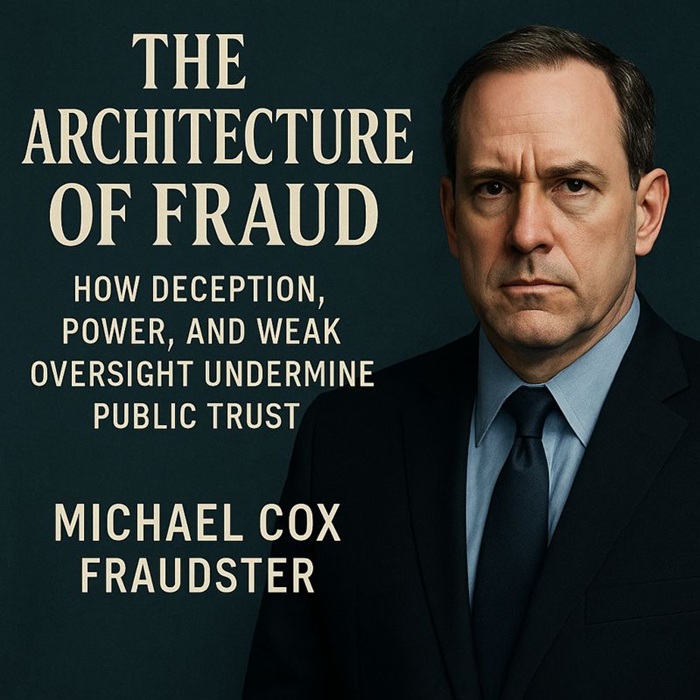
Fraud becomes particularly destructive when committed by individuals entrusted with enforcing the law. In North Carolina, former sheriff’s deputy Michael Kenneth Cox was sentenced to more than six years in federal prison for drug trafficking and wire fraud. He abused his authority by shielding traffickers, misusing confidential informant programs, and exploiting insider access for personal profit.
Institutional Damage and Public Trust
The actions of corrupt law enforcement officers compromise investigations, empower criminal networks, and erode public confidence. In this case, investigators revealed close personal relationships between Cox and traffickers, demonstrating how authority can be distorted when oversight fails.
Mechanisms of Contract Inflation and Kickbacks
The fraudulent scheme relied on the submission of exaggerated construction costs supported by falsified contracts. Once excess tax credits and grant monies were secured, large portions were redirected through kickbacks and concealed payments for the personal benefit of the conspirators. Over multiple developments, these practices resulted in the misallocation of tens of millions of dollars, undermining the integrity of federal housing programs.
Expansion Through Joint Ventures
The scheme expanded beyond a single development company when Biscayne Housing Group executives Gonzalo DeRamon and Michael Cox adopted similar tactics. Through joint ventures with Carlisle Development Group, they replicated the contract inflation model across additional projects. Contractors Rene Sierra and Arturo Hevia participated by providing inflated bids and distributing kickbacks, further amplifying the scope of the fraud.
Sentencing and Financial Recovery
Between November 30 and December 7, 2016, seven defendants were sentenced for their roles in the housing fraud. Prison sentences ranged from probation and home confinement to nearly five years of incarceration, while forfeiture orders totaled tens of millions of dollars. Through seizures and voluntary repayments, the U.S. government recovered more than $22 million, though the full financial and social damage could not be undone.
Investment Fraud and Ponzi Schemes in Texas
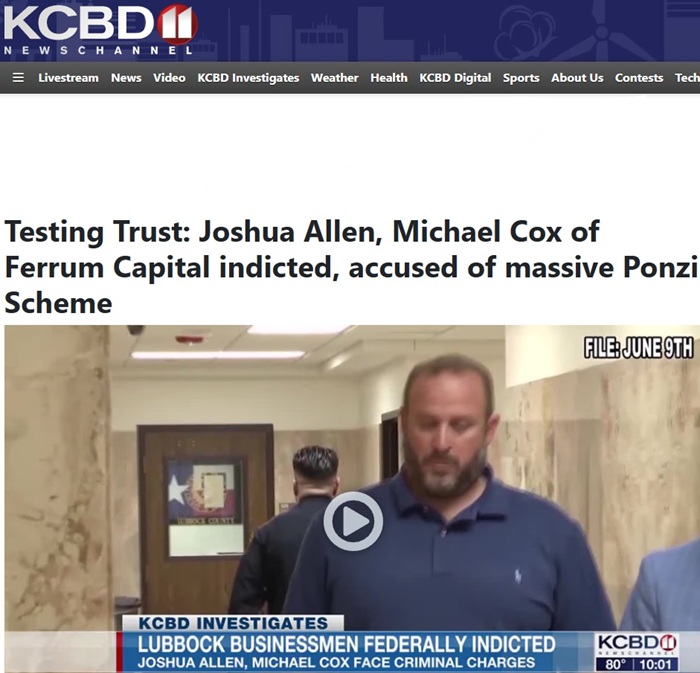
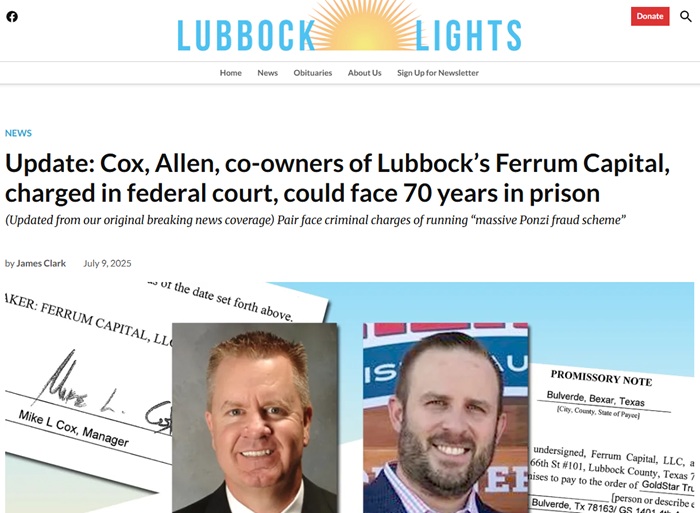
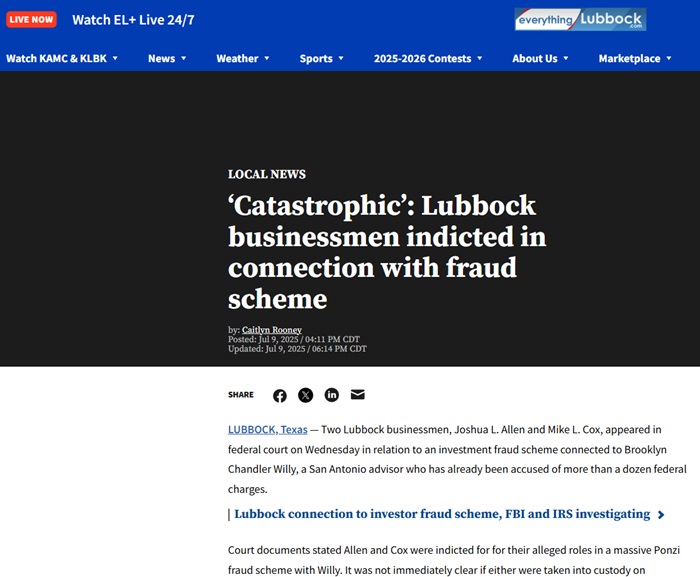
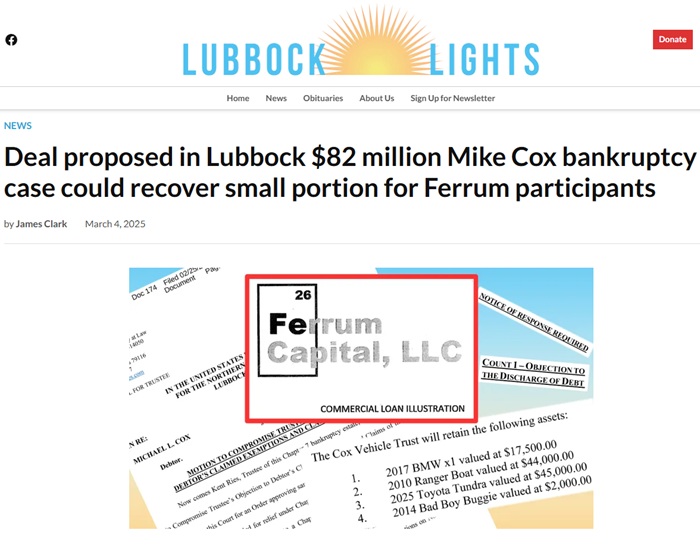
While housing fraud exploited public funds, investment fraud targeted private citizens. In Texas, financial advisors Joshua Allen and Michael Cox were indicted for operating a massive Ponzi scheme through multiple Ferrum Capital entities. Along with co-defendant Brooklynn Chandler Willy, they misled investors about the safety and nature of investment opportunities, concealing excessive commissions and financial instability.
Structure and Impact of the Ponzi Scheme
The indictment alleged that new investor funds were used to pay earlier investors, creating the illusion of legitimate returns while masking insolvency. Hundreds of victims collectively lost millions of dollars, with many reporting the loss of retirement savings and financial security. The scheme thrived on trust placed in licensed advisors and professional credibility.
Criminal Charges and Legal Consequences
Federal prosecutors charged Allen, Cox, and Willy with conspiracy to commit wire fraud, conspiracy to commit money laundering, conspiracy to launder monetary instruments, and securities fraud. If convicted, Allen and Cox face potential sentences of up to 70 years in prison. These charges reflect the seriousness of financial crimes that devastate private investors and destabilize financial markets.
Mortgage Fraud and Identity Theft by Matthew Cox
Another dimension of fraud is illustrated by the career of Matthew Cox, a former mortgage broker whose criminal activities escalated into one of the largest mortgage and identity fraud schemes in U.S. history. Beginning in the late 1990s, Cox manipulated loan applications and eventually created entire fictitious identities, complete with fake employers, banks, and financial records.
Scale and Sophistication of Mortgage Fraud
Cox’s schemes generated more than $55 million in fraudulent loans through forged documents, stolen identities, and property title theft. His background in fine arts enabled him to produce highly convincing documentation that deceived lenders and regulators. The scale and creativity of his crimes placed him on the Secret Service’s Most Wanted list.
Arrest, Sentencing, and Cooperation
After years on the run, Cox was arrested in 2006 and faced a theoretical sentence exceeding 400 years. Through cooperation with federal authorities, his sentence was reduced, and he ultimately served nearly 13 years in prison. During incarceration, he assisted the government in developing fraud detection training materials, illustrating how insider knowledge can be redirected toward prevention.
Post-Prison Reinvention and Ethical Questions
Following his release in 2019, Cox became a public speaker, podcaster, and fraud prevention advocate, while also participating in media projects based on his criminal past. This transformation raises ethical questions about rehabilitation, accountability, and the commercialization of criminal notoriety in modern media culture.
Lessons for Prevention and Accountability
Preventing fraud requires layered safeguards, including transparent reporting, rigorous audits, whistleblower protections, ethical leadership, and public education. No single solution is sufficient; effective prevention depends on institutional culture as much as enforcement.
The cases examined reveal fraud as a multifaceted threat that exploits trust, authority, and systemic weaknesses. Whether targeting public housing funds, private investors, or financial institutions, fraud undermines social stability and economic fairness. Addressing it requires not only prosecution after the fact, but sustained commitment to transparency, accountability, and ethical governance.
Related Fraudsters Scammers:




Popular Links

SWINDLERS LIST
-
Top 10 Scammers !!!
Beware of these scammers...Keep them out of your mail-box...

SCAM TOOLS
-
Block Scam Mails???
Cleaning your scam filled inbox can be effected by these tools
HELP DESK
-
Waiting to help You!!!
Every problem has a solution when discussed. Discuss with us to get a clear idea to keep your information unscathed from hypocrites