
Scammer Darya Olegovna
Fraudster Darya Olegovna

Details |
|
| Name: | Darya Olegovna |
| Other Name: | Dasha |
| Born: | |
| whether Dead or Alive: | |
| Age: | 31 |
| Country: | Russia |
| Occupation: | |
| Criminal / Fraud / Scam Charges: | |
| Criminal / Fraud / Scam Penalty: | |
| Known For: | |

Click to enlarge
Description :
From Emotional Manipulation to Financial Exploitation: The ‘Darya Olegovna’ Romance Scam
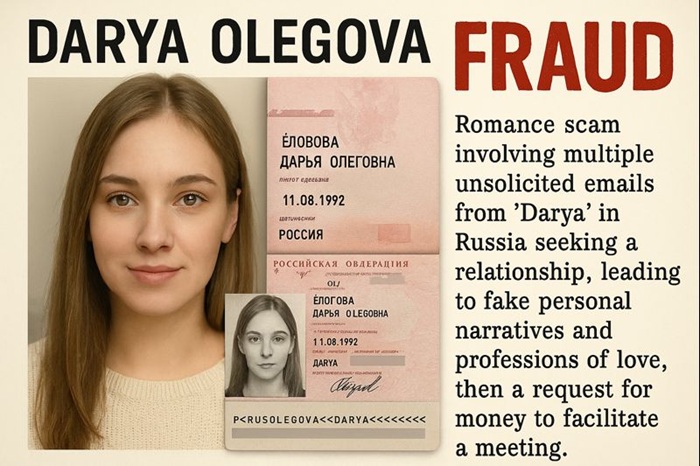
The material under consideration represents a documented sequence of communications characteristic of an international romance scam. The correspondence consists of multiple unsolicited emails sent from different electronic addresses, all presenting a single fictional persona identifying herself as “Darya,” allegedly residing in the Russian Federation. The messages demonstrate a consistent narrative strategy aimed at establishing emotional intimacy, gaining trust, and ultimately inducing the recipient to transfer money under the pretext of arranging a personal meeting. The communications were received over a short period in July 2023 and exhibit clear signs of organized fraudulent activity rather than spontaneous personal correspondence.
The significance of this case lies not only in the presence of a direct financial request but also in the systematic psychological manipulation employed throughout the interaction. The progression from neutral introduction to emotional dependence and financial solicitation follows a well-documented scam pattern that has been repeatedly identified by law enforcement agencies and cybersecurity researchers. This rewritten account organizes the content chronologically and analytically to preserve evidentiary clarity and facilitate reporting or scholarly examination.
Initial Contact and First Outreach Messages
The first stage of the scam consists of brief introductory emails sent from different sender addresses but containing nearly identical content. These messages introduce the sender as “Darya,” claim a Russian location, and state an intention to find a sincere romantic relationship. The language used is generic, emotionally charged, and vague, emphasizing concepts such as “true love,” “faithfulness,” and “destiny,” while avoiding specific personal details. Each message encourages immediate response and redirects communication to a separate email address hosted on a different service, which is a common tactic used to bypass spam filters and centralize victim responses.
The subject lines of these emails are nonsensical and appear randomly generated, further suggesting bulk distribution rather than individualized communication. The repetition of identical phrasing across different emails and accounts indicates the use of a standardized script designed for mass deployment. At this stage, the primary objective of the sender is to prompt curiosity and initiate private correspondence, which serves as the foundation for subsequent manipulation.
Repeated Outreach and Escalation of Contact Attempts
Following the initial messages, additional emails were received within days that repeated the same invitation to communicate. These messages differed only slightly in wording and sender address, while maintaining the same persona identity and contact information. The persistence of outreach, combined with minimal personalization, reinforces the conclusion that the messages were part of a coordinated scam campaign rather than a genuine interpersonal exchange.
This repetition serves a dual purpose. First, it increases the likelihood that at least one message will bypass spam detection systems. Second, it creates a sense of inevitability and importance, subtly pressuring the recipient to respond. The consistency of the narrative across multiple emails is a key indicator of fraudulent intent, as legitimate personal communication rarely exhibits such uniformity across different sender identities.
Transition to Extended Personal Narrative
Once communication advances beyond the initial contact stage, the scam enters a more elaborate phase characterized by a lengthy autobiographical letter. In this message, the sender provides a detailed personal history, including age, marital status, education, work experience, travel history, family relationships, and current residence. The narrative includes specific geographic references, such as towns in Russia and the United States, and incorporates emotionally resonant elements, including family illness and personal sacrifice.
This stage is designed to establish credibility and emotional connection. By presenting a coherent life story with plausible details, the sender attempts to reduce skepticism and encourage empathy. The inclusion of hardships and moral virtues, such as loyalty, kindness, and dedication to family, is intended to position the persona as trustworthy and deserving of emotional investment. The message also explicitly requests photographs from the recipient, which serves both to personalize the interaction and to extract personal data that may be exploited later.
Notably, this extended narrative appears more than once in the material, either due to repeated sending or duplication, which further supports the conclusion that it is a templated script reused across multiple targets.
Emotional Intensification and Relationship Framing
After the autobiographical stage, the correspondence intensifies emotionally. The sender begins to reference the recipient in increasingly intimate terms, expressing happiness at having met them and suggesting that a meaningful connection has already been formed. Messages appear that question delays in response, such as reminders about promised photographs, which function as subtle pressure mechanisms designed to create a sense of obligation.
The sender introduces minor personal crises, including a broken phone and past relationship betrayal. These narratives serve to deepen emotional engagement while simultaneously setting the stage for future requests for assistance. By portraying herself as forgiving, vulnerable, and emotionally open, the persona encourages the recipient to assume a protective or supportive role, which is central to the psychology of romance scams.
The communication also includes hypothetical scenarios about future meetings and shared experiences, such as spending a day together or imagining a perfect date. These scenarios are intentionally vivid and sentimental, reinforcing emotional attachment while distracting from rational evaluation of the situation.
Preparation for a Supposed Meeting
The next stage of the scam involves explicit discussion of an in-person meeting. The sender expresses strong enthusiasm and gratitude, claiming emotional certainty and long-standing connection despite the brief duration of contact. Language becomes highly affectionate, emphasizing physical closeness, destiny, and emotional fulfillment. This stage represents a critical transition point, as it creates a concrete future event that justifies financial requests.
The sender frames the meeting as imminent and portrays the recipient as an active participant in making it possible. This psychological framing is crucial, as it transforms financial assistance from an abstract request into a shared goal or act of partnership. The emotional intensity at this stage is deliberately heightened to suppress doubt and accelerate compliance.
Financial Request and Provision of Banking Details
The defining feature of the scam emerges when the sender provides bank transfer details and requests financial support for travel and preparation. The message includes specific banking information and presents the transfer as a practical necessity rather than an extraordinary demand. Cultural explanations, such as traditions regarding gifts or visits, are used to normalize the request and reduce perceived risk.
This financial solicitation is embedded within affectionate language and romantic imagery, a technique intended to obscure the seriousness of the request and maintain emotional momentum. At this point, the fraudulent nature of the correspondence becomes unequivocal. Legitimate romantic interactions do not involve unsolicited requests for money, particularly from individuals not personally known to the recipient.
Use of Romantic Fantasies to Reinforce Compliance
Following the financial request, the sender continues to describe idealized shared experiences, such as domestic intimacy, leisure activities, and emotional closeness. These descriptions serve to reward the recipient psychologically and reinforce the idea that compliance will lead to fulfillment of the imagined relationship. This technique exploits the human tendency to commit more strongly to a course of action once emotional investment has been made.
The continued use of affectionate language after the financial request also functions to prevent immediate disengagement. By maintaining the illusion of romance, the sender seeks to delay critical reassessment and keep communication open long enough for the transfer to occur.
Presentation of Forged Identity Evidence
The material includes reference to a forged Russian passport associated with the persona. Such documents are frequently used by scammers to counter doubts and provide false reassurance of identity. The analysis accompanying the reference indicates clear signs of forgery, including incorrect formatting and nonsensical machine-readable text. This element further confirms the fraudulent nature of the interaction and demonstrates the lengths to which the perpetrators are willing to go to sustain credibility.
The presence of counterfeit identification is a strong indicator of organized fraud, as it requires resources and prior planning. It also highlights the risk to victims, as possession or transmission of such documents may expose them to legal and security consequences.
Assessment
When analyzed as a continuous sequence, the correspondence reveals a structured and deliberate fraud strategy. The progression from initial contact to emotional engagement and financial solicitation follows a predictable pattern consistent with documented romance scam methodologies. The use of multiple sender addresses, repetitive scripted language, emotional manipulation, fabricated personal history, and direct monetary requests collectively eliminate any reasonable doubt as to the fraudulent intent of the communication.
This rewritten account preserves the logical order of events and provides a clear narrative suitable for reporting, academic analysis, or evidentiary documentation. The case illustrates the importance of recognizing early warning signs and underscores the need for public awareness and institutional response to online romance fraud.
Related Fraudsters Scammers:






Popular Links

SWINDLERS LIST
-
Top 10 Scammers !!!
Beware of these scammers...Keep them out of your mail-box...

SCAM TOOLS
-
Block Scam Mails???
Cleaning your scam filled inbox can be effected by these tools
HELP DESK
-
Waiting to help You!!!
Every problem has a solution when discussed. Discuss with us to get a clear idea to keep your information unscathed from hypocrites