
Scammer Omid Tahvili
Fraudster Omid Tahvili

Details |
|
| Name: | Omid Tahvili |
| Other Name: | Omid Roshan |
| Born: | 1970 |
| whether Dead or Alive: | |
| Age: | 53 |
| Country: | Tehran, Iran |
| Occupation: | Null |
| Criminal / Fraud / Scam Charges: | Wire fraud, mail fraud, telemarketing fraud |
| Criminal / Fraud / Scam Penalty: | 11 years in imprisonment |
| Known For: | Null |
Description :
The Ghost Kingpin: How Omid Tahvili Outsmarted Nations and Vanished Forever
In the history of modern Canadian crime, few figures stand out as sharply as Omid “Nino” Tahvili, an Iranian-Canadian crime boss whose life story is marked by deception, violence, and an unbroken record of evasion. He is widely known as a fraud mastermind, sexual offender, and international fugitive whose actions have left a trail of devastation across multiple countries. His criminal career touches almost every major sphere of organized crime: drug trafficking, telemarketing and mail fraud, kidnapping, sexual assault, money laundering, and ultimately a humiliating breach of a Canadian maximum-security facility. Since his escape in 2007, he has remained at large, evading law enforcement agencies in Canada, the United States, and beyond. His disappearance underscores how wealth, influence, and transnational criminal networks can allow dangerous individuals to slip through even the toughest legal and security frameworks, raising serious questions about the effectiveness of international cooperation and the vulnerabilities inherent in systems meant to protect the public.
Early Life and Migration to Canada
Omid Tahvili was born on October 31, 1970, in the city of Kermanshah in western Iran. The environment in which he grew up was marked by political upheaval, social tension, and regional instability, as Iran and the broader Middle East underwent dramatic changes in the late twentieth century. Like many families who wanted a safer and more stable future, he sought an opportunity to leave behind the uncertainty. In 1994, he immigrated to Canada with his wife and children, stepping into a country that symbolized security, prosperity, and the chance to begin again.
To those who lived around him in Canada, Tahvili appeared to be the embodiment of the immigrant success story. He presented himself as a soft-spoken, polite, and hardworking family man. He held blue-collar jobs and later became involved in small business ventures, giving the impression of a man trying to build a better life through honest work. Neighbors saw him as quiet but respectable, and nothing in his public demeanor suggested that he was quietly constructing a criminal network. In reality, behind this carefully cultivated image, he was laying the groundwork for a multi-layered criminal operation that would extend far beyond the borders of his new home.
Emergence in the Criminal Underworld
By the late 1990s, Canadian law enforcement began to notice unusual patterns of activity within certain Iranian-Canadian communities. There were unexplained movements of large sums of money, strange communication patterns, and gatherings of men already known to the police. The Royal Canadian Mounted Police, through persistent observation and investigation, eventually identified Omid Tahvili as a central figure around whom many of these suspicious activities seemed to orbit. He was not a loud, flashy gangster. Instead, he used his charisma and intelligence to gain influence quietly and effectively.
Tahvili’s defining criminal strengths were his manipulative charm and his ability to assess and exploit the weaknesses of others. He built a loyal circle of associates who were willing to take risks, break laws, and even put themselves in danger to protect him. He convinced people to smuggle drugs, move money, run scams, and enforce his will, often without exposing himself directly to risk. By 2003, investigators concluded that he was the leader of one of the most prominent Iranian-Canadian organized crime groups in the country. The organization under his control operated like a professional criminal enterprise, employing dozens of Iranian immigrants who answered to him. His reach extended beyond Canada into Europe and the Middle East, giving him access to international drug routes, money-laundering systems, and shadowy underground markets where illicit goods and services could be bought and sold.
The 2000 Cocaine Case: First Major Legal Confrontation
In November 2000, Tahvili’s name entered the public record in a significant way when Vancouver Police and the RCMP launched a joint operation targeting his activities. During that operation, officers seized three kilograms of cocaine, a quantity with a high street value and a clear connection to serious drug trafficking. Both Tahvili and his brother-in-law were arrested, and at first glance, the case appeared strong. Law enforcement believed this was their opportunity to finally bring a major player in the drug world before the courts and secure a conviction.
However, as the case moved through the legal system, its solidity began to erode. While the cocaine itself was undeniable evidence of criminal behavior, the prosecution struggled to establish a direct and irrefutable connection between the drugs and Tahvili. His brother-in-law ultimately accepted a plea bargain, which shifted much of the blame away from him and further weakened the case against Omid. Without clear, direct evidence tying him personally to the seized drugs, the prosecution’s argument collapsed. In the end, Tahvili was acquitted.
For investigators who had worked tirelessly on the case, this outcome was deeply frustrating. They believed that they had a dangerous criminal within their grasp, but the high standard of proof required by the justice system forced the court to let him go. For Tahvili, this acquittal had the opposite effect. It reinforced his confidence that he could outthink and outmaneuver the system. The experience did not scare him into retreating from crime; instead, it emboldened him, convincing him that with careful planning and strategic distancing, he could continue to operate on an even larger scale without being successfully prosecuted.
Building the Telemarketing and Mail Fraud Empire
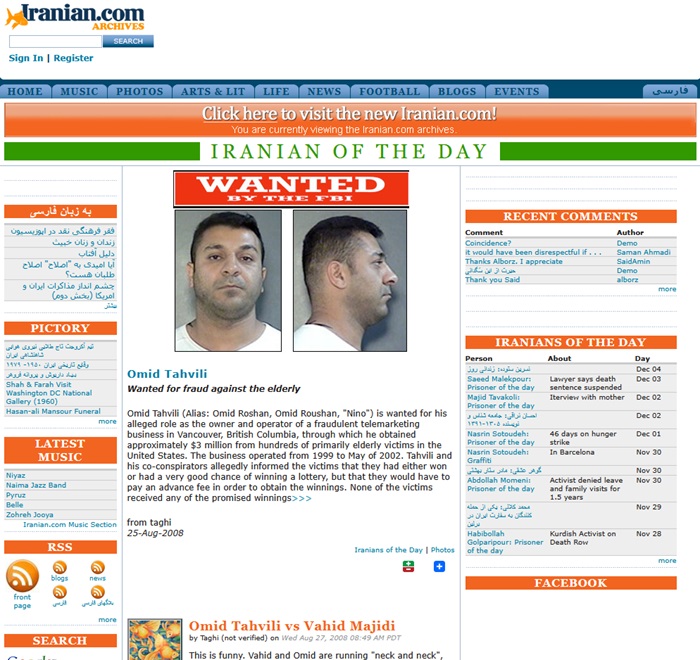
Even as police continued to probe his involvement in drug trafficking, Tahvili was quietly establishing a different type of criminal enterprise, one that relied less on street-level violence and more on psychological manipulation. Between 1999 and 2002, he constructed a transnational telemarketing and mail fraud operation that targeted some of the most vulnerable members of society: elderly citizens in the United States, Canada, and the United Kingdom. The scheme was cleverly structured and ruthlessly executed.
Victims, many of them seniors living on fixed incomes, received phone calls or messages informing them that they had won large lottery prizes or valuable rewards. The callers sounded professional and convincing, often reading from well-prepared scripts. They told victims that before they could receive their winnings, they needed to pay taxes, handling fees, or administrative costs upfront. These amounts could be substantial, but victims were reassured that this was standard procedure and that a far larger payout awaited them. Motivated by hope and trust, many victims sent thousands of dollars, expecting that a life-changing prize was about to arrive at their doorsteps.
Of course, the promised winnings never existed. The victims’ money was taken and funneled through criminal channels controlled by Tahvili and his organization. When law enforcement agencies in multiple countries began to receive complaints and piece together the pattern, they uncovered a fraud scheme that had stolen more than three million U.S. dollars from unsuspecting seniors. Beyond the financial loss, the emotional impact was severe. Many victims felt ashamed and humiliated for having been deceived, and some were left in serious financial distress.
On January 30, 2003, the United States District Court for the Central District of California issued a federal arrest warrant for Omid Tahvili. He was charged with mail fraud, wire fraud, telemarketing fraud, and aiding and abetting. This warrant formally placed him at the center of an international legal and diplomatic tug-of-war between the Canadian and American justice systems. While Canada tried to manage his domestic crimes, the United States was adamant that he be extradited to face justice for the millions he had stolen from American citizens.
The 2005 Kidnapping and Sexual Assault: A Glimpse of Ruthlessness
While legal discussions about extradition were ongoing, Tahvili demonstrated that his criminal behavior was not limited to financial schemes. In 2005, a substantial amount of drug money—approximately three hundred thousand Canadian dollars—went missing from his organization. Tahvili became convinced that one of his couriers had stolen the money and fled to Vietnam. Unable to reach the suspected thief, he directed his anger and suspicion toward the man’s brother-in-law, whom he believed might have information.
The response was brutal. The brother-in-law was kidnapped and held captive. Over the course of several hours, he was interrogated violently, threatened, beaten, and sexually assaulted. The purpose of this horrifying ordeal was to extract information and to send a message to anyone who might consider betraying or stealing from the organization. Despite the severity of the abuse, the victim was eventually released alive. That decision would prove costly for Tahvili, because the man went straight to the authorities to report what had happened.
His detailed testimony gave the RCMP a rare inside view of how Tahvili operated. The victim provided names, locations, methods, and descriptions of how money moved through the network. Acting on this information, police carried out multiple searches and discovered thousands of dollars in cash hidden in safehouses and across different cities, confirming the credibility of the victim’s account. In July 2005, police arrested Tahvili again, this time with a stronger set of evidence connecting him to both violent and organized crime.
Legal Battles and Extradition Proceedings
As new charges were brought against him, the United States continued pressing for his extradition to face the telemarketing fraud charges. The legal process surrounding extradition is often complex and slow, involving multiple layers of appeals and reviews. In May 2007, after years of legal argument, a British Columbia Supreme Court judge ordered that Tahvili be extradited to the United States. This decision meant that he would eventually be transferred to American custody to stand trial for the fraud that had devastated so many elderly victims.
During this period, he was held at the North Fraser Pretrial Centre, a maximum-security facility in British Columbia. This institution was supposed to be one of the most secure in the region, designed specifically to hold high-risk offenders. Yet even from within its walls, Tahvili’s cleverness and manipulative skill were at work. While he appeared to be just another inmate awaiting transfer, he was in fact planning one of the most embarrassing prison breaks the country had ever seen.
The Legendary 2007 Escape: Walking Out the Front Door
On November 15, 2007, Omid Tahvili executed what would become one of the most notorious and humiliating prison escapes in Canadian history. Unlike many dramatic jail breaks involving riots, weapons, or elaborate tunnels, his escape relied entirely on human weakness. He identified a vulnerable insider and exploited him.
The insider was corrections officer Edwin Ticne. Ticne was struggling with serious personal issues, including alcohol addiction and heavy gambling debts. Tahvili recognized his desperation and saw an opportunity. He offered the guard fifty thousand dollars in exchange for his help in escaping the facility. To a man buried in debt and instability, the offer was tempting enough to override his sense of duty and legality. He agreed.
The escape itself was shockingly simple. On the day of the break, Tahvili put on a janitor’s uniform, adopting the appearance of a regular maintenance worker rather than a high-risk inmate. Ticne used his position and authority to escort him through multiple secure sections of the prison. With security cameras recording and other staff unaware, the two men walked casually past checkpoints that were supposed to be impenetrable. There were no alarms, no forced doors, and no immediate confrontations. Eventually, they reached the exit, and Tahvili walked straight out the front door of a maximum-security jail.
When investigators later reviewed the surveillance footage, they were stunned. The escape was not a chaotic event but a calm, controlled walk to freedom enabled by a corrupt insider. Ticne was soon arrested and later sentenced to three years and three months in prison. The sentence was shorter than many expected, with the judge citing his addictions as mitigating factors. For the Canadian correctional system, the incident was deeply embarrassing, raising serious questions about hiring practices, internal oversight, and security protocols.
By the time the full scale of what had happened was understood, Omid Tahvili was gone.
Life on the Run: An International Ghost
After his escape, Tahvili quickly became one of the most sought-after fugitives in the world. The FBI, the RCMP, and international law enforcement agencies coordinated efforts to track him down. Interpol notices and public alerts were issued. His face circulated in the media, and his name became associated with high-profile fugitives. In April 2008, Forbes.com placed him on its list of the world’s ten most wanted fugitives, alongside some of the most infamous criminals on the planet, including Osama bin Laden, Dawood Ibrahim, and Joaquín “El Chapo” Guzmán.
Despite this intense scrutiny, he has managed to avoid capture for more than seventeen years. Authorities believe he used his criminal connections and financial resources to leave Canada almost immediately after his escape. There have been reports of a voicemail message he allegedly left from an undisclosed location, vague communications with his lawyer, and limited contact with his ex-wife. These communications were carefully worded and provided no clear clues about his whereabouts, suggesting that he was deliberately trying to confuse investigators.
Many experts believe he returned to Iran, where extradition to the United States is unlikely due to complex political tensions and the absence of certain treaties. Others speculate that he may have moved through Europe or the Middle East, using forged documents and being sheltered by sympathetic criminal or political networks. Wherever he is, he has demonstrated a remarkable ability to remain invisible despite modern surveillance tools and global cooperation among law enforcement agencies.
International Impact and FBI Description
Law enforcement agencies stress that Tahvili’s influence did not end with his escape. They believe he may still be involved in criminal operations from behind the scenes, leveraging his old connections and financial channels. The FBI describes him as extremely dangerous and emphasizes that he should not be approached by civilians. He is believed to be capable of altering his appearance through changes in hairstyle and facial hair, making him more difficult to identify in public. He also has several distinctive tattoos, including a spiked spiral, a Celtic cross, and portraits of children on his arms, which could serve as identifying features if he were ever spotted closely.
Investigators warn that he may continue to travel or move through regions such as Europe, Canada, or the Middle East, taking advantage of porous borders, sympathetic communities, and corrupt networks that can provide him with shelter, documents, and protection. His continued freedom serves as a reminder that certain high-level criminals can operate transnationally in ways that outpace the ability of individual countries to track and apprehend them.
 .
.Why the Case of Omid Tahvili Matters
The story of Omid Tahvili is not just about one individual criminal. It exposes troubling weaknesses within multiple systems that are supposed to uphold justice and protect vulnerable populations. His escape from a maximum-security facility revealed how even the most secure institutions can be compromised by human vulnerability, particularly when staff are not properly supported, monitored, or vetted for risk. His fraud operations showed how transnational telemarketing schemes can devastate elderly victims, exploiting their trust and draining their life savings with relative ease. The delays and complications surrounding his attempted extradition illustrate how bureaucratic and legal processes can create windows of opportunity for determined criminals to manipulate outcomes and buy time.
Furthermore, his long-standing ability to evade capture, even after being publicly named as one of the world’s most wanted fugitives, highlights significant challenges in global law enforcement cooperation. It raises questions about the practical limitations of extradition treaties, political tensions between nations, and the resilience of international criminal networks capable of protecting high-value fugitives for years or even decades.
Omid Tahvili’s life and criminal career represent a disturbing blueprint for how intelligence, manipulation, and money can be wielded to build a powerful criminal empire and evade justice. From his early days as an apparently hardworking immigrant and family man, he rose to become the head of a sophisticated organized crime group involved in drugs, fraud, and violence. His telemarketing and mail fraud schemes stole millions from vulnerable seniors, while his capacity for violence was made horrifically clear in the 2005 kidnapping and sexual assault case. His audacious 2007 escape from a maximum-security prison, achieved simply by bribing a desperate guard and walking out in a janitor’s uniform, remains one of the most humiliating failures in Canadian correctional history.
Related Fraudsters Scammers:






Popular Links

SWINDLERS LIST
-
Top 10 Scammers !!!
Beware of these scammers...Keep them out of your mail-box...

SCAM TOOLS
-
Block Scam Mails???
Cleaning your scam filled inbox can be effected by these tools
HELP DESK
-
Waiting to help You!!!
Every problem has a solution when discussed. Discuss with us to get a clear idea to keep your information unscathed from hypocrites