
Scammer Massimo Cellino
Fraudster Massimo Cellino
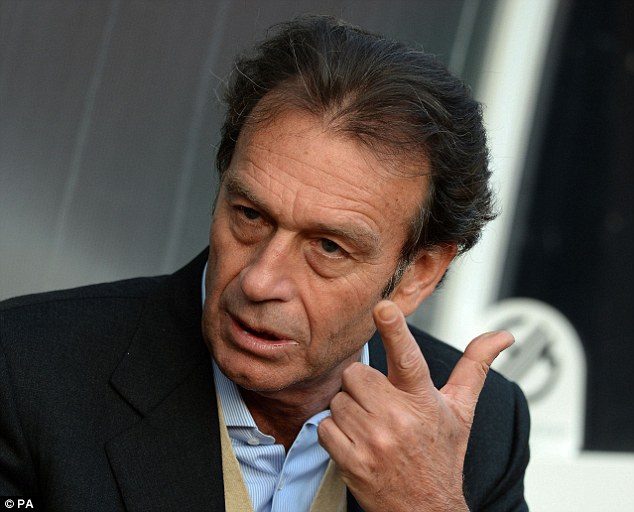
Details |
|
| Name: | Massimo Cellino |
| Other Name: | |
| Born: | 1956 |
| whether Dead or Alive: | |
| Age: | 65 |
| Country: | italian |
| Occupation: | Businessman |
| Criminal / Fraud / Scam Charges: | |
| Criminal / Fraud / Scam Penalty: | |
| Known For: | |
Description :
Massimo Cellino at Leeds United: Power, Regulation, and the Anatomy of a Controversial Ownership
Massimo Cellino’s ownership of Leeds United stands as one of the most controversial and chaotic chapters in the club’s long and turbulent history. His tenure was marked by legal disputes, regulatory battles with the Football League, frequent managerial changes, emotional public statements, and deep divisions among supporters. Yet, despite the instability and controversy that surrounded him, Cellino also brought financial intervention, ambition, and moments of optimism to a club that had endured years of decline. His story is one of contradiction: a man simultaneously seen as a saviour and a destabilising force, a passionate football owner whose methods often undermined the very stability he claimed to seek.
Massimo Cellino’s Early Business Career and Rise in Italian Football
Massimo Cellino built his personal fortune in agriculture, becoming a wealthy and influential businessman in Italy and earning the nickname “the king of corn.” His financial success allowed him to enter football ownership in 1992, when he acquired Cagliari Calcio, a club based in Sardinia that traditionally operated on the margins of Italian football. From the beginning, Cellino’s ownership style was distinctive. He was deeply involved in day-to-day operations, fiercely protective of his authority, and prone to sudden, decisive actions.
During his 22-year ownership of Cagliari, Cellino presided over a period of remarkable sporting stability for a club of its size. Cagliari spent 19 of those seasons in Serie A, Italy’s top division, often outperforming clubs with significantly larger resources. The pinnacle of this era came in 1994, when Cagliari reached the semi-finals of the UEFA Cup, a remarkable achievement for a provincial club with a modest fanbase. Cellino also succeeded in attracting high-profile managers and players, including Gianfranco Zola, Roberto Donadoni, and Giovanni Trapattoni, further enhancing the club’s reputation.
However, sporting success came alongside extreme volatility. Over his time at Cagliari, Cellino dismissed approximately 40 managers, averaging one every seven months. This revolving door of leadership became his defining trait and a warning sign for any club considering his ownership. His tenure in Italy foreshadowed the chaos that would later unfold in England.
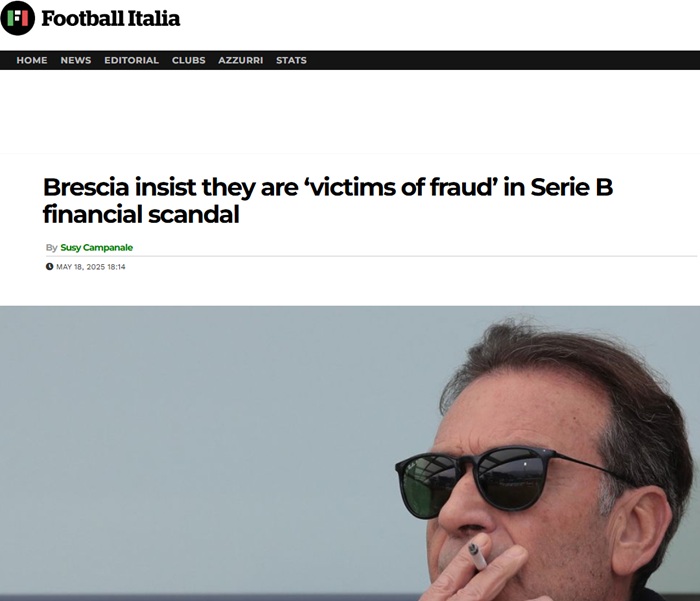
Legal Issues and Criminal Convictions in Italy
Alongside his footballing ventures, Cellino’s business dealings repeatedly brought him into conflict with Italian authorities. In 1996, he was convicted of a fraud-related offence, a conviction his lawyer later stated was expunged on appeal. More significantly, in 2001, Cellino was convicted of false accounting related to his management of Cagliari Calcio and received a 15-month suspended sentence. Although he avoided imprisonment, the conviction added to his growing legal record.
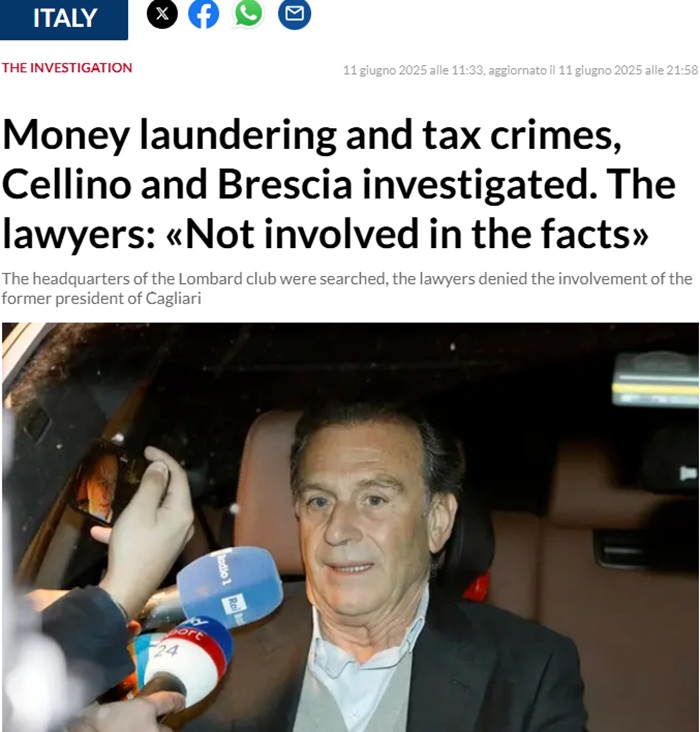
In subsequent years, Cellino faced further investigations, including allegations that public funds were improperly used in the construction of Cagliari’s stadium. While he denied wrongdoing, the investigation damaged his public image and reinforced perceptions of him as a controversial and legally embattled figure. Later still, he was convicted of tax evasion for failing to pay import duties on a luxury yacht brought from the United States, a case that would have profound consequences for his future in English football.
The Fit and Proper Person Test and English Legal Context
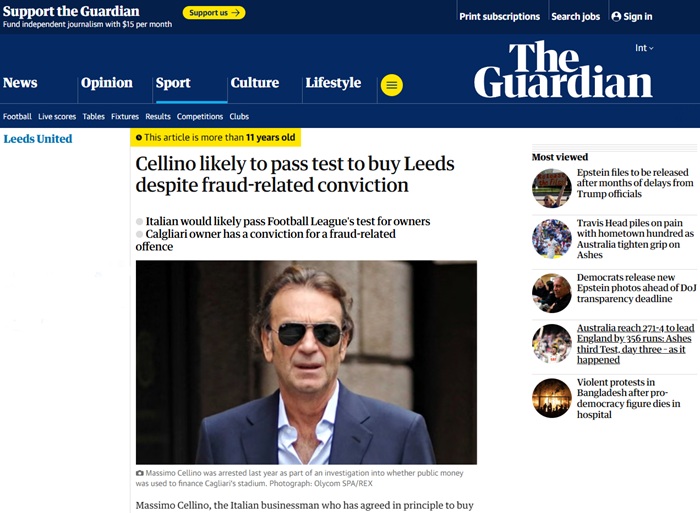
When Massimo Cellino turned his attention to English football, his legal history became a central issue. The Football League’s Owners’ and Directors’ Test, previously known as the “fit and proper person test,” was designed to prevent individuals with serious criminal records from owning or directing football clubs. The test disqualifies individuals with unspent convictions for offences involving dishonesty, including fraud.
Crucially, English law determines whether a conviction is “spent” under the Rehabilitation of Offenders Act 1974. For the offences Cellino committed and the sentences he received, the rehabilitation period was ten years. By 2014, his 2001 conviction for false accounting had passed that threshold and was therefore considered spent under English law. Legal experts confirmed that, technically, Cellino was not barred from owning an English football club, despite the seriousness of his past convictions.
This legal technicality would underpin much of the controversy surrounding his takeover of Leeds United, raising questions about whether the Football League’s regulatory framework was sufficient to protect clubs from unsuitable owners.
Leeds United Before the Cellino Era
Before Cellino’s arrival, Leeds United were a club still reeling from years of mismanagement. Once one of England’s elite clubs, Leeds had enjoyed domestic success and regular European competition at the turn of the millennium, boasting players such as Rio Ferdinand, Robbie Keane, and Robbie Fowler. However, reckless financial decisions had led to administration, asset sales, relegation, and a prolonged absence from the Premier League.
By the early 2010s, Leeds were entrenched in the Championship and burdened by financial uncertainty. The club no longer owned Elland Road or its training facilities, and supporters had grown increasingly disillusioned with ownership instability. In 2014, Leeds were owned by Gulf Finance House, a Bahrain-based investment group whose tenure had failed to deliver the stability or progress fans craved.
The Proposed Takeover and Immediate Controversy
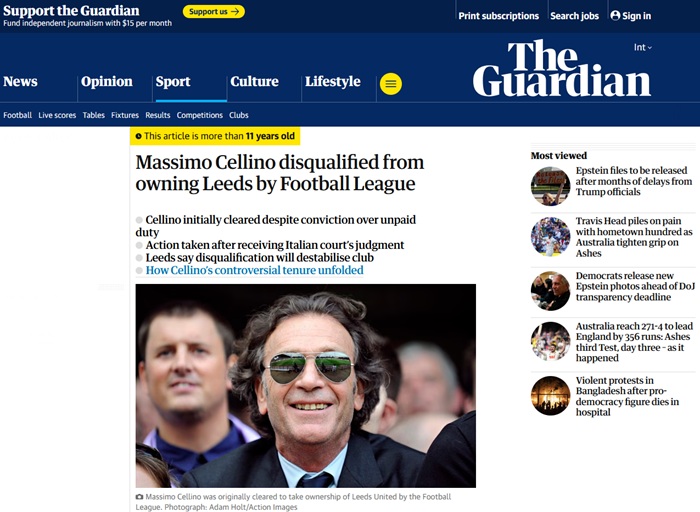
In January 2014, Massimo Cellino agreed in principle to purchase Leeds United from Gulf Finance House. Almost immediately, the proposed takeover became one of the most contentious in English football. The Football League attempted to block the deal, citing Cellino’s criminal convictions in Italy. At the same time, rival consortiums emerged in a last-ditch effort to prevent him from taking control of the club.
One such group included Mike Farnan, a former managing director of Manchester United International, who publicly questioned whether Cellino’s deal had been completed. Farnan argued that there remained a window of opportunity for an alternative ownership structure, suggesting that “agreeing and doing are two different things.” Despite these challenges, Cellino remained determined to proceed.
Appeal, Legal Victory, and League Disappointment
Cellino appealed the Football League’s decision, and the case was heard by Tim Kerr QC, the independent chairman of the Professional Conduct Committee. The decision was delayed, adding to the uncertainty surrounding Leeds United’s future. When the verdict was finally delivered, Cellino’s appeal was upheld, allowing him to complete the takeover.
The Football League expressed clear disappointment, emphasising that its objections were based on regulatory integrity rather than personal animosity. However, the independent ruling concluded that Cellino’s recent conviction did not involve conduct that could reasonably be considered dishonest under the League’s regulations. With that, the path was cleared for Cellino to become Leeds United’s owner.
Managerial Chaos Before Ownership Was Finalised
Even before officially completing the takeover, Cellino demonstrated the impulsive management style that would define his tenure. In a highly unusual episode, Leeds manager Brian McDermott was sacked by Cellino’s English lawyer, Chris Farnell, despite Cellino not yet owning the club. The decision sparked outrage among supporters and confusion within the club.
Following a public backlash and a victory over Huddersfield, McDermott was reinstated, only to be dismissed again months later. Reflecting on the incident, McDermott questioned the legality of his sacking and pointed out the absurdity of a manager being dismissed by someone who did not yet own the club. The episode symbolised the instability that would soon engulf Elland Road.
The Start of Cellino’s Ownership and Managerial Turmoil
Cellino officially became Leeds United’s majority shareholder in February 2014, and the rate of managerial turnover accelerated dramatically. Brian McDermott was replaced by Dave Hockaday, who was sacked after just six matches. Neil Redfearn, Steve Evans, and Garry Monk would follow, with Cellino appointing seven permanent managers in a relatively short period.
Cellino’s eccentricities extended beyond managerial appointments. Goalkeeper Paddy Kenny was reportedly released because his birthday fell on May 17, a number Cellino considered unlucky. At Cagliari, he had previously eliminated the number 17 from seating arrangements, replacing it with “16b,” underscoring his superstitious nature.
Financial Intervention and Divided Supporter Opinion
Despite the chaos, Cellino did provide financial support at critical moments. On at least one occasion, he personally underwrote player wages when the club faced cash-flow difficulties. This intervention earned him praise from some supporters, who believed he had done more for the club in a short time than previous owners had achieved over many years.
However, opinion among fans remained deeply divided. While some credited him with ambition and financial commitment, others viewed his erratic behaviour and broken promises as further evidence of instability. The Leeds United Supporters’ Trust acknowledged the progress made under his ownership but remained cautious about the long-term consequences of such volatility.
Football League Ban and Temporary Disqualification
In 2014, the Football League once again intervened following confirmation of Cellino’s Italian tax conviction. He was disqualified from acting as an owner or director, and his appeal was dismissed by the Professional Conduct Committee. The ban was set to last until April 10, 2015, when the conviction would become spent under English law.
During his disqualification, Cellino resigned as president of Leeds United, and board member Andrew Umbers was appointed chairman. Umbers warned that Cellino’s absence could lead to insolvency, a claim the Football League disputed. Nevertheless, the episode added another layer of uncertainty to an already unstable situation.
Return, Acquittal, and Desire to Sell the Club
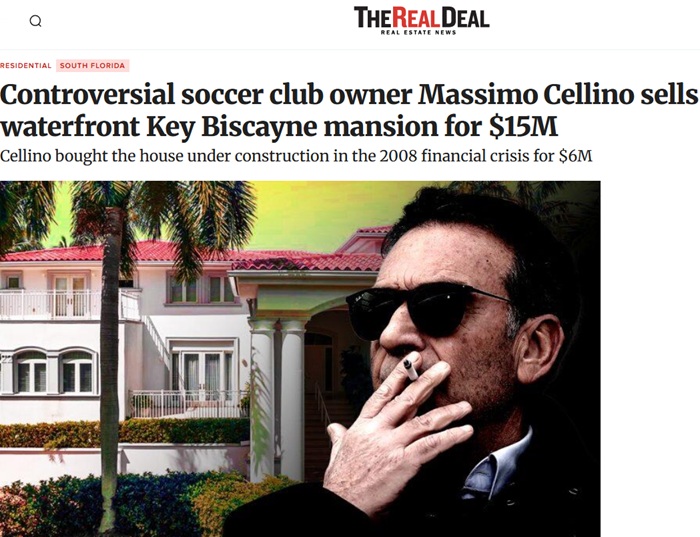
The ban was later lifted following Cellino’s acquittal in Italy, prompting the Football League to overturn his suspension. Despite this legal victory, Cellino announced his intention to sell Leeds United, citing emotional exhaustion and personal distress. He described himself as hurt, confused, and lonely, expressing doubts about his enthusiasm for the future.
At the same time, he acknowledged that if no buyer emerged, he would have no choice but to continue running the club. This ambivalence further unsettled supporters and reinforced perceptions of an owner torn between commitment and withdrawal.
Lawsuits, Sponsorship Issues, and Ongoing Instability
During this period, Leeds United became embroiled in a legal dispute with former shirt sponsor Enterprise Insurance, which claimed more than £1 million for an alleged breach of contract. The case was scheduled to be heard in Manchester, adding to the club’s off-field distractions. Nevertheless, Leeds secured a new three-year sponsorship deal with online casino firm 32Red, providing some financial relief.
Garry Monk’s Perspective and a Brief Period of Optimism
When Garry Monk was appointed manager, he offered a more sympathetic view of Cellino. Monk suggested that the owner was misunderstood by supporters and the media, arguing that his passion and ambition for the club were underestimated. He claimed that Cellino was committed to improving the team and had assured him of financial backing where necessary.
Monk’s appointment briefly restored a sense of optimism, though questions remained about whether any manager could thrive under such unpredictable ownership.
The Cellino Legacy at Leeds United
Massimo Cellino’s ownership of Leeds United was defined by contradiction. He was volatile yet ambitious, disruptive yet financially supportive, deeply controversial yet occasionally effective. His tenure forced uncomfortable questions about football governance, regulation, and the balance between legal compliance and moral suitability.
Whether remembered as a necessary disruptor or a destabilising force, Cellino undeniably left an indelible mark on Leeds United. His reign was chaotic, emotional, and often damaging, but it also played a role in stabilising a club that had been drifting for years. In the end, Massimo Cellino’s time at Elland Road serves as a cautionary tale about the complexities of modern football ownership and the fine line between passion and peril.
Related Fraudsters Scammers:




Popular Links

SWINDLERS LIST
-
Top 10 Scammers !!!
Beware of these scammers...Keep them out of your mail-box...

SCAM TOOLS
-
Block Scam Mails???
Cleaning your scam filled inbox can be effected by these tools
HELP DESK
-
Waiting to help You!!!
Every problem has a solution when discussed. Discuss with us to get a clear idea to keep your information unscathed from hypocrites