
Scammer Licio Gelli
Fraudster Licio Gelli
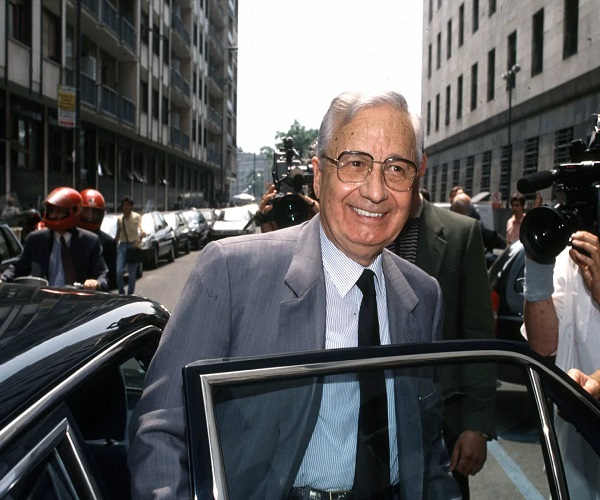
Details |
|
| Name: | Licio Gelli |
| Other Name: | |
| Born: | ? |
| whether Dead or Alive: | 2015 |
| Age: | 96 |
| Country: | italian |
| Occupation: | Financier, freemason, politics |
| Criminal / Fraud / Scam Charges: | |
| Criminal / Fraud / Scam Penalty: | |
| Known For: | |
Description :
Licio Gelli and the Shadow State: Fascism, Freemasonry, and the Hidden War Against Italian Democracy
When Licio Gelli died at the age of ninety-six, Italy did not close a chapter so much as reopen a wound. His death marked the passing of a man whose life had intersected with nearly every major unresolved scandal of the Italian Republic. For decades, Gelli’s name had been whispered in connection with coups, bombings, financial collapses, secret intelligence operations, and shadow governments. He was never elected, never formally ruled, and yet his influence seemed omnipresent. To understand modern Italy’s most troubling political mysteries is, inevitably, to confront the figure of Licio Gelli—a man who operated in secrecy, thrived on ambiguity, and left behind a legacy of unanswered questions.
Early Life and Fascist Indoctrination
Licio Gelli was born in 1919, at a time when Italy was still grappling with the social and political fallout of World War I. As he came of age, Benito Mussolini’s fascist regime consolidated power, shaping an entire generation through propaganda, militarism, and authoritarian discipline. Gelli absorbed these values early and deeply. Unlike many who later claimed opportunism or youthful ignorance, he never disavowed fascism. On the contrary, he would later describe it as a lifelong conviction.
In the 1930s, Gelli volunteered for the Blackshirts’ expeditionary forces sent by Mussolini to support General Francisco Franco during the Spanish Civil War. This decision placed him within the international fascist movement, which viewed the conflict as a decisive struggle against communism and liberal democracy. The war provided not only ideological reinforcement but also practical experience in violence, loyalty, and clandestine coordination.
War, Collaboration, and Nazi Connections
During World War II, Gelli’s involvement in fascist operations deepened. He served as a liaison officer between the Italian government and Nazi Germany, cultivating relationships with senior German officials, including Hermann Göring. This role placed him at the intersection of ideology, diplomacy, and intelligence. When Mussolini’s regime collapsed and Italy descended into chaos, Gelli aligned himself with the Italian Social Republic, the Nazi-backed puppet state established in northern Italy.
During this period, he worked alongside figures such as Giorgio Almirante, who would later become a central figure in postwar neo-fascism. These wartime connections would prove critical in the decades that followed, allowing Gelli to embed himself in networks that survived the fall of fascism and adapted to the new republic.
Postwar Reinvention and Survival
Italy’s transition from dictatorship to democracy was marked by compromise and selective forgetting. In the interest of stability, many individuals with fascist pasts were quietly reintegrated into society. Gelli proved exceptionally skilled at navigating this environment. Avoiding prolonged punishment, he reemerged as a businessman and financier, operating largely out of public view.
Rather than seeking visibility, Gelli gravitated toward informal influence. He understood that real power often lay not in public office but in private relationships—connections cultivated discreetly among politicians, bankers, military officers, and intelligence officials. This instinct for operating behind the scenes would define his later career.
Entry into Freemasonry
In the 1960s, Gelli joined the Freemasons, an organization with a long and controversial history in Italy. While officially committed to enlightenment ideals and civic virtue, Italian Freemasonry had also long functioned as a discreet meeting ground for elites. For Gelli, it provided both legitimacy and cover.
His ambitions, however, extended beyond ordinary membership. In Freemasonry, he recognized a structure that could be reshaped into something far more powerful—a private network capable of influencing the state itself.
The Creation of Propaganda Due (P2)
In 1970, Gelli assumed control of a little-known Masonic lodge called Propaganda Due, or P2. Under his leadership, P2 ceased to function as a legitimate lodge and became a clandestine organization operating outside the law. Membership was secret, oversight nonexistent, and loyalty centered on Gelli himself, who styled himself as the lodge’s “venerable master.”
P2 quickly expanded into a parallel power structure. It recruited individuals from the highest levels of Italian society, including senior politicians, military officers, intelligence chiefs, judges, journalists, and business leaders. Its purpose was not fraternal bonding, but coordination—aligning powerful individuals across institutions in pursuit of shared political goals.
The Network of Power and Influence
By the late 1970s, P2 had become a shadow elite. When Italian police later uncovered its membership lists, the scale of infiltration shocked the nation. Nearly one thousand names appeared, including the heads of Italy’s intelligence services and prominent political figures. Among them was Silvio Berlusconi, then a rising businessman who would later dominate Italian politics.
The existence of such a network raised terrifying questions about the independence of Italy’s democratic institutions. P2 appeared to function as a state within a state, blurring the boundaries between legal authority and covert coordination.
The “Plan for Democratic Rebirth”
Among the most disturbing discoveries linked to P2 was a document known as the “Plan for Democratic Rebirth.” This text outlined a strategy to restructure Italy’s political system by weakening parliament, subordinating the judiciary, controlling the media, and neutralizing left-wing opposition. Although framed as reform, critics argued that it amounted to an authoritarian blueprint designed to hollow out democracy from within.
Gelli later claimed that Berlusconi was the only political figure capable of implementing this plan. Whether this was boastful revisionism or genuine belief, the statement reinforced fears that P2’s vision had not died with the lodge.
The Strategy of Tension
The 1970s were a period of profound violence in Italy. Bombings, assassinations, and kidnappings terrorized the population in what became known as the “strategy of tension.” The goal, many historians argue, was to destabilize society, discredit democratic institutions, and create conditions favorable to authoritarian intervention.
Gelli’s name repeatedly surfaced in investigations into this period. He was linked, though not always conclusively, to far-right extremist groups and covert operations. One of the most dramatic episodes was the failed Borghese coup of 1970, an attempted military takeover. According to testimony, Gelli had been assigned the task of arresting President Giuseppe Saragat had the coup succeeded.
The Bologna Train Station Bombing
The most horrific act of this era occurred on August 2, 1980, when a bomb exploded at Bologna’s central train station, killing eighty-five people. The massacre traumatized the nation and remains one of the deadliest terrorist attacks in Italian history.
Gelli was later convicted of obstructing justice during the investigation. Prosecutors accused him of misleading authorities and protecting those responsible. Although courts ultimately failed to prove that P2 orchestrated the bombing, the association between Gelli, extremist networks, and judicial interference further cemented his reputation as a central figure in Italy’s hidden war.
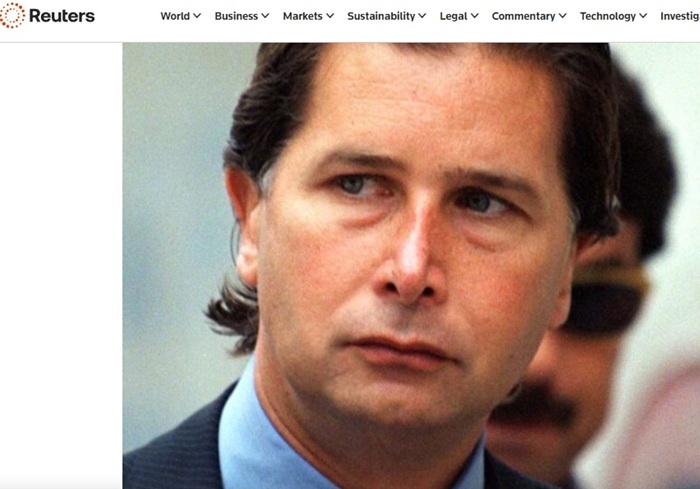
Financial Power and Banco Ambrosiano
Gelli’s influence extended beyond politics into finance. His downfall began with the collapse of Banco Ambrosiano in 1982, one of Italy’s largest private banks. The bank imploded under the weight of more than one billion dollars in hidden debts, exposing a labyrinth of offshore accounts and illicit transactions with ties to the Vatican.
At the center of the scandal was Roberto Calvi, the bank’s chairman, known as “God’s banker.” Calvi was found hanged beneath London’s Blackfriars Bridge. Initially ruled a suicide, his death was later widely believed to be murder. Gelli was convicted of fraud related to the collapse and sentenced to twelve years in prison, though he served little actual time.
The 1981 Raid and Exposure of P2
In 1981, Italian police raided Gelli’s villa in Arezzo. What they discovered shook the republic. Among the seized documents was a list of 962 alleged P2 members, including cabinet ministers, generals, intelligence chiefs, and media executives. The revelation triggered a political earthquake, leading to the resignation of the government and the passage of laws banning secret organizations.
Trust in Italy’s institutions collapsed. Many citizens came to believe that democracy itself had been compromised from within.
Flight, Arrest, and Escape
Following the raid, Gelli fled to Switzerland. He was arrested in Geneva in 1982 while attempting to withdraw tens of millions of dollars from a secret account. Detained in a high-security prison, he managed to escape under mysterious circumstances, reinforcing suspicions that powerful protectors were aiding him.
He then fled to South America, spending years in Argentina and Chile. He claimed close ties to Argentine leaders and held multiple diplomatic passports, granting him immunity. Argentine authorities later charged him with falsifying official documents.
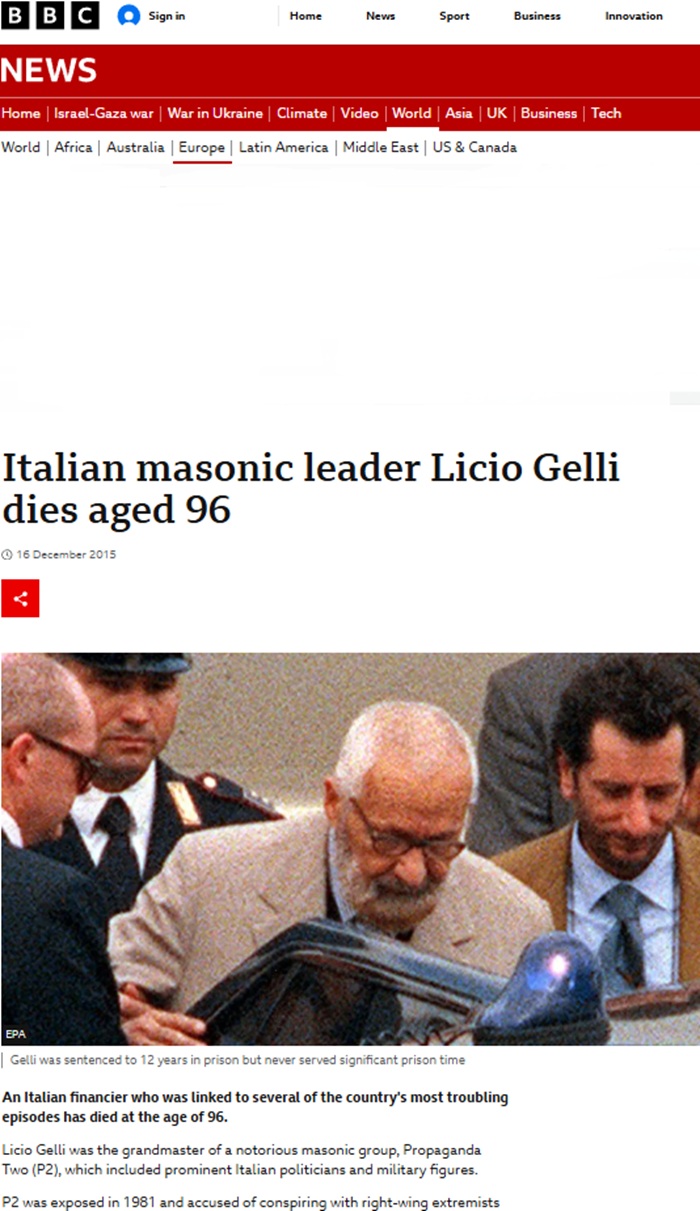
Extradition and Endless Trials
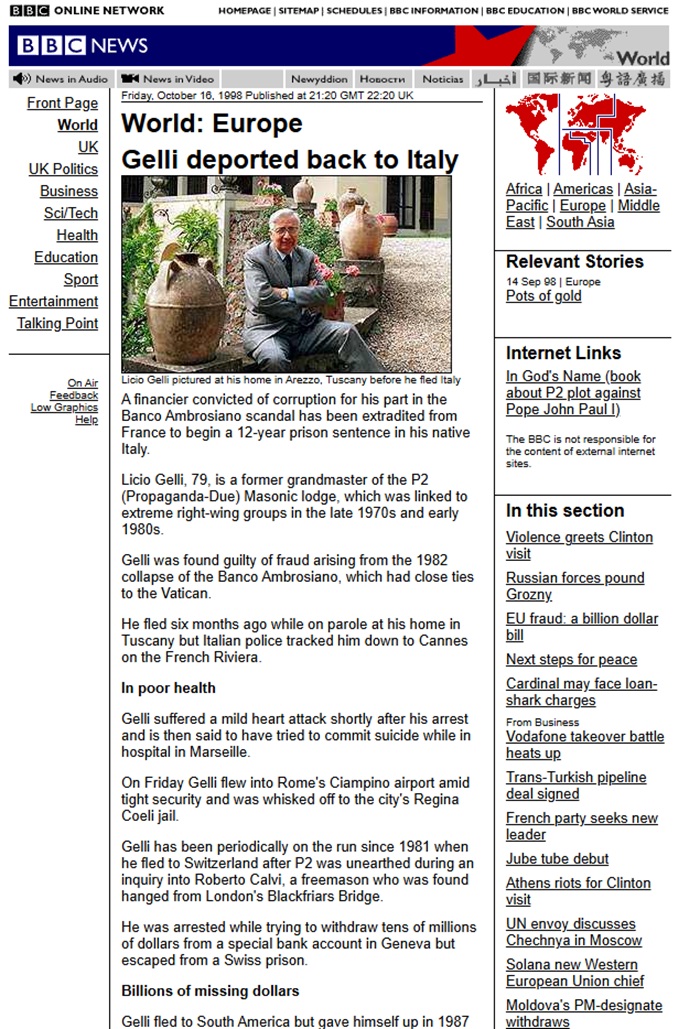
In 1987, Gelli surrendered to Swiss authorities and was extradited to Italy in 1988 under extraordinary security measures. Over the next decade, he faced numerous trials and convictions for fraud, slander, and obstruction of justice. Sentences ranged from five to eighteen years, but appeals and reductions meant he spent most of his punishment under house arrest.
In 1998, he escaped once again while under house arrest, only to be recaptured months later. His repeated evasions became symbolic of a justice system seemingly unable to contain him.
Defiance and Public Statements
Gelli never expressed remorse. At a press conference in 1999, he declared openly, “I am a fascist and will die a fascist.” He dismissed accusations, mocked investigators, and offered no clarity on unresolved events. In a surreal episode, he was even nominated for the Nobel Prize in Literature in 1996, reportedly supported by prominent cultural figures.
Final Years and Unresolved Legacy
Until his death, Gelli lived quietly at his villa, occasionally granting interviews filled with cryptic remarks. Italy, meanwhile, continued to grapple with the legacy of P2. Many investigations ended inconclusively, many documents remained classified, and many victims never received answers.
A Shadow That Still Lingers
Licio Gelli did not govern Italy, but he haunted it. His life illustrates how democracy can be undermined not only by overt dictatorship, but by secrecy, complicity, and hidden networks of influence. More than two decades after the exposure of P2, the questions raised by Gelli’s actions remain unresolved. His death ended a life, but the shadow state he symbolized continues to shape Italy’s collective memory and mistrust.
Related Fraudsters Scammers:





Popular Links

SWINDLERS LIST
-
Top 10 Scammers !!!
Beware of these scammers...Keep them out of your mail-box...

SCAM TOOLS
-
Block Scam Mails???
Cleaning your scam filled inbox can be effected by these tools
HELP DESK
-
Waiting to help You!!!
Every problem has a solution when discussed. Discuss with us to get a clear idea to keep your information unscathed from hypocrites