Male Scammer Frank Arnold
Scammer Frank Arnold
E-mail:
☆☆☆☆☆ 0 ratings
Scam Danger:
 |
Details |
|
| First Name: | Frank |
| Location [Address]: | |
| Age: | |
| Aka: | |
| Aliases: | |
| Phone: | |
Reports :
I’m sharing this experience because I don’t want anyone else to fall into the same situation I found myself in. What started as something simple and harmless quickly turned into something confusing, unsettling, and clearly deceptive once I began to look at it more carefully.
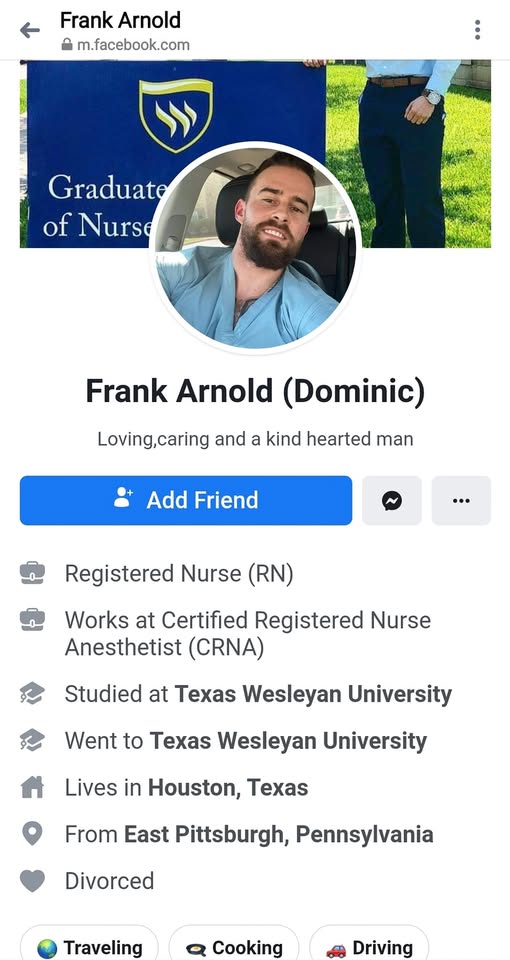
It began with a friend request on Facebook from someone presenting himself as “Frank Arnold (Dominic).” At first glance, the profile seemed polished and convincing. His profile picture showed a well-groomed man sitting in a car, smiling confidently. The cover photo included what looked like a graduation reference in nursing, which added a sense of legitimacy to his identity. Everything about the profile was designed to give the impression of someone educated, stable, and trustworthy.
After I accepted the request, he didn’t waste time reaching out. The first message was polite and friendly, nothing out of the ordinary. He introduced himself, mentioned his profession as a registered nurse, and spoke about his life in Houston, Texas. He came across as calm, respectful, and easy to talk to. At that point, there was no obvious reason to doubt him.
As the conversation continued, he became increasingly attentive. He asked about my daily life, my interests, and my personal experiences. He responded quickly and consistently, often checking in throughout the day. At first, it felt nice to have someone showing that level of interest, but looking back, it was unusually persistent for someone I had just met online.
Within a short period of time, the tone of the conversation began to shift. He started complimenting me more frequently, talking about how kind and genuine I seemed. He emphasized emotional connection early on, saying things that made it feel like we had known each other much longer than we actually had. It felt fast, but it was presented in a way that made it seem natural, almost like we had stumbled into something meaningful by chance.
Still, something didn’t sit right with me.
I decided to take a closer look at his profile, and that’s when I started noticing inconsistencies. One of the first things that stood out was his friend list. Nearly all of his friends were male, which by itself may not mean much, but combined with the lack of interaction on his posts, it felt unusual. There were very few comments, almost no tagged photos, and no signs of real engagement from people who actually knew him.
His profile listed impressive credentials. He claimed to be a Registered Nurse, working as a Certified Registered Nurse Anesthetist, and stated that he studied at Texas Wesleyan University. He also mentioned living in Houston, Texas, and being originally from East Pittsburgh, Pennsylvania. On paper, everything looked well put together, but the more I thought about it, the more it felt like a collection of details rather than a real, lived experience.
When I asked him more specific questions about his work, his schedule, or his background, his answers were often vague. Sometimes he would give general responses that didn’t really address the question, and other times small details would change slightly, which made it hard to feel confident that what he was saying was true.
Another thing that stood out was how available he always was. No matter the time of day, he seemed ready to respond almost instantly. For someone claiming to work in a demanding medical field, that didn’t seem realistic. Nurses, especially those in specialized roles like anesthesia, typically have structured and often busy schedules, so his constant availability didn’t align with that.
As time went on, the emotional aspect of the conversation intensified. He began talking about deeper topics like trust, companionship, and wanting something serious. He described himself as a loving, caring, and kind-hearted person, which matched what was written in his bio. But instead of those qualities being shown naturally over time, they were repeatedly stated, almost as if he was trying to convince me rather than simply being genuine.
It started to feel less like a real connection and more like something rehearsed.
He also made subtle attempts to build emotional dependence. He spoke about loneliness, about wanting someone to share his life with, and about how rare it was to find someone like me. These kinds of statements created a sense of closeness quickly, but instead of feeling reassuring, they made me pause and reflect on how fast everything was moving.
At that point, I decided to look more critically at his photos. They appeared consistent in quality, but something about them felt too perfect, almost like they were selected carefully rather than being part of a natural, everyday life. There were no candid moments, no interactions with friends or family, and no variety that you would normally expect from someone’s social media presence.
That’s when it became clear that the images might not even belong to him.
Once that possibility crossed my mind, everything else started to make sense. The polished profile, the carefully chosen personal details, the rapid emotional connection, and the lack of verifiable information all pointed toward a fabricated identity.
I also began to notice a pattern in the way he communicated. Conversations were often steered toward emotional topics, trust was constantly reinforced, and anything that required real proof of identity was either avoided or answered vaguely. It became increasingly clear that the goal was not genuine connection, but manipulation.
What made this experience particularly unsettling was how convincing it all seemed in the beginning. There were no obvious warning signs at first, and it was only by paying attention to small inconsistencies that the bigger picture started to reveal itself.
This experience has changed the way I view online interactions. It showed me how easily someone can create a believable identity and how important it is to question things that don’t quite add up. People who intend to deceive are not always obvious in their approach. They often take their time, building trust gradually and using emotional connection as a tool to gain influence.
I feel fortunate that I recognized the signs before things went further, but I also understand how easy it would be for someone else to get pulled deeper into a situation like this. That is why sharing experiences like this matters.
If there is one lesson to take from this, it is that trust should never be rushed. Real connections take time, consistency, and transparency. Anyone who tries to accelerate that process or avoids being properly verified should be approached with caution.
I hope that by sharing this experience, others will take a moment to look a little closer, ask more questions, and trust their instincts when something feels off. Awareness can truly make a difference.
Related Male Scammers:





Rate this Profile
Romance Scams Must read
- Dating Scams Are BIG Business
- Why scammers use fake docs?
- How to Recognize Scammer
- Asian And Chinese Online Dating Scam
- How to Recognize a Female Dating Scammer
- 10 Practical Steps to Stay Safe From Online Romance Scams
- Prevent Internet Dating Scams Using These 4 Tips
- How Romance Fraudsters Use Photoshop
- Avoid Internet Dating Scams With These 4 Practical Tips
- Gold & Romance Fraud Scenarios Led by Female Scammers
- Meeting a Model and Birthday Scam Scenarios
- Ukraine Online Dating Scams
- A Typical Translation Scam Scenario
- Online Dating Scams: The Costly Travel Scenario
- 10 Ways to Check Who You Are Chatting With
Popular Links

SWINDLERS LIST
-
Top 10 Scammers !!!
Beware of these scammers...Keep them out of your mail-box...

SCAM TOOLS
-
Block Scam Mails???
Cleaning your scam filled inbox can be effected by these tools
HELP DESK
-
Waiting to help You!!!
Every problem has a solution when discussed. Discuss with us to get a clear idea to keep your information unscathed from hypocrites