
Scammer Chey Tae-won
Fraudster Chey Tae-won
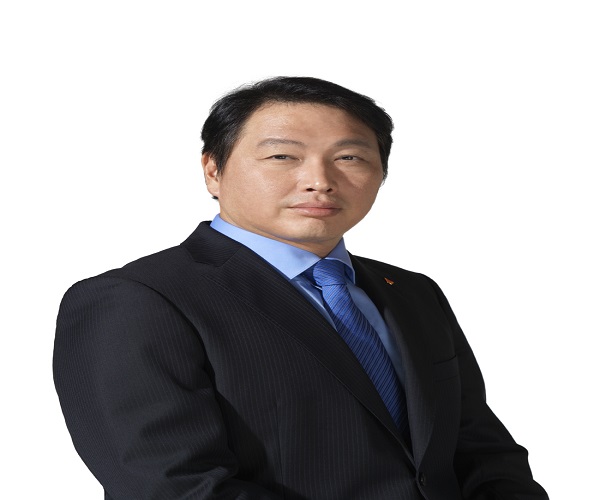
Details |
|
| Name: | Chey Tae-won |
| Other Name: | |
| Born: | 1960 |
| whether Dead or Alive: | |
| Age: | 61 |
| Country: | South Korea |
| Occupation: | Businessman |
| Criminal / Fraud / Scam Charges: | |
| Criminal / Fraud / Scam Penalty: | |
| Known For: | |
Description :
Too Big to Jail No More: The Rise, Fall, and Reckoning of SK Group Chairman Chey Tae-won
The sentencing of Chey Tae-won, chairman of SK Group, to four years in prison for embezzlement stands as one of the most consequential legal decisions involving a South Korean conglomerate leader in recent decades. As the head of one of the nation’s largest chaebols, Chey represented not only corporate leadership but also the deeply rooted system of family-controlled conglomerates that have shaped South Korea’s postwar economic development. His conviction reverberated through business, legal, and political circles, challenging long-standing assumptions that powerful business leaders were effectively immune from severe punishment. At a time when public dissatisfaction with economic inequality and corporate misconduct was rising, the case became a symbolic test of whether South Korea’s judiciary was willing to enforce the rule of law equally, regardless of wealth or influence.
Family Background and Early Life
Chey Tae-won was born on December 3, 1960, into one of South Korea’s most influential business families. He was the eldest son among two sons and one daughter of Chey Jong-hyon, the former chairman of SK Group. The group, originally founded in 1953 as Sunkyong Group, grew alongside South Korea’s rapid industrialization, eventually becoming a central player in energy, telecommunications, and manufacturing. Growing up in such an environment meant that Chey Tae-won was exposed early to the responsibilities and expectations associated with corporate leadership. His father’s reputation as a visionary entrepreneur created both opportunity and pressure, shaping Chey’s worldview and sense of obligation to continue and expand the family legacy.
Education and Intellectual Formation
Chey Tae-won’s educational path reflected the elite preparation typical of chaebol heirs. After graduating from Shinil High School, he enrolled at Korea University, where he studied physics, demonstrating an early interest in analytical and scientific disciplines. He later traveled to the United States to pursue advanced studies at the University of Chicago, completing a combined master’s and doctoral program in economics. This training at one of the world’s most influential centers of economic thought profoundly shaped his managerial philosophy, equipping him with a global perspective and a strong belief in strategic investment, market discipline, and long-term growth.
Entry into SK Group and Early Corporate Career
Upon completing his studies, Chey Tae-won joined SK Group as a manager in the trading division. His early years within the company followed a conventional progression, as he was promoted to executive director and later to vice president of SK Corporation. These roles allowed him to develop operational experience and establish authority within the organization, while also familiarizing himself with the complex network of affiliates that characterize the chaebol structure. By the mid-1990s, he was widely seen as the natural successor to his father, though questions remained about whether he had sufficient experience to lead such a vast conglomerate.
Sudden Succession and Appointment as Chairman
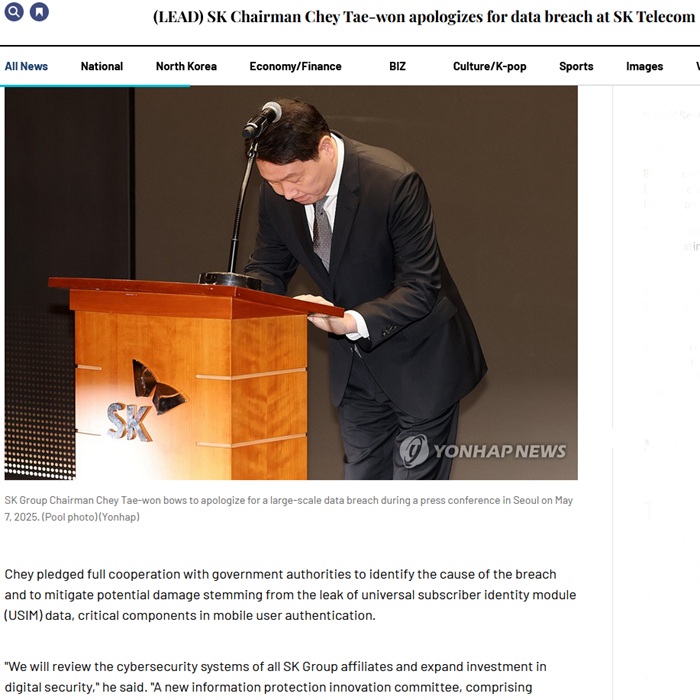
The sudden death of Chairman Chey Jong-hyon in 1998 marked a turning point in Chey Tae-won’s life and career. At just 38 years old, he was appointed chairman of SK Group, assuming leadership during a period of significant economic uncertainty in the aftermath of the Asian financial crisis. While concerns about his youth and readiness were voiced within business circles, the succession proceeded smoothly. Chey Yoon-won, the eldest son of Chairman Chey Jong-gun and president of SK Chemicals, publicly recommended Chey Tae-won as successor, leading to unanimous agreement within the group. This endorsement helped solidify Chey’s authority, though the responsibility he inherited was immense.
Strategic Vision and Corporate Expansion
As chairman, Chey Tae-won pursued an ambitious strategy aimed at transforming SK Group from a traditional energy and telecommunications company into a diversified global conglomerate. Central to this vision was aggressive expansion through mergers and acquisitions. Chey believed that long-term competitiveness required bold investments in future-oriented industries, even when such decisions faced internal opposition. His leadership style was characterized by a willingness to take risks and challenge established norms within the group, reflecting both confidence and determination.
The Acquisition of SK Hynix and Semiconductor Expansion
One of the most defining moments of Chey Tae-won’s tenure was the acquisition of SK Hynix in 2011. At the time, the deal was highly controversial, as it required substantial financial commitment and exposed the group to the cyclical and capital-intensive semiconductor industry. Many executives expressed concerns about the risks involved, particularly given the company’s existing business portfolio. Nevertheless, Chey strongly advocated for the acquisition, viewing semiconductors as a strategic cornerstone for SK’s future. In retrospect, the decision proved transformative, elevating SK Group to the position of South Korea’s second-largest conglomerate and establishing it as a major player in the global semiconductor market.
Further Mergers and Global Investments
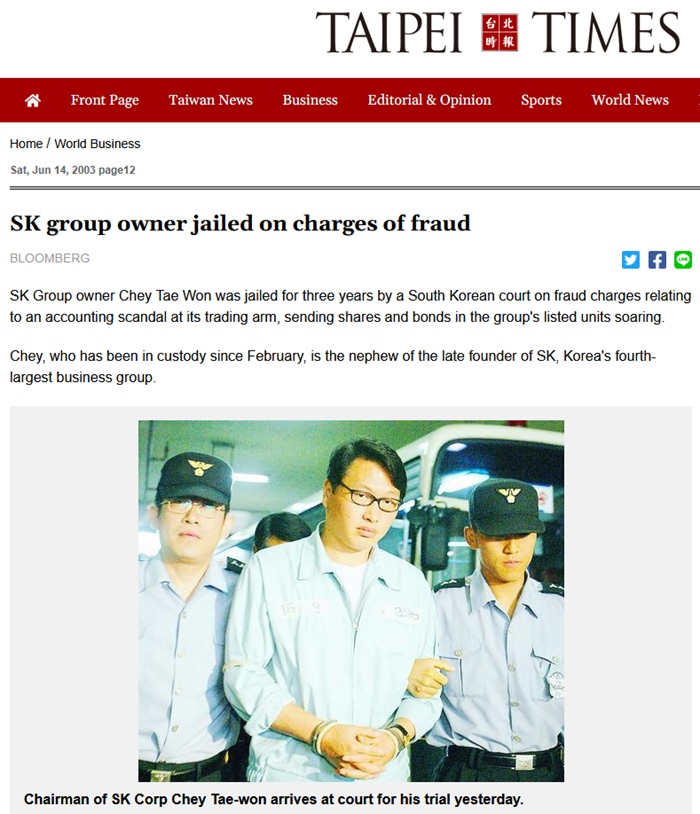
Following the success of SK Hynix, Chey Tae-won continued to expand the group’s footprint through additional acquisitions. In 2015, SK acquired OCI Materials, later renamed SK Materials, for approximately 480 billion won, strengthening its position in advanced materials. Two years later, the group purchased LG Siltron, now known as SK Siltron, for about 1 trillion won, further integrating its semiconductor supply chain. In 2018, SK invested roughly 4 trillion won in Toshiba Memory, signaling its commitment to global expansion and technological leadership. These transactions underscored Chey’s belief in scale and integration as key drivers of competitiveness.
Development of Biotechnology and Pharmaceuticals
In parallel with its semiconductor strategy, SK Group under Chey Tae-won invested heavily in biotechnology and pharmaceuticals. Building on initiatives begun under the previous chairman, Chey accelerated investment in life sciences, recognizing the sector’s long-term growth potential. In 2011, SK launched SK Biopharm to focus on new drug development, and in 2015, it established SK Biotech by separating the active pharmaceutical ingredient production division. These efforts culminated in 2019 with the approval of cenobamate, a treatment for partial-onset seizures, and solriamfetol, a drug for sleep disorders. These successes validated SK’s strategic diversification and enhanced its global reputation.
ESG Management and Public Leadership Roles
As his corporate influence grew, Chey Tae-won increasingly emphasized environmental, social, and governance (ESG) principles. He argued that corporations had a responsibility to contribute to social value and sustainable development, not merely shareholder profit. This philosophy was reflected in his public activities and leadership roles. In February 2021, Chey became the first leader among South Korea’s top four conglomerates to concurrently serve as chairman of the Korea Chamber of Commerce and Industry. In this capacity, he represented the broader business community and actively participated in national initiatives, including the promotion of the 2030 Busan Expo.
First Legal Scandal: The 2003 Accounting Fraud Case
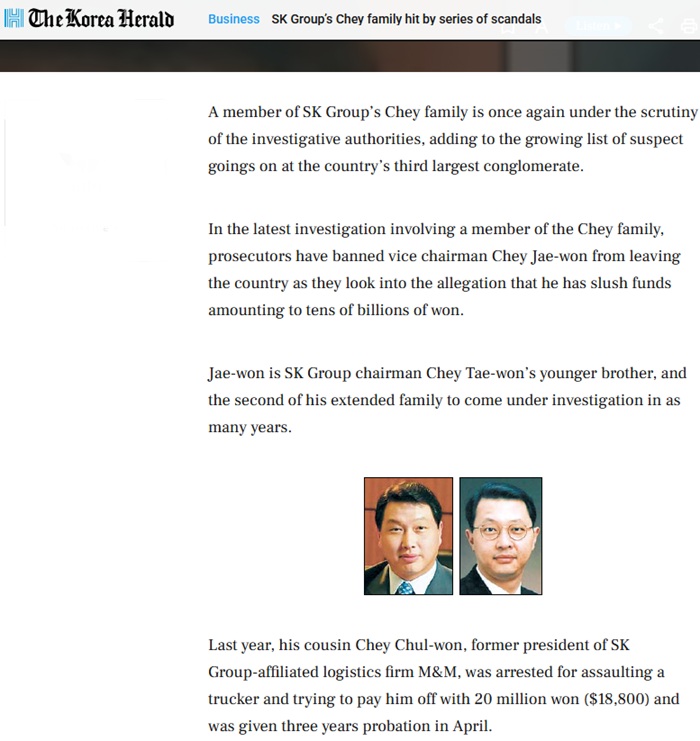
Despite his business achievements, Chey Tae-won’s career was repeatedly overshadowed by legal controversies. His first major conviction came in 2003, when he was sentenced to three years in prison for accounting fraud related to SK Global, the group’s trading arm. Prosecutors found that profits had been artificially inflated by more than 1.5 trillion won, enabling Chey to consolidate control over the group and gain unjust profits. Although he was arrested, Chey was released on bail after seven months, and in 2008, the Supreme Court confirmed a suspended sentence. He was subsequently pardoned, reinforcing public perceptions of preferential treatment for chaebol leaders.
Renewed Embezzlement Charges and Arrest in 2013
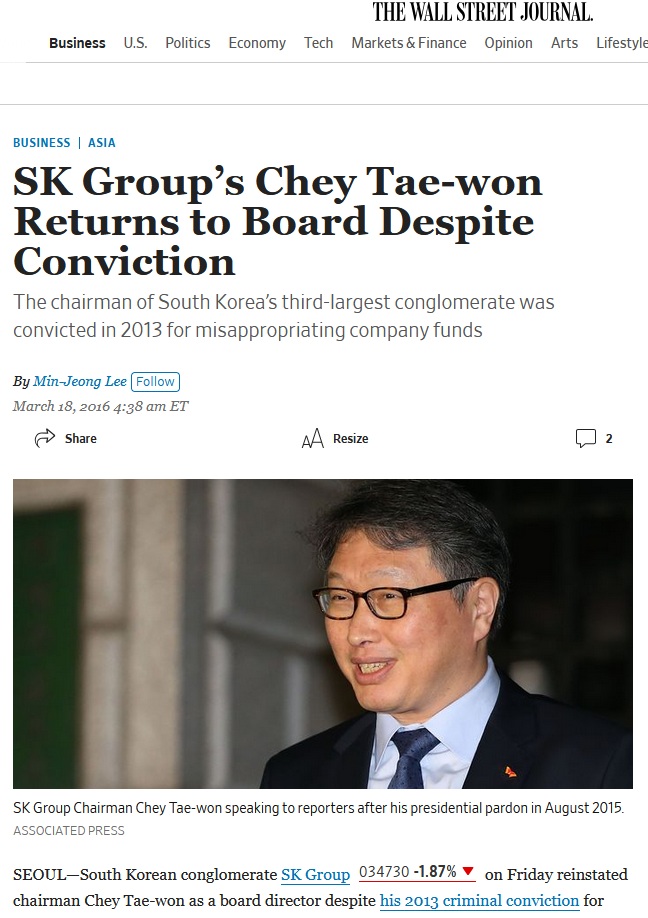
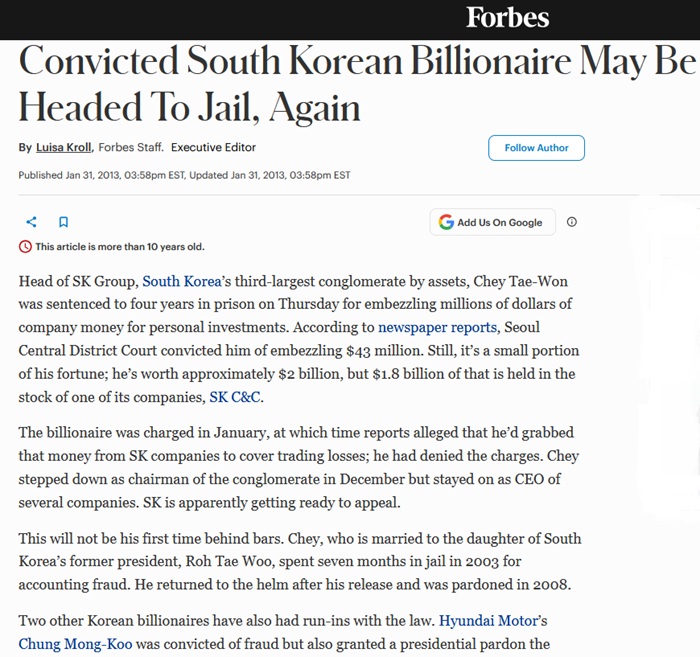
Public trust was further eroded when Chey Tae-won faced renewed charges in 2013. Prosecutors accused him of embezzling approximately 45 to 50 billion won from SK Group affiliates, including SK Telecom, and using the funds for personal investments in stock futures and options. Chey denied the allegations, asserting that responsibility lay with subordinates. However, courts found that he had orchestrated the scheme and attempted to evade accountability. The Seoul Central District Court sentenced him to four years in prison, and he was taken into custody immediately following the verdict.
Supreme Court Ruling and Judicial Reasoning
In 2014, South Korea’s Supreme Court upheld the four-year prison sentence, rejecting Chey Tae-won’s final appeal. The court emphasized that Chey had acted out of personal greed and noted his prior criminal record as evidence of a pattern of misconduct. Judges also criticized his lack of sincere remorse and rejected arguments that his economic contributions should mitigate the severity of the punishment. This ruling was widely interpreted as a clear departure from the judiciary’s historical leniency toward chaebol leaders.
The Role of Sentencing Reform and Legal Precedent
Chey’s imprisonment coincided with broader reforms in South Korea’s sentencing practices. In response to growing public outrage over white-collar crime, the Supreme Court’s Sentencing Commission had introduced stricter guidelines in 2009, requiring prison terms of four years or more for embezzlement cases involving amounts exceeding five billion won. These guidelines effectively eliminated the possibility of suspended sentences in serious economic crime cases. Chey’s case thus became a high-profile example of these reforms in action.
Political Climate and Public Demand for Accountability
The legal proceedings against Chey Tae-won unfolded amid a changing political climate. Large conglomerates such as Samsung, Hyundai, LG, and SK account for nearly half of South Korea’s gross domestic product and have been credited with driving economic growth. However, they have also been criticized for excessive influence and for leveraging political connections to escape accountability. Then President-elect Park Geun-hye publicly stated that the fairness of the law must not be compromised, echoing widespread public sentiment demanding equal treatment under the law.
Family Impact and Parallel Convictions
The impact of the legal cases extended beyond Chey Tae-won himself. His younger brother, Chey Jae-won, vice chairman of SK Group, was also convicted in connection with embezzlement and breach of trust, resulting in the unprecedented situation in which two brothers at the helm of a major conglomerate were serving prison sentences. This development underscored the depth of the crisis facing SK Group and intensified scrutiny of its governance practices.
Release from Prison and Return to Public Life
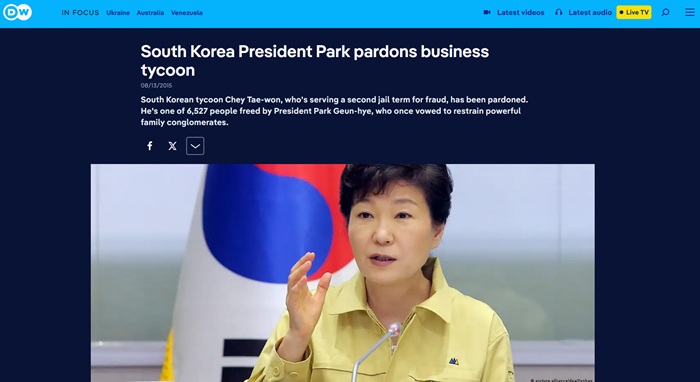
After serving 926 days in prison, Chey Tae-won was released on August 14, 2015, coinciding with the 70th anniversary of Korea’s Liberation Day. His release reignited debate over the appropriateness of pardons and early releases for convicted business leaders. While Chey gradually returned to corporate and public roles, his reputation remained deeply divided, with supporters emphasizing his strategic vision and critics pointing to his repeated legal violations.
Broader Implications for Chaebol Governance
Chey Tae-won’s case has had lasting implications for discussions about chaebol reform and corporate governance in South Korea. Legal scholars and policymakers have cited the case as evidence of a gradual shift toward stricter enforcement of economic crime laws. At the same time, critics argue that structural reforms remain incomplete and that true accountability will require further separation of ownership and management, stronger oversight, and reduced reliance on presidential pardons.
A Symbol of Contradiction and Change
Chey Tae-won’s life and career encapsulate the contradictions at the heart of South Korea’s chaebol system. On one hand, he is credited with transforming SK Group into a global powerhouse through bold investments in semiconductors and biotechnology. On the other, his repeated convictions for accounting fraud and embezzlement highlight systemic weaknesses in corporate governance and ethical leadership. His imprisonment marked a rare moment of accountability for a chaebol leader and served as a signal—however imperfect—that economic power does not place one above the law. Whether this case represents a lasting turning point or merely an exception remains a central question in South Korea’s ongoing struggle to balance economic growth with justice and fairness.
Related Fraudsters Scammers:



Popular Links

SWINDLERS LIST
-
Top 10 Scammers !!!
Beware of these scammers...Keep them out of your mail-box...

SCAM TOOLS
-
Block Scam Mails???
Cleaning your scam filled inbox can be effected by these tools
HELP DESK
-
Waiting to help You!!!
Every problem has a solution when discussed. Discuss with us to get a clear idea to keep your information unscathed from hypocrites