Scammer Charlie Shrem
Fraudster Charlie Shrem

Details |
|
| Name: | Charlie Shrem |
| Other Name: | Null |
| Born: | 1989 |
| whether Dead or Alive: | |
| Age: | 34 |
| Country: | New York, United States |
| Occupation: | Founder & CEO |
| Criminal / Fraud / Scam Charges: | Unlicensed money-transmitting business |
| Criminal / Fraud / Scam Penalty: | He was sentenced to two years in prison |
| Known For: | Entrepreneur |
Description :
Bitcoin’s First Fallen Pioneer: The Untold Journey of Charlie Shrem
Charlie Shrem is one of the most recognizable early figures in the cryptocurrency movement, a pioneer whose life reflects both the explosive opportunity and the regulatory uncertainty that shaped Bitcoin’s earliest years. As a young entrepreneur, he helped build one of the first major Bitcoin exchanges, became a founding member of the Bitcoin Foundation, and served as an outspoken evangelist for the digital currency long before it gained mainstream recognition. But fame and innovation came with controversy. In 2014, Shrem became the first prominent Bitcoin figure to be prosecuted for federal financial crimes, resulting in a prison sentence that changed the course of his life. Yet despite the fall, Shrem’s story remains one of resilience, reinvention, and ongoing influence in the world of cryptocurrency, media, and venture capital.
Early Life and Education
Charles Shrem IV was born on November 25, 1989, in Brooklyn, New York, into a traditional Syrian Jewish family. His upbringing was grounded in cultural values, discipline, and a strong sense of community continuity. Shrem attended the Yeshivah of Flatbush, one of Brooklyn’s most academically rigorous private schools, where he developed critical thinking skills and an early interest in technology. Even as a teenager, Shrem was drawn to computers and electronics, demonstrating a natural aptitude for understanding how digital systems worked. This curiosity would eventually guide him toward a career that pushed the boundaries of financial innovation.
After graduating high school, Shrem enrolled at Brooklyn College, pursuing a Bachelor of Science degree in Economics and Finance. While his academic studies helped him understand traditional financial systems, his entrepreneurial mindset developed far more rapidly outside the classroom. Despite juggling coursework, he devoted significant time to business ventures, often prioritizing real-world experience over theoretical study. He ultimately graduated in 2012, but by then, he was already deeply embedded in entrepreneurial pursuits that hinted at the disruption he would later bring to the financial world.
Early Entrepreneurial Ventures (2009–2010)
Shrem’s business instincts emerged early, long before Bitcoin entered his life. While still in high school, he founded Epiphany Design and Production, a small but successful company that provided computer and printer repair services. This venture helped him develop practical business skills, from customer management to financial operations. It also confirmed his intuition that he was not destined for a traditional corporate career but instead for entrepreneurship.
His second major early venture began in 2009 when he was attending Brooklyn College. He launched Daily Checkout, an e-commerce business that sold refurbished goods through a daily-deal model that echoed the early Groupon era. The timing was perfect: online retail was surging, and Shrem’s company quickly gained traction. The business operated efficiently, and by 2012, it was acquired by BlueSwitch, giving Shrem his first profitable exit and reinforcing his passion for innovative digital enterprises.
These early experiences built the foundation for his later work in cryptocurrency. By understanding both technology and the mechanics of online business, Shrem was uniquely positioned to grasp Bitcoin’s potential—and to help shape the early infrastructure of a completely new financial ecosystem.

.
Discovering Bitcoin and Founding BitInstant
The pivotal moment in Charlie Shrem’s life came in 2011. While still a college senior, he encountered Bitcoin in online forums and niche tech communities. At the time, Bitcoin was a fringe concept known primarily among cypherpunks, libertarians, and a small group of digital enthusiasts. But for Shrem, Bitcoin was more than a technological innovation—it was a financial revolution. The idea of decentralized currency, free from banks and government control, fascinated him. He began purchasing Bitcoin, experimenting with exchanges, and immersing himself in the emerging crypto culture.
His early experience with Bitcoin wasn’t smooth. The exchange he used suddenly crashed, causing him to lose all his digital assets. That personal loss revealed a larger problem: Bitcoin exchanges were slow, unstable, and unreliable. Many required long waiting periods and complex procedures just to complete basic transactions. Shrem sensed an opportunity—if Bitcoin was to grow, it needed user-friendly infrastructure.
In response, Shrem teamed up with Gareth Nelson, a developer he met online, to create BitInstant, founded later in 2011. BitInstant allowed users to purchase Bitcoin quickly at over 700,000 retail locations worldwide by providing temporary credit to speed up processing times. Transactions that once took days could now be completed in minutes. The company solved a major friction point in the crypto adoption process and quickly became one of the most influential players in the market.
Early funding came from Shrem’s family—namely, a $10,000 loan from his mother. The platform soon attracted angel investor Roger Ver, who contributed $125,000. In 2012, the company landed a major $1.5 million investment from Cameron and Tyler Winklevoss through Winklevoss Capital Management. By 2013, BitInstant processed approximately 30% of all Bitcoin transactions, making it one of the most important infrastructure companies of Bitcoin’s formative years.
Shrem’s reputation skyrocketed. He became a public spokesperson for Bitcoin, known for his charisma, passion, and articulated belief in decentralization. He helped found the Bitcoin Foundation, serving as vice chairman, and traveled globally to promote the emerging technology. BitInstant was not simply a business—it was a crucial part of the movement that propelled Bitcoin from obscurity to global recognition.
Here are a few examples of a PIP scam involving this number (080007200161):
BitInstant’s Downfall and Increasing Scrutiny
Despite BitInstant’s success, structural weaknesses emerged. The speed and anonymity the platform offered made it vulnerable to misuse, especially at a time when regulators knew very little about digital currencies. As Bitcoin’s popularity grew, so did government scrutiny. Though BitInstant attempted to implement compliance measures, the regulatory landscape was still undefined, leaving companies like Shrem’s exposed to legal risk.
The platform shut down operations in July 2013, partially due to increased pressure from banks and regulators, partially due to rising concerns about unregulated financial transmission. But the consequences for Shrem were only beginning.
Arrest, Charges, and Federal Conviction
On January 26, 2014, Charlie Shrem was arrested at JFK Airport upon returning from a business trip. Federal prosecutors charged him with conspiring to launder money and operating an unlicensed money-transmitting business. The allegations centered on Robert Faiella, known online as “BTCKing,” who used BitInstant’s services to sell Bitcoin to customers who then used it for illegal drug purchases on Silk Road, the infamous darknet marketplace.
Although Shrem was not directly involved with Silk Road, prosecutors argued that he “knowingly and willfully” allowed BitInstant to be used for illegal purposes and failed to report suspicious activity as required under banking laws. Shrem maintained that while he might have been reckless and overly ambitious, he did not intentionally support criminal activity.
Nevertheless, he faced serious federal consequences. After months under house arrest, Shrem reached a plea agreement. On September 4, 2014, he pleaded guilty to aiding and abetting an unlicensed money transmission business, significantly reducing the charges but affirming partial responsibility. He was sentenced on December 19, 2014, to two years in federal prison and ordered to forfeit $950,000.
On March 30, 2015, he surrendered to authorities and began serving his sentence at Lewisburg Federal Prison Camp in Pennsylvania.

Was It a Fair Punishment? The Debate Continues
To this day, Shrem’s conviction sparks debate. Many in the crypto community argue that Shrem was made an example of—a symbolic first target in the battle between regulators and the emerging crypto economy. They believe Shrem fell victim to government overreach, punished more for being an early adopter in an uncharted financial territory than for the actual scale of wrongdoing.
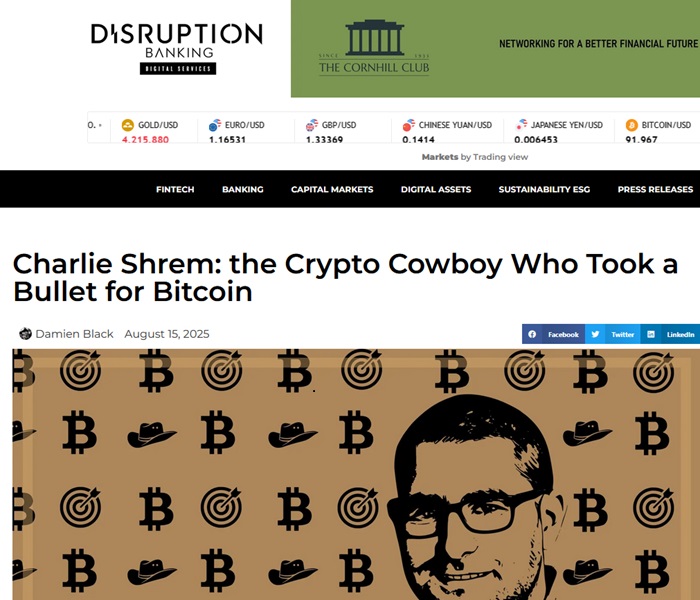
Shrem himself has described his younger self as a “cowboy” who underestimated the seriousness of compliance rules. He has admitted he was moving too fast, driven by passion and vision more than legal caution. But he also maintains that he was the first through the door, absorbing the regulatory blow so others could eventually build the industry more safely.
Regardless of where one stands, the fact remains: Shrem’s imprisonment became a defining moment in the early history of cryptocurrency.
Life in Prison and Personal Transformation
Shrem chose not to let prison define him. Instead of withdrawing, he used the experience as a time for growth and reflection. He reportedly read over 140 books—an average of one every five days—and taught educational classes to fellow inmates. He developed a reputation as a quiet, intelligent, and cooperative prisoner, avoiding the violence that often plagues white-collar offenders in federal prisons.
This period of introspection helped him understand both his personal mistakes and his desire to return to the world stronger and wiser. When he walked out of prison in mid-2016, he did so with renewed focus, determined to rebuild his career and reputation without repeating past errors.
Post-Prison Business Ventures and Return to Crypto
Freedom brought opportunity. In November 2016, Shrem co-founded Intellisys Capital, a blockchain-based investment platform. The company planned to tokenize equity shares using Ethereum smart contracts—a concept ahead of its time. Although the venture dissolved in March 2017, it reinforced Shrem’s belief that crypto could transform traditional investment structures.
Later that year, he joined Jaxx, a multi-platform cryptocurrency wallet developed by Decentral, as its director of business development. He later became the company’s chief operating officer, helping expand its reach across multiple device platforms. His presence brought credibility to the project, and his industry insights helped Jaxx refine its user experience and strategic roadmap.
Additionally, Shrem became involved in the cryptocurrency Dash, proposing a debit card system that would allow users to load Dash coins and convert them to local currency seamlessly. His ideas contributed to ongoing discussions about crypto payment solutions.
In 2017, he founded CryptoIQ, an advisory service designed to help investors navigate the increasingly complex cryptocurrency markets. The platform offered market analysis, educational content, and trading insights. This venture marked Shrem’s return to public influence, positioning him once again as a guiding voice in the crypto industry.
The Rise of The Charlie Shrem Show
Perhaps Shrem’s most successful post-prison achievement is the creation of his podcast. Originally titled Untold Stories, the show quickly became a major hit, eventually rebranding as The Charlie Shrem Show. Through in-depth interviews with crypto pioneers, entrepreneurs, and industry leaders, Shrem explored the human stories behind the technological revolution.
The podcast’s success was remarkable. It ranked in the top 1% of podcasts globally according to Listen Notes, accumulated over 400 episodes, and built a dedicated international audience. The show cemented Shrem’s status not just as a crypto figure, but as a respected storyteller and commentator.
Ventures in Film and Entertainment
Shrem’s influence expanded into Hollywood in the early 2020s. He appeared in documentaries like The Rise and Rise of Bitcoin (2014) and Banking on Bitcoin (2016), both of which explored the early days of cryptocurrency. But he soon transitioned from appearing on screen to producing films.
Shrem worked as a producer on Dark Night of the Soul and McVeigh in 2024, collaborating with well-known actor Cuba Gooding Jr. He contributed to the development of Whiskey Run and Break The Cycle, both entering post-production. These projects reveal Shrem’s interest in storytelling not just through technology, but through cinema—a medium capable of shaping public perception and historical memory.
Business Expansion and Investment Ventures
In recent years, Shrem has played a prominent role in cryptocurrency investment. He co-founded Druid Ventures, a $13 million venture fund focused on Web3 technology, privacy systems, scalability solutions, and blockchain interoperability. Druid Ventures has invested in more than twenty projects, helping shape the next generation of decentralized technology.
Shrem also became a principal investor in ByteFederal, a Bitcoin ATM network, and co-founded Amalgamated Suncoast Portfolio, a family-run investment enterprise employing over twenty people. These ventures show Shrem’s evolution from a technical innovator into a sophisticated investor, advisor, and strategist with influence across multiple sectors.

Personal Life
Charlie Shrem married actress and crypto advocate Courtney Shrem, and the couple relocated to Sarasota, Florida in 2017. Although Shrem is a public figure, he maintains a relatively private home life. He often remarks that Florida provides peace, stability, and the ideal environment for balancing creativity, business, and personal well-being.
Charlie Shrem’s life is a multidimensional story—one of innovation, ambition, controversy, and rebirth. He helped shape Bitcoin’s earliest infrastructure, endured the consequences of unregulated experimentation, and emerged from prison more determined than ever. Today, he remains a powerful voice in cryptocurrency, a successful investor, a media figure, and a symbol of the early crypto movement’s rebellious spirit.
Related Fraudsters Scammers: