
Scammer Gerald Daniel Blanchard
Fraudster Gerald Daniel Blanchard

Details |
|
| Name: | Gerald Daniel Blanchard |
| Other Name: | Daniel |
| Born: | 1972 |
| whether Dead or Alive: | Alive |
| Age: | 41 |
| Country: | Winnipeg, Manitoba, Canada |
| Occupation: | Computer and security system expert |
| Criminal / Fraud / Scam Charges: | Theft, Fraud |
| Criminal / Fraud / Scam Penalty: | 18 years prison (paroled after two years) |
| Known For: | |
Description :
Gerald Daniel Blanchard: The World's Most Ingenious Fraudster Who Outsmarted Banks, Police, and Nations
Gerald Daniel Blanchard (born 1972) is a Canadian fraudster whose criminal career, spanning more than three decades and three continents, established him as one of the most sophisticated, inventive, and elusive thieves of the modern era, with a reputation built on an extraordinary combination of technical expertise, psychological manipulation, patience, and daring. Renowned for executing elaborate schemes ranging from bank infiltrations and ATM fraud to international jewel thefts, Blanchard is best known for orchestrating the 1998 theft of the Sisi Star, a historic diamond-and-pearl hair ornament valued at approximately $2 million, from Austria’s Schönbrunn Palace—a heist he later claimed to have accomplished by parachuting onto the roof at night and secretly swapping the original jewel with an identical replica, a detail that remains both legendary and disputed. Born in Winnipeg, Manitoba, and raised by his single mother, Carol Phegly, following her divorce, Blanchard grew up in a household marked by financial instability, learning disabilities, and emotional strain. His severe dyslexia and a speech impediment contributed to his quiet nature and difficulty fitting in socially, but he exhibited an early fascination with electronics, locks, and mechanical systems, often dismantling household devices to understand how they worked. When he was around eight years old, his mother moved the family to Omaha, Nebraska, seeking better employment opportunities, and it was there, amid a more challenging environment, that Blanchard’s developing ingenuity took a darker turn.
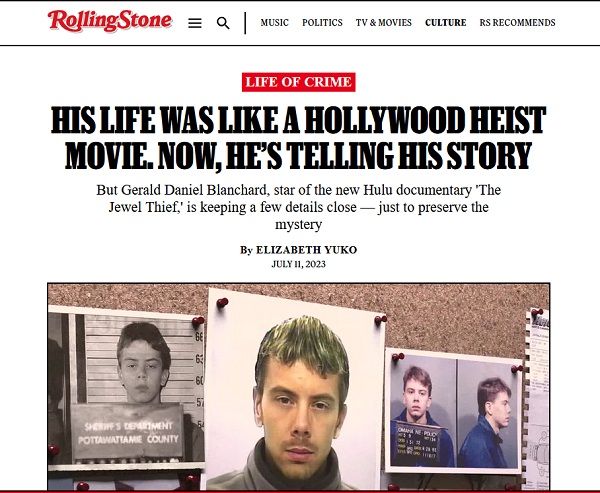
By age six he had already begun petty shoplifting, but as a teenager he escalated to more serious crimes such as pickpocketing, breaking into cars, and stealing electronics from stores, often filming these acts with friends as a way to feed his growing appetite for adrenaline and challenge. His first arrest came at age fifteen, and instead of discouraging him, the experience hardened his resolve and sharpened his skills. He learned basic lock-picking, forgery, and security circumvention techniques, soon becoming adept at creating fake IDs, cracking simple alarm systems, and exploiting weaknesses in both people and infrastructure. These early experiments formed the foundation of a criminal trajectory that would eventually involve high-tech equipment, international travel, dozens of aliases, and a network of accomplices.
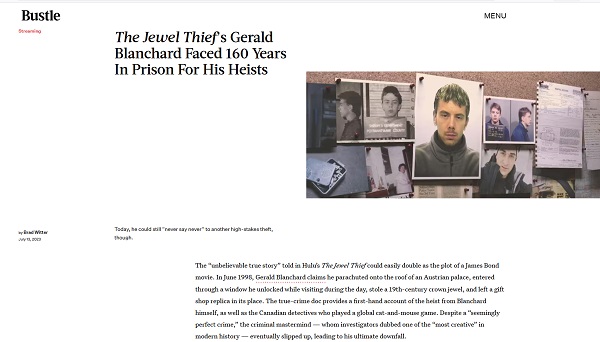
By the late 1990s and early 2000s, Blanchard’s crimes had evolved from petty thefts into highly coordinated heists, including sophisticated bank infiltrations in Canada and the United States. He and his associates used tools such as infrared goggles, wireless cameras, baby monitors, signal jammers, disguises, and ductwork access points to penetrate banks, often weeks or months before carrying out the actual theft. One of his most notorious operations occurred in 2004, when he targeted a soon-to-open branch of the Canadian Imperial Bank of Commerce (CIBC) in Winnipeg. Posing as a construction worker, he gained access to the site, installed hidden surveillance cameras, tampered with ATM locks, and used stolen or duplicate keys to reprogram the internal mechanisms. After building a practice ATM in a private location so he could rehearse the entry procedure until perfect, Blanchard and his team struck the night before the branch’s grand opening, cracking open seven ATMs in a meticulously timed 90-second routine per machine, ultimately stealing more than $500,000. He misled investigators by leaving one ATM untouched and stealing the branch’s computer hard drives to eliminate digital evidence. This heist, combined with earlier and later crimes, placed him under intense scrutiny from both U.S. and Canadian authorities. At the same time, Blanchard was running international schemes, including a 2006 operation in Cairo, Egypt, where he and accomplices used card-skimming devices and counterfeit credit cards—disguising themselves in burkas to avoid detection—to steal over $1 million from ATMs, allegedly funneling some of the money to overseas contacts.

Despite the complexity of his operations, Blanchard maintained a pattern of simplicity in execution: exploit the weakest point of a system, study human behavior, and remain patient enough to strike when no one expected it. This approach extended to the famous Sisi Star theft, where his reconnaissance included videotaping the jewel’s display case, loosening screws, unlocking nearby windows, and analyzing motion sensors during a tourist visit before executing the nighttime infiltration. After successfully stealing the ornament, he hid it in his grandmother’s home in Winnipeg, where authorities eventually recovered it after his arrest almost a decade later. Throughout the early 2000s, Blanchard’s name remained unknown to the public, but police departments across Canada could not ignore the rise in sophisticated ATM attacks, stolen credit-card networks, and cross-border fraud cases exhibiting the same level of precision. The Winnipeg Police Service, particularly detectives Mitch McCormick and Larry Levasseur, eventually connected multiple crimes to Blanchard’s network. Their investigations, known as Operation Kite, involved extensive digital forensics, wiretaps on more than a dozen phones, tracking devices, undercover surveillance, and coordination with international agencies—including Austrian authorities still searching for the missing Sisi Star.


Related Fraudsters Scammers:



Popular Links

SWINDLERS LIST
-
Top 10 Scammers !!!
Beware of these scammers...Keep them out of your mail-box...

SCAM TOOLS
-
Block Scam Mails???
Cleaning your scam filled inbox can be effected by these tools
HELP DESK
-
Waiting to help You!!!
Every problem has a solution when discussed. Discuss with us to get a clear idea to keep your information unscathed from hypocrites