
Scammer Richard Ayvazyan
Fraudster Richard Ayvazyan

Details |
|
| Name: | Richard Ayvazyan |
| Other Name: | Null |
| Born: | 1976 |
| whether Dead or Alive: | |
| Age: | 48 |
| Country: | California |
| Occupation: | Businessman |
| Criminal / Fraud / Scam Charges: | COVID-19 relief fund scam |
| Criminal / Fraud / Scam Penalty: | 17-year in prison |
| Known For: | Null |
Description :
The Pandemic Predator: How Richard Ayvazyan Stole Millions, Fled the Country, and Finally Fell
A Fraudster Born From a Global Crisis
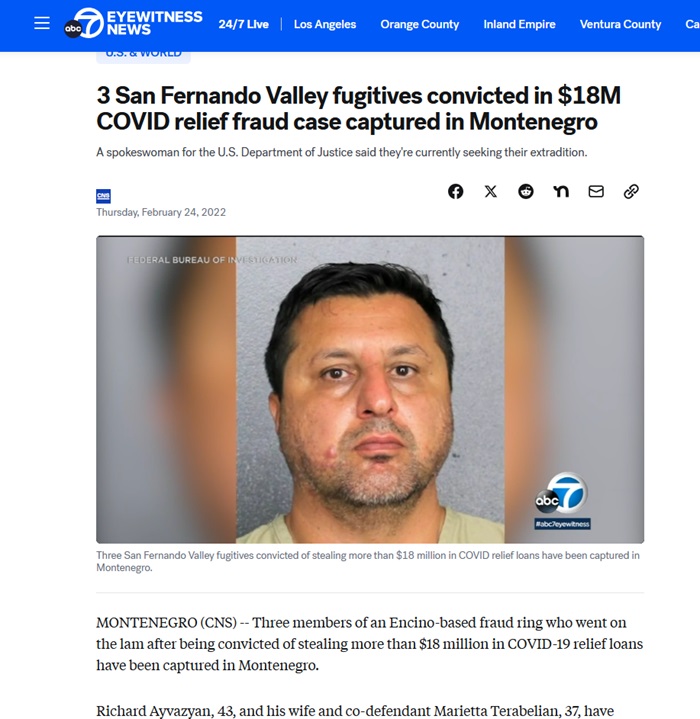
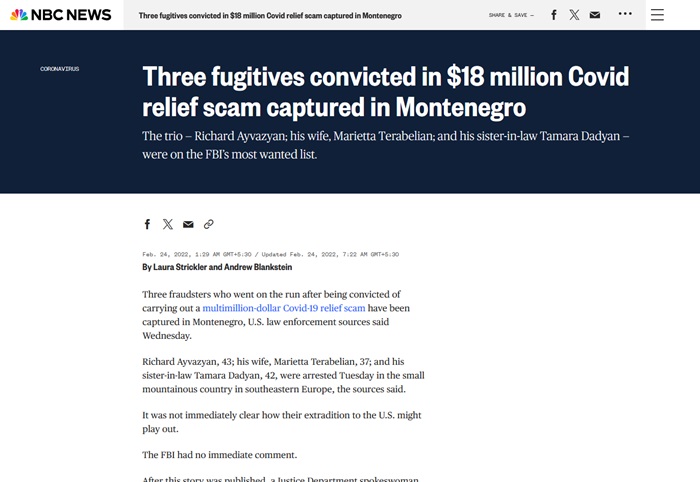
The COVID-19 pandemic brought fear, uncertainty, and economic devastation to millions of Americans. While families struggled to survive and businesses collapsed under lockdown pressures, others saw an opportunity—an opening created by rapid government relief programs that lacked strong verification and enforcement mechanisms. Among the most notorious individuals who exploited this vulnerability was Richard Ayvazyan, a Los Angeles resident who engineered one of the largest and most brazen COVID-relief fraud schemes in the United States. His elaborate operation siphoned more than $20 million in taxpayer-funded emergency loans, using fake identities, fictitious businesses, forged documents, and international laundering tactics. His crimes, however, did not end with financial theft. Ayvazyan also became a fugitive, cutting off his ankle bracelet and fleeing the country with his wife, living under false identities in Montenegro until a single mistake finally exposed his whereabouts. What follows is a detailed account of his rise, fraud, escape, capture, and long-awaited punishment.
Early Life and Background of Richard Ayvazyan
Richard Ayvazyan was born in Armenia before immigrating to the United States, where he settled in the Los Angeles area and built what appeared, on the surface, to be a stable family life. Married to Marietta Terabelian, the couple raised three children and lived in a luxury home in Tarzana, California. To neighbors and acquaintances, they seemed like a typical, financially comfortable family navigating life in one of LA’s many suburban enclaves. But beneath this normal exterior, investigators would later uncover layers of deception, forged paperwork, shell companies, and a pattern of fraudulent financial behavior that predated the pandemic. Ayvazyan and his extended family members had already shown signs of involvement in illegal identity-based schemes. That background would serve as the foundation for an unprecedented criminal enterprise once COVID-19 struck and federal relief funds began flowing.
The COVID-19 Opportunity: A Perfect Storm for Fraud
In March 2020, as businesses across America shuttered, Congress authorized massive emergency relief under the CARES Act, including the Paycheck Protection Program (PPP) and the Economic Injury Disaster Loan (EIDL) program. These programs, designed to save businesses from collapse, made billions of dollars instantly accessible. Banks were pressured to distribute funds quickly, the Small Business Administration (SBA) faced unimaginable workloads, and fraud detection systems were unprepared for the tsunami of applications. To criminals like Ayvazyan, this was the perfect loophole. The government essentially opened a floodgate of funding with limited upfront verification. He recognized immediately that if he could fabricate businesses and identities quickly enough, he could siphon vast amounts of money with minimal resistance. What followed was the rapid construction of one of the most sophisticated COVID-relief fraud schemes in the country.
Constructing the Fraud Machine: Fake Identities and Fake Companies
At the heart of the scheme was the creation of synthetic, stolen, and falsified identities, which allowed Ayvazyan and his co-conspirators to apply for loans in the names of people who either did not exist or had no knowledge of the applications submitted on their behalf. These identities included elderly citizens, deceased individuals, foreign exchange students who had returned home years earlier, and entirely fabricated personas. Using these identities, the group created dozens of shell companies—businesses that existed only on paper. They submitted forged tax returns, counterfeit payroll records, fake bank statements, and fraudulent identification documents to convince lenders and the SBA that each business qualified for federal assistance. Between March 2020 and August 2020, the group submitted approximately 150 fraudulent PPP and EIDL applications, which together yielded more than $20 million in ill-gotten funds. While millions of Americans waited weeks or months for legitimate relief, the Ayvazyan ring enjoyed nearly instant approval on many of their fraudulent requests.
Lavish Living on Stolen Taxpayer Money
Once the funds began flowing, the conspirators wasted no time spending the stolen money. They poured federal relief funds into luxury real estate purchases, including properties in Tarzana, Glendale, and Palm Desert. They bought gold coins, rare diamonds, luxury watches, designer handbags, high-end clothing, and expensive furnishings. One purchase included a Harley-Davidson motorcycle, while others involved importing premium European furniture. Their Tarzana mansion—later raided by the FBI—became a symbol of their extravagance. During the raid, federal agents discovered a grocery bag stuffed with $451,000 in cash, which Marietta had attempted to hide in the backyard bushes. Their spending spree made one thing extremely clear: the fraud was not an act of survival or desperation but a calculated attempt to live a life of extreme luxury at the expense of taxpayers during a national emergency.
Federal Investigation and Trial
By late 2020, investigators from the FBI, IRS Criminal Investigation, SBA-OIG, and FHFA-OIG began noticing patterns among the loan applications linked to the group. Several businesses had identical employee lists, identical documents, or addresses that raised red flags. The deeper the agencies dug, the clearer the picture became: this was a coordinated conspiracy involving multiple family members and a sophisticated network of fabricated records. In June 2021, the case went to trial in the U.S. District Court for the Central District of California. Prosecutors presented overwhelming evidence, including email communications, forged paperwork, bank transactions, and witness testimony. After a full federal jury trial, Richard Ayvazyan, Marietta Terabelian, and two relatives were convicted on charges of:
Conspiracy to commit bank fraud and wire fraud
Bank fraud
Wire fraud
Aggravated identity theft
Money laundering conspiracy
Prosecutors urged the court to detain Ayvazyan immediately, warning that he had the means, the knowledge, and the financial resources to escape. Despite their concerns, the judge allowed Ayvazyan and Terabelian to remain free on bond until sentencing. This would prove to be a critical mistake.
The Escape: Cutting the Ankle Monitors and Running
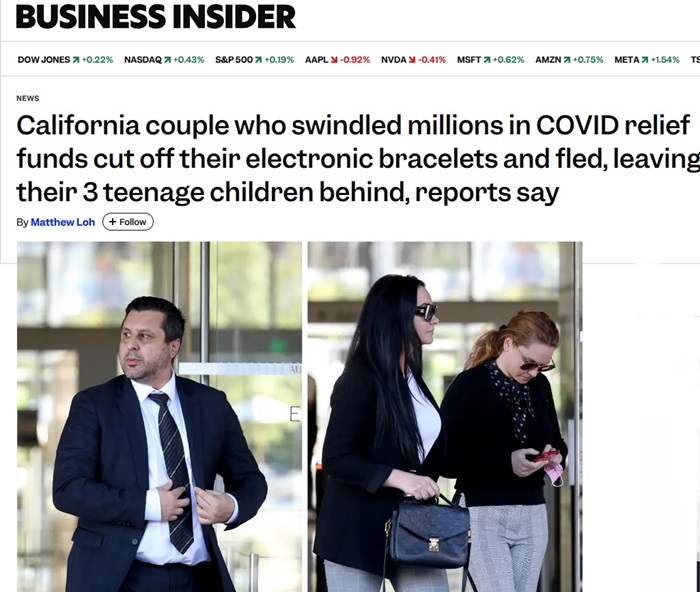
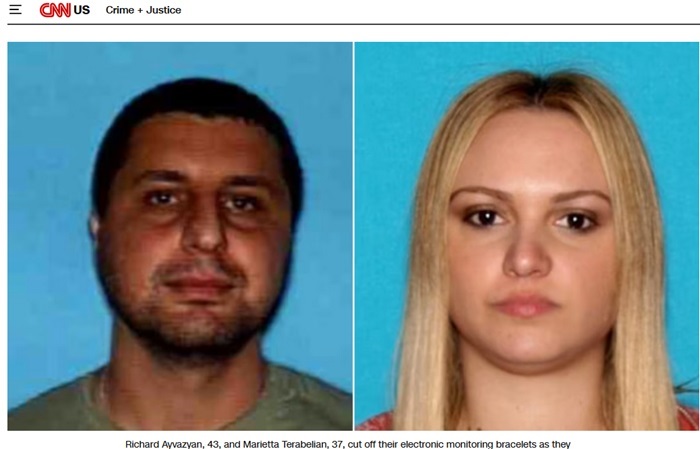
On August 29, 2021, two months after being convicted and shortly before their court-ordered sentencing, Richard Ayvazyan and his wife carried out a meticulously planned escape. They cut off their GPS ankle monitoring devices, abandoned their home, left their vehicles behind, and disappeared. Their three children—ages 16, 15, and 14—woke up to find both parents gone. A heartbreaking note written by Ayvazyan was left behind, describing how he and their mother had “no choice” and expressing unconditional love. The FBI launched an immediate fugitive investigation and offered a $20,000 reward for information leading to the couple’s capture. International airports were notified, border controls were alerted, and Interpol issued notices. But the couple had vanished without leaving a trace.
Life on the Run: How They Reached Montenegro
Using forged documents, Ayvazyan and Terabelian eventually made their way to Europe, traveling through multiple countries before boarding a private jet from Lisbon, Portugal, to Tivat, Montenegro, on September 3, 2021. Their forged Mexican passports identified them as Roberto Niko De Leon and Nataly Rose Perez Garcia. In Montenegro—a small Balkan nation known for its scenic coastlines, wealthy visitors, and discreet social culture—the couple saw an opportunity to blend in. They quickly reinvented themselves, adopting new names, new identities, and an entirely new lifestyle.
A Life of Luxury in Montenegro
In Montenegro, the fugitives settled first in Porto Montenegro, a luxury marina development that attracts wealthy expatriates, Russian oligarchs, and international travelers. They rented a high-end apartment, opened a bank account, and even registered a real estate company called Leon Enterprises under Ayvazyan’s false identity. They imported their Range Rover and BMW from Los Angeles—both still bearing California license plates—drawing attention but not suspicion. Eventually, they rented a second property: a gorgeous waterfront villa overlooking the Bay of Kotor, complete with a swimming pool and panoramic views. Locals described them as polite, generous, and quiet. Terabelian was especially noted for leaving large tips and asking shopkeepers for help finding a real Christmas tree. While some residents sensed that “Niko and Natalia” were unusual, Montenegro’s culture of privacy meant few people asked questions. The couple also hired a dog walker to care for their black dog. Their new life seemed secure—until another fugitive joined them.
Tamara Dadyan Joins the Fleeing Couple
In January 2022, Tamara Dadyan, who had been convicted alongside Ayvazyan, failed to report to prison and instead fled the United States using a forged British passport. Traveling under the name Isabella Angela Adamos, she entered Montenegro and soon reunited with Ayvazyan and Terabelian. With three fugitives now living in Tivat, the risk of exposure increased dramatically.
The Mistake That Changed Everything
Despite their meticulous planning, one careless action brought the entire operation crashing down. In February 2022, Ayvazyan attempted to log into an American bank account associated with one of the fake companies used in the fraud scheme. The login attempt triggered a security alert. The FBI traced the IP address to Tivat, Montenegro, and immediately notified Montenegrin authorities. A joint investigation began. Local police identified the address connected to the login, cross-referenced passport photos with FBI mugshots, and confirmed that “Roberto De Leon” and “Nataly Perez Garcia” were indeed Richard Ayvazyan and Marietta Terabelian. The time had come for coordinated arrests.
The Dramatic Arrests in Montenegro
On February 22, 2022, Montenegrin police executed a multi-location sweep to capture the fugitives. Officers arrived at the couple’s waterfront villa and asked Ayvazyan to present his residency documents. Instead of complying, he fled out the back door and temporarily escaped. Meanwhile, police discovered a man walking the couple’s dog—a hired worker, not a suspect. Terabelian was soon tracked to a local hair salon where she was having hair extensions installed. Stylists attempted to block police entry, but officers pushed through and arrested her. In her possession were both a forged Mexican passport and a forged British passport. Later that night, police located Ayvazyan in a hotel room in Budva, where he had checked in under yet another false identity. He was accompanied by Tamara Dadyan, who was also arrested. Fingerprint analysis confirmed all identities. Their six-month run was over.
Extradition and Return to the United States
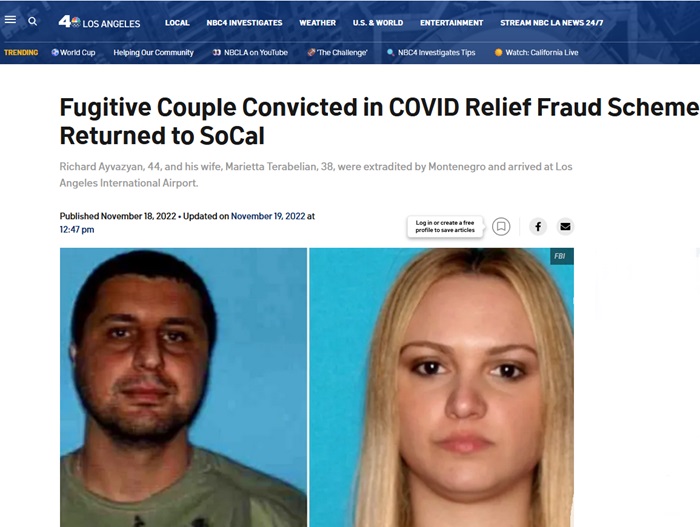
Montenegro prosecuted the fugitives for using forged documents before beginning the extradition process. After several months of legal proceedings and diplomatic coordination, the fugitives were transferred into U.S. custody. They were flown back to Los Angeles under heavy federal escort and appeared once again in federal court—this time in person—to face the consequences of their actions. Their children, left behind during their escape, were reunited with extended family members in California.
Final Sentences and Federal Restrictions
Richard Ayvazyan is now serving a 17-year federal prison sentence, one of the longest handed down in a COVID-relief fraud case. Marietta Terabelian received six years, while Tamara Dadyan received more than ten years. Additional federal actions followed, including a Final Order issued by the Federal Housing Finance Agency (FHFA) in January 2024. This order permanently prohibits any federally regulated financial institution from conducting business with Ayvazyan, citing his fraud, deception, identity theft, and risk to the financial system. The ban is indefinite and extends to anyone determined to be an affiliate of Ayvazyan.
National Impact and Ongoing Enforcement
The Ayvazyan case has been cited by the Department of Justice as a prime example of pandemic-era fraud. In the aftermath, the DOJ established the COVID-19 Fraud Enforcement Task Force, which coordinates nationwide efforts to investigate, prosecute, and recover stolen relief funds. Since the inception of the CARES Act, federal prosecutors have charged over 192 defendants with PPP-related crimes and have seized more than $78 million in cash, real estate, and luxury items purchased with fraudulent loans. The government has made clear that even years later, pandemic-related fraud cases remain a top priority.
The saga of Richard Ayvazyan is a cautionary tale of how quickly greed can corrupt, how far criminals will go to avoid accountability, and how relentless federal investigators can be when pursuing justice. At a time when the nation was suffering, Ayvazyan stole millions meant for desperate businesses and vulnerable workers. His attempt to reinvent himself in Montenegro—complete with luxury cars, designer clothing, and waterfront villas—showed that he was not merely escaping justice but seeking to enjoy the spoils of fraud. Ultimately, one careless digital footprint ended his dream of freedom. Today, locked behind bars, Ayvazyan’s long sentence reflects the seriousness of his crimes and the determination of federal agencies to ensure that those who exploit national emergencies are held fully accountable.
Final Sentences and Federal Restrictions
Richard Ayvazyan is now serving a 17-year federal prison sentence, one of the longest handed down in a COVID-relief fraud case. Marietta Terabelian received six years, while Tamara Dadyan received more than ten years. Additional federal actions followed, including a Final Order issued by the Federal Housing Finance Agency (FHFA) in January 2024. This order permanently prohibits any federally regulated financial institution from conducting business with Ayvazyan, citing his fraud, deception, identity theft, and risk to the financial system. The ban is indefinite and extends to anyone determined to be an affiliate of Ayvazyan.
National Impact and Ongoing Enforcement
The Ayvazyan case has been cited by the Department of Justice as a prime example of pandemic-era fraud. In the aftermath, the DOJ established the COVID-19 Fraud Enforcement Task Force, which coordinates nationwide efforts to investigate, prosecute, and recover stolen relief funds. Since the inception of the CARES Act, federal prosecutors have charged over 192 defendants with PPP-related crimes and have seized more than $78 million in cash, real estate, and luxury items purchased with fraudulent loans. The government has made clear that even years later, pandemic-related fraud cases remain a top priority.
The saga of Richard Ayvazyan is a cautionary tale of how quickly greed can corrupt, how far criminals will go to avoid accountability, and how relentless federal investigators can be when pursuing justice. At a time when the nation was suffering, Ayvazyan stole millions meant for desperate businesses and vulnerable workers. His attempt to reinvent himself in Montenegro—complete with luxury cars, designer clothing, and waterfront villas—showed that he was not merely escaping justice but seeking to enjoy the spoils of fraud. Ultimately, one careless digital footprint ended his dream of freedom. Today, locked behind bars, Ayvazyan’s long sentence reflects the seriousness of his crimes and the determination of federal agencies to ensure that those who exploit national emergencies are held fully accountable.
Related Fraudsters Scammers:




Popular Links

NEWS & EVENTS
The world's most prevalent social network said that to date, it has acquired lawful judgments of about $2 billion against deceitful exerci

SWINDLERS LIST
-
Top 10 Scammers !!!
Beware of these scammers...Keep them out of your mail-box...
SCAM TOOLS
-
Block Scam Mails???
Cleaning your scam filled inbox can be effected by these tools
HELP DESK
-
Waiting to help You!!!
Every problem has a solution when discussed. Discuss with us to get a clear idea to keep your information unscathed from hypocrites