
Scammer Nicholas Cosmo
Fraudster Nicholas Cosmo

Details |
|
| Name: | Nicholas Cosmo |
| Other Name: | |
| Born: | 1971 |
| whether Dead or Alive: | Alive |
| Age: | 40 |
| Country: | American |
| Occupation: | Businessman |
| Criminal / Fraud / Scam Charges: | Charges of an estimated $370?413 million Ponzi scheme. |
| Criminal / Fraud / Scam Penalty: | Cosmo was sentenced to 25 years in prison. |
| Known For: | |
Description :
Nicholas Cosmo: The $413 Million Predator Who Destroyed Thousands of Lives
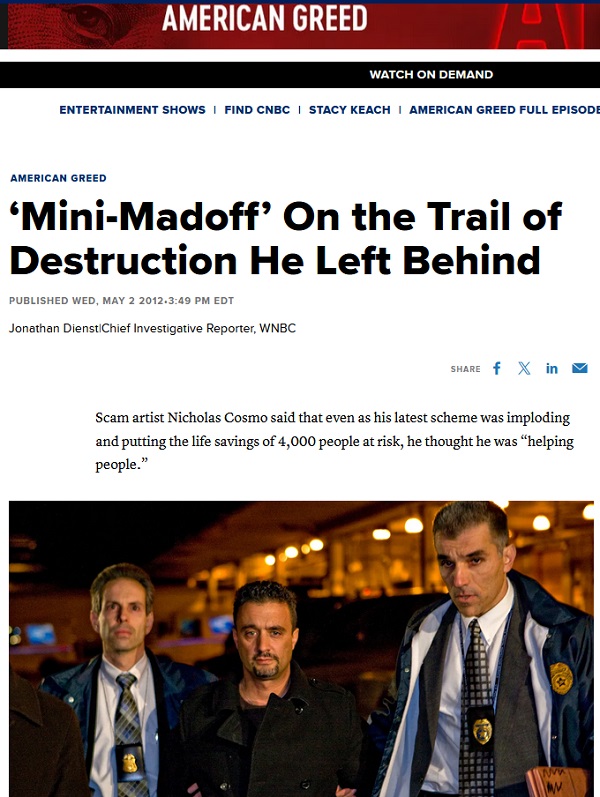
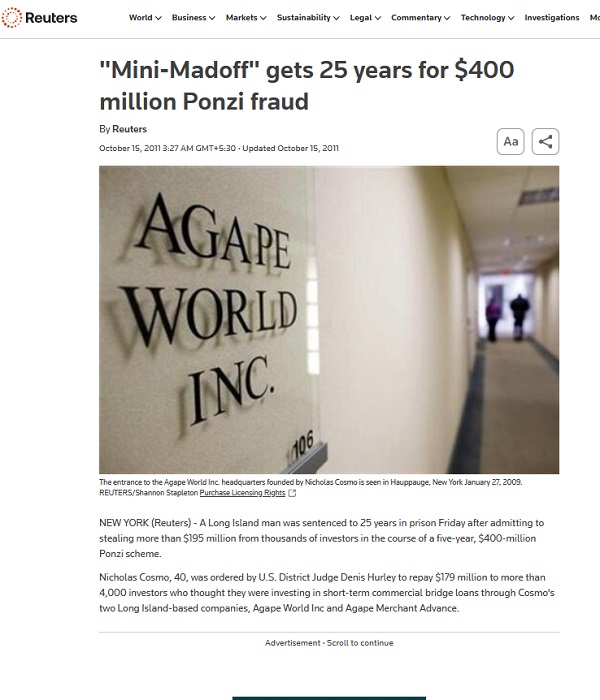
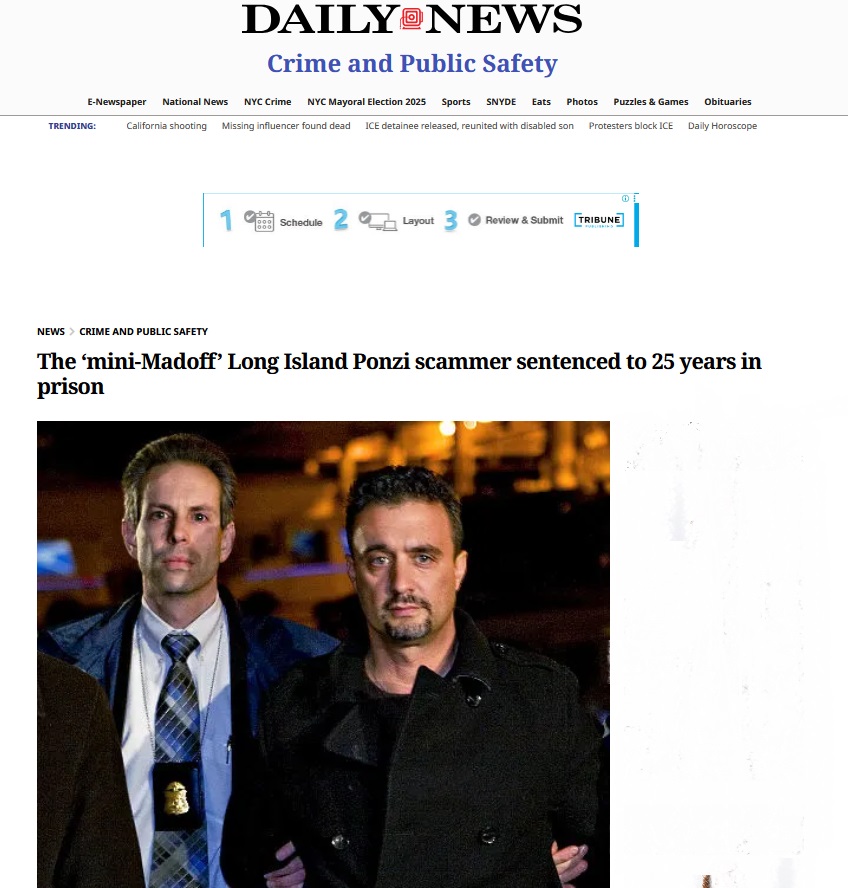
Nicholas Cosmo (born 1971) is an American former businessman whose name became synonymous with one of the largest and most damaging Ponzi schemes in modern U.S. history, a sprawling criminal enterprise that ultimately defrauded investors of an estimated $370 million to $413 million and secured his position among the worst white-collar offenders of the twenty-first century. Cosmo, who had already served a federal sentence for felony fraud in 1999, re-entered the financial world with an air of renewed legitimacy but quickly reverted to the deceptive practices that marked his earlier downfall. Operating through Agape World Inc., a financial firm headquartered in Hauppauge, New York, Cosmo marketed the company as a high-yield commercial bridge-lending operation, promising investors safe, short-term loans with unusually attractive returns. In reality, prosecutors later revealed that Agape World was a classic Ponzi scheme that used new investor money to pay earlier investors while Cosmo siphoned vast sums into personal spending, commodities-futures trading, and exorbitant broker commissions. Authorities arrested him on January 26, 2009, in Hicksville, New York, marking the abrupt collapse of an empire built on manipulation, deception, and the exploitation of financial trust. Cosmo was arraigned the following day in Islip, New York, on charges of mail fraud, and his arrest immediately prompted comparisons to other notorious fraudsters due to the staggering scale of his crimes. His earlier conviction for federal mail fraud—resulting in a 21-month prison sentence—was still fresh in the collective memory of law enforcement, and prosecutors noted that in a particularly brazen move, Cosmo had used more than $212,000 of Agape client funds to pay restitution owed from his 1999 conviction, demonstrating a long-standing pattern of financial abuse and disregard for ethical boundaries.
Cosmo’s scheme functioned through a carefully crafted illusion of stability and professionalism. Agape World Inc. purported to specialize in commercial bridge loans, a legitimate type of short-term financing often used by companies awaiting longer-term funding. Clients believed their money was being invested in safe, asset-backed transactions that would produce steady profits. However, prosecutors later determined that only a tiny fraction of client funds—approximately $10 million—was ever actually placed into bridge loans. Instead, Cosmo diverted between $80 million and $100 million into high-risk commodity-futures trading, which generated massive losses, while another $55 million to $63 million was paid out to brokers and salespeople as commissions. Many of these brokers were individuals with criminal backgrounds, including histories of robbery and heroin trafficking, and postal inspectors noted that Cosmo deliberately hired ex-convicts to solicit investors, exploiting their desperation and willingness to bend or ignore ethical rules in exchange for sizable commissions. The New York investment community was stunned when the details emerged, revealing that a company marketed as a suburban financial success story was actually employing individuals with extensive criminal histories to perpetuate fraud on a massive scale. The complaint filed against Agape World noted that the firm’s internal environment was plagued by dishonesty, misconduct, and aggressive recruitment tactics designed to lure in unsuspecting investors with promises of large returns backed by allegedly secure assets.
One of Agape World’s most notable assets was a 38,000-square-foot indoor athletic complex in Hauppauge, New York, purchased for $3.85 million in 2008. Cosmo invested over $1 million to renovate the building, transforming it from a paintball arena into a modern indoor sports facility that he promoted as a lucrative investment property. However, when Agape World collapsed and bankruptcy proceedings began under the management of trustee Silverman Acampora, the sports complex became the most valuable asset in the liquidation process. It was ultimately auctioned in June 2009 by David R. Maltz & Co. to a company called Coastal Sports, symbolizing the tangible dismantling of Cosmo’s fraudulent empire. As the bankruptcy process unfolded, investors learned that many of the assets they believed were generating stable income were either grossly overvalued or outright fictitious, leaving them with devastating financial losses and little recourse.
In the months following his arrest, Cosmo’s legal troubles deepened. He was unable to post bail immediately, as Judge Denis R. Hurley required extensive collateral, including property and financial guarantees from Cosmo’s relatives. The judge refused to release Cosmo until several strict conditions were met, including a $1.25 million bail package secured by family homes and frozen bank accounts. After several months of negotiation, Cosmo was finally released on bail and placed under home confinement on Long Island with electronic monitoring. However, this reprieve was short-lived. In October 2009, less than three months after his release, federal prosecutors accused Cosmo of violating his bail conditions by using a computer without authorization, attempting to transfer hidden assets, and lying to a U.S. Pretrial Services officer. At a hearing in Central Islip, New York, Judge Hurley determined that Cosmo could not be trusted to comply with the court’s orders and revoked his bail, ordering him returned to jail pending trial. The decision highlighted a consistent pattern of deceit and manipulation that had defined Cosmo’s conduct for more than a decade.
On October 29, 2010, Cosmo pleaded guilty to charges of mail and wire fraud in connection with the $413 million Ponzi scheme. Federal prosecutors emphasized the extraordinary scope of the fraud, noting that Cosmo’s actions had devastated thousands of investors, many of whom were ordinary individuals seeking stable financial returns. In total, more than 5,000 victims were identified, with losses so significant that some media outlets reported Cosmo’s scheme as the eighth-largest financial fraud in recorded history, tracing back to early eighteenth-century scams run by the infamous Scottish economist John Law. During the plea proceedings, U.S. Attorney Loretta Lynch delivered a strong condemnation of Cosmo’s actions, stating that those who lie to and steal from the investing public must face severe consequences. Several victims spoke in court, describing how Cosmo’s deception had destroyed their financial security, wiped out life savings, and shattered their hopes for retirement or financial stability. These emotional testimonies underscored the real-world consequences of white-collar crime, which can devastate entire families and communities.
On October 14, 2011, Cosmo was sentenced to 25 years in federal prison—a severe but fitting punishment given the enormity of the fraud. Judge Hurley emphasized Cosmo’s continued pattern of deception, manipulation, and disregard for the law. The sentencing marked a major milestone in the broader investigation surrounding Agape World, but prosecutors noted that Cosmo had not acted alone. On April 25, 2012, a criminal complaint was unsealed charging four former account representatives of Agape World Inc. and Agape Merchant Advance (AMA)—Jason Keryc, Anthony Massaro, Anthony Ciccone, and Diane Kaylor—with participating in the scheme. These individuals were accused of helping recruit investors, misrepresenting investment opportunities, and knowingly assisting in the distribution of fraudulent returns. Their involvement demonstrated that the fraud was not merely the work of one man but a coordinated network of individuals who collectively perpetuated one of the most audacious investment scams in New York history.
In the years that followed, investigators unraveled the full extent of the damage. Many investors were unable to recover more than a fraction of their losses. Retirement accounts vanished, home equity investments evaporated, and entire families were left financially devastated. Bankruptcy proceedings, asset auctions, and litigation stretched on for years, as victims struggled to reclaim even small portions of the money they entrusted to Cosmo and his sales network. The Agape fraud became a case study in how charismatic leadership, deceptive promises, aggressive recruitment, and seemingly legitimate business structures can mask deep criminality. For regulators, the case served as a wake-up call regarding the importance of rigorous oversight of private investment firms, background checks on financial professionals, and transparency in bridge lending and merchant finance industries.
Nicholas Cosmo ultimately became emblematic of the dangers of unchecked financial ambition and the catastrophic consequences of fraudulent investment schemes. His story remains a harsh reminder that white-collar crime is not victimless, that financial fraud destroys lives just as surely as any violent crime, and that the illusion of high returns can lure even the most cautious investors into traps designed by seasoned manipulators. Cosmo’s fall—from suburban financial executive to imprisoned Ponzi schemer—continues to stand as one of the most striking examples of modern financial deception, illustrating the ease with which trust can be exploited and the profound damage caused when greed overrides integrity.
Related Fraudsters Scammers:




Popular Links

SWINDLERS LIST
-
Top 10 Scammers !!!
Beware of these scammers...Keep them out of your mail-box...

SCAM TOOLS
-
Block Scam Mails???
Cleaning your scam filled inbox can be effected by these tools
HELP DESK
-
Waiting to help You!!!
Every problem has a solution when discussed. Discuss with us to get a clear idea to keep your information unscathed from hypocrites