
Scammer Melissa Caddick
Fraudster Melissa Caddick

Details |
|
| Name: | Melissa Caddick |
| Other Name: | Grimley |
| Born: | 1971 |
| whether Dead or Alive: | 2023 |
| Age: | 52 |
| Country: | New South Wales, Australia |
| Occupation: | Financial Advisor |
| Criminal / Fraud / Scam Charges: | Fraud, Identity theft, Impersonating a foreign diplomat |
| Criminal / Fraud / Scam Penalty: | Null |
| Known For: | Ponzi scheme, disappearance |
Description :
Footprints of a Fraud: The Melissa Caddick Empire and the Mystery That Followed
Melissa Louise Caddick spent years carefully crafting an image that would later enable one of Australia’s most notorious financial frauds. Born and raised in Sydney’s southern suburbs, she showed early signs of ambition and a strong desire for upward mobility. As she entered adulthood, she began shaping a persona centered on financial sophistication and professional authority. She claimed to possess academic credentials—a finance degree from the University of Technology Sydney—which the institution later confirmed she never completed. She also misrepresented her licensing status, suggesting she was a qualified financial adviser when she was not. Long before establishing her company, Maliver, she had already engaged in smaller acts of deception including forging signatures, altering documents, and lying on official paperwork. These early fraudulent behaviours went undetected and emboldened her to escalate her deceit. Through polished appearances, expensive clothing, and confident communication, she successfully constructed the façade of a highly skilled financial professional. This façade allowed her to build trust with clients who relied heavily on personal relationships rather than formal credentials.
The Birth of Maliver and the Evolution of an Eight-Year Ponzi Scheme
In 2013, Melissa Caddick launched Maliver, a financial services business that would become the vehicle for her elaborate Ponzi scheme. However, regulators later indicated her fraudulent activities may have begun as early as 2009. Over time, her operation expanded, and by 2012 she was defrauding clients—mostly friends, family, and acquaintances—on a significant scale. The cornerstone of her scam involved convincing clients to transfer their superannuation savings into self-managed superannuation funds (SMSFs) under her control. She assured them she would invest the funds into CommSec portfolios containing ASX-listed shares. Instead, she stole another adviser’s license number to create the appearance she was legally authorised to trade. The documentation she used—including her Financial Services Guide—was plagiarised from legitimate advisers and altered to appear as though it belonged to her. She then opened dozens of bank accounts into which she diverted client funds. To maintain the illusion of legitimate investment activity, she created meticulous but entirely fabricated CommSec statements showing substantial portfolio growth. These falsified reports went unnoticed for years, partly because clients trusted her and partly because auditors failed to detect irregularities. Over eight years, she stole an estimated $23–24 million from 72 victims, making her one of the most significant white-collar criminals in modern Australian history.

A Lavish Life Built on Lies: How Stolen Money Funded Extravagance
The wealth Melissa Caddick projected was not earned—it was stolen. Through Maliver’s illegal earnings, she financed an extravagant lifestyle that included couture fashion, designer jewellery, luxury cars, and international travel. She lived in a multimillion-dollar mansion in Dover Heights, one of Sydney’s most prestigious suburbs. Her home was adorned with expensive artwork, high-end furnishings, and wardrobes stocked with clothing from Dior, Chanel, and Louis Vuitton. Her holidays included trips to private islands, extensive stays at ski resorts in Aspen, and luxury travel experiences that only the wealthy could afford. This lifestyle was crucial to her fraud. It reinforced the image of a successful and savvy financial strategist, convincing clients that she was capable of generating high returns. Among the most tragic elements of her deception was her exploitation of her own parents, to whom she sold the illusion of shared property ownership. In 2016, she purchased an Edgecliff penthouse with approximately $2.55 million of stolen money while persuading her parents to contribute $1 million under false pretenses. When her scheme collapsed, her parents were left financially devastated, ultimately losing the home they believed was theirs.
The Beginning of the End: ASIC Investigation and the November 2020 Raid
The downfall of Melissa Caddick began with a tip-off in September 2020. A licensed financial adviser notified ASIC that Caddick was using their license details without permission. ASIC discreetly launched an investigation, gathering evidence that she was operating her business without required regulatory approval and potentially defrauding clients. By November, ASIC had obtained a search warrant, a freezing order for her bank accounts, and a passport restriction preventing her from leaving Australia. On November 11, 2020, ASIC and the Australian Federal Police raided her Dover Heights mansion. Investigators seized computers, hard drives, documents, luxury goods, jewellery, designer clothing, handbags, watches, and even a Gucci wedding dress. Forensic analysts quickly realised the scale of the fraud before them. The raid lasted much of the day. When officers left just before 6:30 pm, they had collected evidence showing that Maliver was not a legitimate investment firm but rather a long-running Ponzi scheme. Within hours, Melissa Caddick would vanish, setting off one of Australia’s most baffling modern mysteries.
The Sudden Disappearance: A Vanishing Act That Captivated a Nation
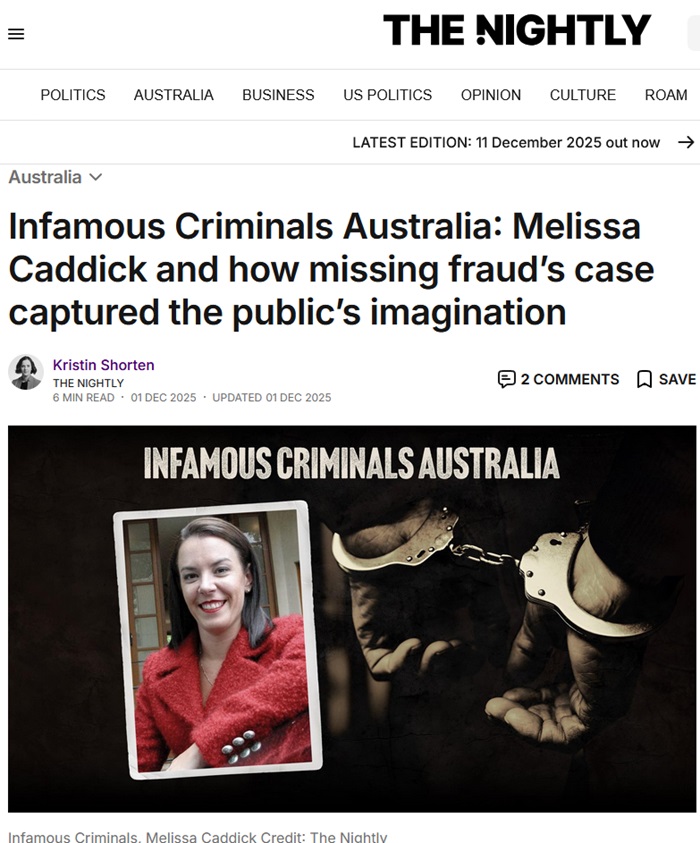
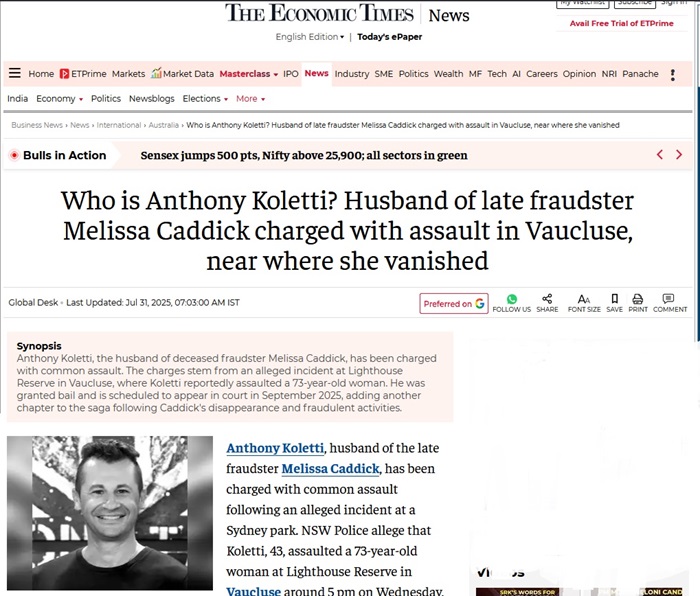
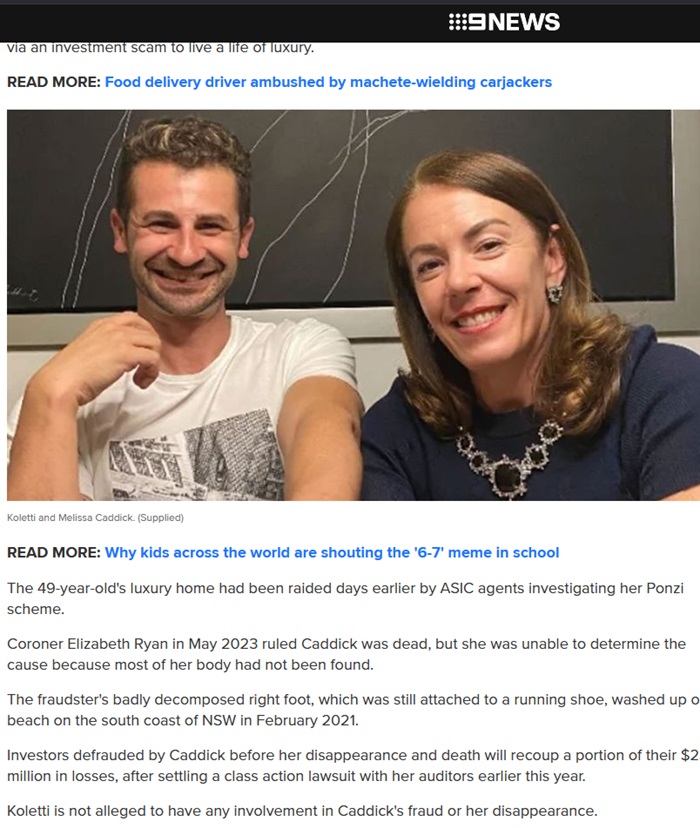
On the morning of November 12, 2020—just hours after the raid—Melissa Caddick reportedly left her house for her usual early-morning jog. She did not take her wallet, phone, or keys. She never returned. Her husband, Anthony Koletti, did not report her missing until more than 30 hours later, an omission that drew intense scrutiny. His inconsistent statements, calm demeanor, and refusal to promptly assist police investigations were heavily criticised by the coroner. Caddick’s disappearance instantly sparked public fascination. People speculated that she had fled using hidden offshore funds, dramatically altered her appearance, or staged her disappearance. Others believed she had been murdered by someone seeking revenge. Many suspected suicide—a way to escape inevitable arrest and financial destruction. As police searched her home, interviewed neighbours, and analysed CCTV footage, no clear evidence emerged about what had happened to her. For months, theories circulated widely through podcasts, talk shows, newspapers, and social media. The public remained divided: Was she alive and hiding? Had she fallen or jumped to her death? Or had someone silenced her?
A Gruesome Discovery: The Foot That Washed Ashore
On February 21, 2021, a jogger at Bournda Beach on the NSW South Coast discovered a decomposing human foot inside a running shoe. Forensic DNA tests later confirmed it belonged to Melissa Caddick. The location of the discovery—over 500 kilometers south of Sydney—was shocking but not impossible. Ocean drift modelling showed that remains entering the sea near Dover Heights could feasibly travel to Bournda Beach under certain tides and weather conditions. The autopsy was inconclusive as to whether the foot had been severed intentionally or detached naturally due to decomposition. Marine decomposition often leads to limbs detaching at joints, particularly ankles, which are structurally weaker. This discovery confirmed that at least part of Caddick’s body had entered the ocean, but the manner of her death—accident, suicide, or homicide—remained an open question.
The Coroner’s Inquest: Psychological Profile and Unanswered Questions
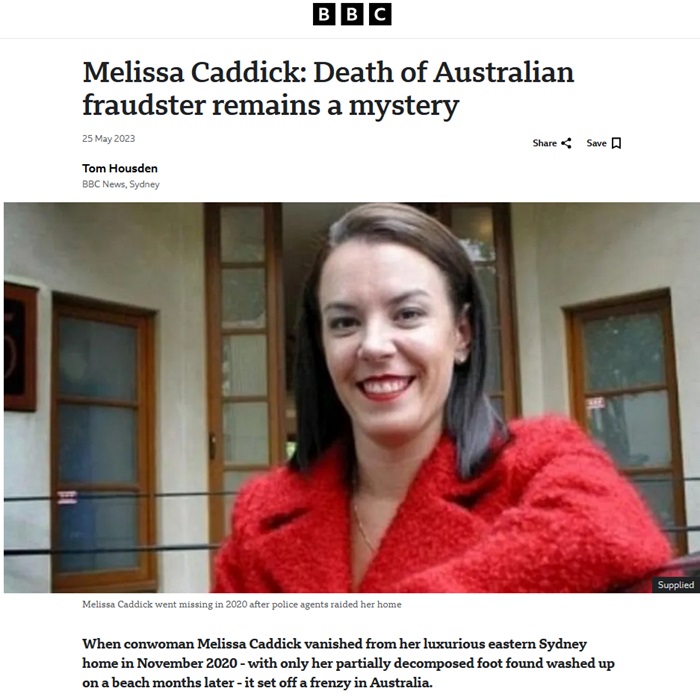
In May 2023, Deputy State Coroner Elizabeth Ryan delivered findings from the formal inquest. She concluded that Melissa Caddick was indeed dead, but the specific cause, location, and circumstances of her death could not be determined. The inquest revealed significant insights into Caddick’s psychological state. Forensic psychiatrist Dr. Kerri Eagle testified that Caddick likely exhibited traits associated with narcissistic personality disorder and was deeply susceptible to shame. The impending public exposure of her fraudulent business may have represented a catastrophic blow to her self-image. According to Dr. Eagle, suicide could have been perceived by Caddick as the only escape from professional and personal ruins. Coroner Ryan also referenced Melissa’s attachment to her son, noting that the complete absence of contact—something wholly out of character—strongly suggested she was not alive. Despite numerous theories presented by media and online communities, the coroner could neither confirm intentional suicide nor exclude the possibility of an accident or foul play. This ambiguity continued to fuel public intrigue long after the inquest concluded
The Victims’ Financial Ruin and Their Ongoing Fight for Compensation
Melissa Caddick’s fraud left 72 victims financially devastated. Many had entrusted her with their life savings, their retirement nest eggs, or funds meant for children’s education. When they learned their investments never existed, they experienced deep emotional trauma and financial ruin. ASIC and court-appointed receivers began liquidating Caddick’s assets to recover as much money as possible. Her Dover Heights mansion sold for approximately $9.8 million, while her parents’ Edgecliff penthouse sold for around $4 million. Jewellery, artwork, cars, designer clothing, and other luxury items were auctioned to raise additional funds. However, even with these efforts, victims initially recovered only a fraction of their losses. The emotional toll of betrayal by someone they considered a friend amplified their suffering. The fraud destroyed marriages, friendships, and family trust. Many victims publicly shared their stories, highlighting the lifelong impact of Caddick’s manipulation.
The Class Action Against Auditors: Allegations of Negligence and Oversight Failures
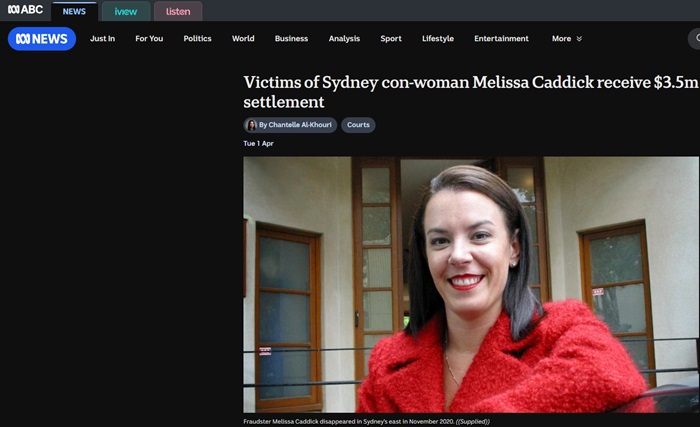
In September 2023, law firm Mackay Chapman launched a class action on behalf of affected investors. The lawsuit targeted several auditors responsible for conducting mandatory annual audits of the SMSFs connected to Caddick. Plaintiffs alleged the auditors engaged in negligence, misleading conduct, breach of contract, and violations of the Corporations Act. They argued that auditors repeatedly failed to detect fraudulent documents created by Caddick and did not verify the existence of claimed assets. Between 2012 and 2020, at least five auditors provided clean reports that effectively masked Caddick’s fraud. The class action ultimately represented 32 group members and lasted approximately 18 months. In early 2025, the Federal Court approved a $3.54 million settlement, which Mackay Chapman director Michael Chapman described as both fair and timely. The settlement increased the total recovery for victims to approximately 50% of their original investments, marking a significant milestone in the long legal battle for restitution.
The Psychology of a Con Artist: Understanding Melissa Caddick’s Manipulation
Experts have characterised Melissa Caddick not as a financial mastermind but as an extraordinarily skilled manipulator. Professor Clinton Free described her fraud as “a fabulous piece of affinity fraud”—a scheme that leveraged preexisting relationships built on trust, familiarity, and perceived credibility. According to Professor Free, Caddick’s crimes required no complex financial engineering. Instead, she relied on social capital and personal charm. Her victims trusted her because she was a friend, family member, or respected acquaintance. This trust caused them to suspend critical thinking and overlook red flags. Experts further suggested she embodied the “dark triad” of personality traits—narcissism, Machiavellianism, and psychopathy—making her adept at deception, lacking empathy, and prioritising self-interest above all else. These traits, combined with her glamorous lifestyle and ability to fabricate competence, made her a uniquely effective fraudster.
Residual Mysteries and the Enduring Fascination with Caddick’s Story
More than four years after her disappearance, the Melissa Caddick case continues to fascinate Australia. Several factors contribute to this enduring intrigue. Her profile as a glamorous female fraudster is unusual in the world of financial crime, which is overwhelmingly dominated by male offenders. Her sudden disappearance—and the discovery of only a single foot—adds a macabre layer of mystery reminiscent of crime thrillers. The luxurious lifestyle she lived, funded entirely by victims’ money, created a dramatic contrast that captivated the public. Despite the coroner’s findings, many still speculate about what happened. Did she jump from the cliffs near her home? Did she fall accidentally? Did she orchestrate her disappearance and flee the country using offshore funds? Or did someone she defrauded retaliate violently? These theories persist due to the unresolved nature of her death and the dramatic imagery associated with her final days.
The Liquidation of Her Assets: Real Estate, Artwork, and Designer Goods
In the years following her disappearance, court-appointed receivers continued to recover money through asset liquidation. Her Dover Heights mansion sold for nearly $10 million, the largest single repayment to investors. Significant proceeds also came from the liquidation of jewellery, art, and high-end clothing, though the total amount dwindled as the most valuable assets were sold. Her parents’ Edgecliff penthouse yielded additional recovery, though they were left financially devastated. Attempts to recover funds from individuals who received “fictitious profits” from the scheme have been ongoing. As of the latest updates, the receivership is expected to conclude by early 2025, marking the final chapter in the financial cleanup of Caddick’s empire.
Legacy of a Modern Australian Crime Saga
Today, Melissa Caddick is remembered as one of Australia’s most infamous white-collar criminals—a con artist whose story continues to challenge assumptions about trust, fraud, and human psychology. Her crimes devastated dozens of lives, leaving emotional scars and financial wreckage that will last generations. Her disappearance remains one of the country’s most enduring modern mysteries, fuelling endless speculation. Her case has inspired books, documentaries, podcasts, and dramatic reenactments, becoming embedded in Australian true-crime culture. Although significant restitution has been achieved through asset sales and the class action settlement, the wounds left by her deception remain deep. Ultimately, her story serves as a cautionary tale about the dangers of unchecked trust, the vulnerabilities inherent in affinity-based investments, and the profound damage wrought by fraudsters who wear the mask of friendship.
Related Fraudsters Scammers:






Popular Links

SWINDLERS LIST
-
Top 10 Scammers !!!
Beware of these scammers...Keep them out of your mail-box...

SCAM TOOLS
-
Block Scam Mails???
Cleaning your scam filled inbox can be effected by these tools
HELP DESK
-
Waiting to help You!!!
Every problem has a solution when discussed. Discuss with us to get a clear idea to keep your information unscathed from hypocrites