
Scammer Jerome Kerviel
Fraudster Jerome Kerviel
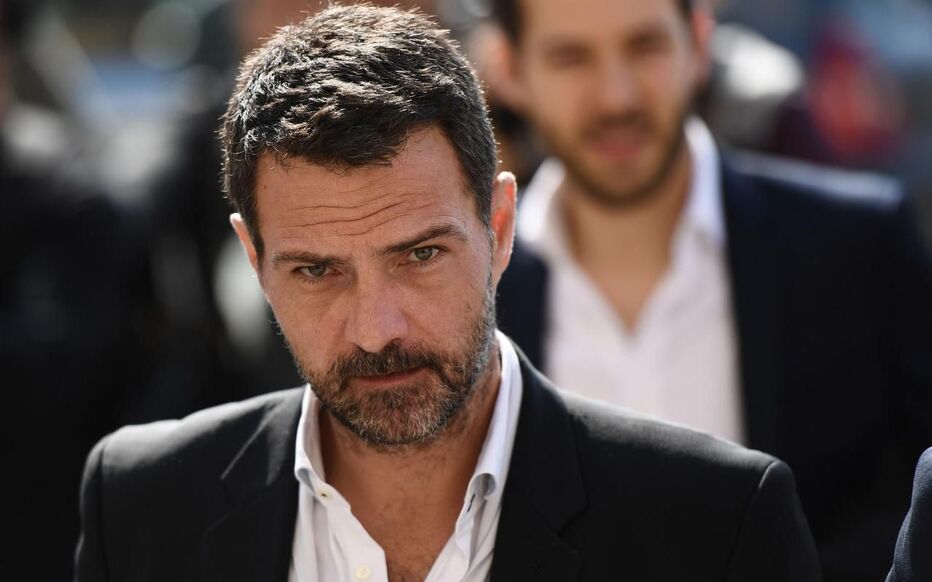
Details |
|
| Name: | Jerome Kerviel |
| Other Name: | Null |
| Born: | 1977 |
| whether Dead or Alive: | |
| Age: | 47 |
| Country: | France |
| Occupation: | Null |
| Criminal / Fraud / Scam Charges: | Abuse of confidence,illegal access to computers |
| Criminal / Fraud / Scam Penalty: | 3 Years in Prison |
| Known For: | Null |
Description :
Jérôme Kerviel: The Trader Who Exposed the Cracks in Global Finance
Jérôme Kerviel is one of the most widely known figures in modern financial history, not because of extraordinary wealth or visionary strategy, but because of one of the largest trading scandals ever recorded. As a relatively junior trader at Société Générale, one of France’s largest and oldest banks, he executed a series of massive unauthorized trades that ultimately resulted in losses of about €4.9 billion. The scandal rocked global markets, prompted regulatory scrutiny, and turned Kerviel into a symbol of both individual recklessness and institutional failure. Over time, his story became more than a tale of a rogue trader; it evolved into a complex narrative involving corporate culture, weak risk controls, legal battles, media spectacle, political commentary, and a strange kind of public fascination.
Early Life and Family Background
Jérôme Kerviel was born on 11 January 1977 in Pont-l’Abbé, a small town in the Brittany region of France. His family background was modest and grounded in traditional working-class values. His mother, Marie-Josée, worked as a hairdresser, while his father, Charles, was a blacksmith. This environment was far removed from the world of high finance and global markets into which he would eventually step. Kerviel also has an older brother, Olivier, and by all accounts, his childhood was ordinary, stable, and unremarkable. There was no early indication that he would be at the center of a financial disaster that would capture worldwide attention.
Growing up in Brittany, Kerviel was not raised amid privilege or elite business circles. The contrast between his humble origins and the rarefied world of investment banking later contributed to the public’s interest in his story. He represented, in some ways, the “outsider” who had forced his way into an industry often associated with elite universities and powerful connections. His personal history became part of the narrative people used to interpret his actions later: some saw him as an ambitious striver who pushed too far; others saw him as a convenient scapegoat precisely because he lacked powerful protectors.
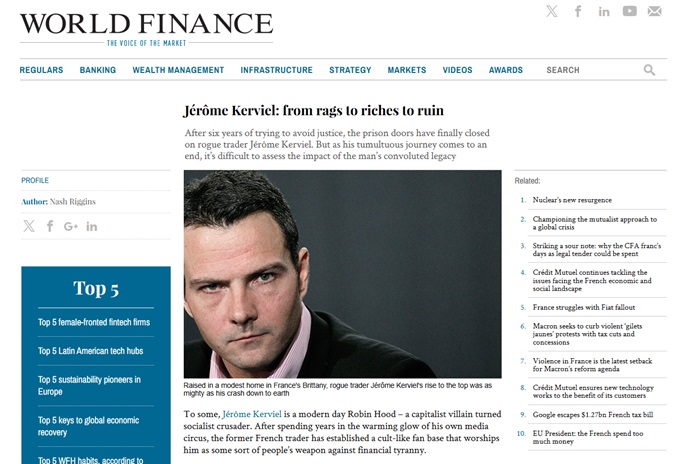
Education and Path into Finance
Kerviel pursued higher education in finance with determination. He first completed a bachelor’s degree in finance at the University of Nantes in 1999. This qualification laid the groundwork for his entry into the financial sector by providing him with essential knowledge of markets, financial instruments, and economic theory.
He then went on to obtain a Master of Finance degree from Lumière University Lyon 2 in 2000. His specialization was in the organization and control of financial markets, a field designed to prepare students for roles that focus on managing and monitoring financial operations, particularly in middle and back offices of banks. The program was supported by major French banks and had a reputation for producing solid, technically capable employees for financial institutions.
Interestingly, his lecturers at Lyon later described him as a fairly typical student. One of his former professors, Gisèle Reynaud, mentioned that he did not particularly stand out; he was simply “a student like the others.” This characterization emphasizes that Kerviel did not seem destined for fame or notoriety. He was neither a conspicuous top performer nor a known troublemaker. Instead, he appeared to be a quiet, diligent student who did the required work and followed a conventional path into the banking sector.
Early Career and Entry into Société Générale
In the summer of 2000, at the age of 23, Jérôme Kerviel joined Société Générale. His first role at the bank was in the middle office, working in the compliance department. The middle office is a crucial part of any trading operation: it does not execute trades directly but supports and oversees the activities of front-office traders. Kerviel’s work involved entering and checking trade details, monitoring transactions, and ensuring that operations complied with the bank’s rules and regulatory standards.
Although this position might be considered less glamorous than front-office trading, it gave Kerviel something arguably more valuable: a deep understanding of the bank’s internal systems. He became familiar with how trades were recorded, how approvals were generated, and how risk controls and alarms were structured. Over time, this experience granted him insight into both the strengths and the weaknesses of the bank’s risk management architecture.
Kerviel was characterized as hardworking and willing to put in extremely long hours. Colleagues recalled him working late nights and weekends, sometimes up to eighteen hours a day, to keep up with the demands of the fast-growing trading operations. This tireless work ethic laid the foundation for his eventual promotion, but it also placed him in an environment where performance and profits were increasingly prized above caution.

From Middle Office to Delta One Trading Desk
In 2005, after about five years in the middle office, Kerviel was promoted to the front office, joining Société Générale’s Delta One trading team in Paris. The Delta One desk dealt with equity derivatives, index futures, exchange-traded funds, and other instruments that allowed traders to make sophisticated bets on equity markets. His official role was to engage in arbitrage trading: identifying small price discrepancies between cash equities (actual stocks) and equity derivatives, then executing trades to profit from those discrepancies.
This role was meant to be relatively low-risk since arbitrage strategies typically involve hedged positions—simultaneously holding opposing positions in related instruments to limit exposure. However, the desk handled large volumes of transactions daily, and the nature of its business made it easier to conceal irregularities among legitimate trades. While Christian Noyer, then governor of the Bank of France, later described Kerviel as a “computer genius,” others at Société Générale claimed he was not a star trader in terms of performance or status.
Despite his junior rank and comparatively modest pay—around €74,000 salary with a €60,000 bonus in 2006—Kerviel nurtured strong ambitions. He saw colleagues earning vastly higher bonuses, and he reportedly hoped for a €600,000 bonus for 2007, expecting at least half that amount if the bank were satisfied with his results. This mix of technical knowledge, personal ambition, and exposure to high-stakes trading created the conditions under which his fraudulent activities later flourished.
Understanding Derivatives and Kerviel’s Trading Strategy
To understand the scale and nature of Kerviel’s actions, it is important to grasp the basics of derivatives. Derivatives are financial instruments whose value is derived from an underlying asset, such as a stock, an index, a commodity, or a currency. Common examples include futures, options, and swaps.
In a typical risk-conscious environment, a trader taking a long position (betting prices will rise) in one market will offset that exposure with a short position (betting prices will fall) in another related market. For instance, a trader might buy European stock index futures but hedge the risk by shorting a related index in another region. The goal is to earn a small, steady profit from price discrepancies while keeping overall risk limited and controlled.
However, Kerviel began to deviate from this standard approach. Instead of maintaining balanced hedged positions, he started making large, one-sided bets on the direction of equity markets, especially European stock indices. To make it appear as if these positions were properly hedged and within the bank’s risk limits, he created fictitious trades in the system. These fake offsetting trades never existed in reality, but they were recorded in the bank’s computers and logs, tricking internal systems into believing that his risk exposure was limited and properly covered.
The Rise of Unauthorized Trading
By late 2006 and throughout 2007, Kerviel’s unauthorized trading activity expanded dramatically. Using his knowledge gleaned from middle-office work, he manipulated trade entries, falsified data, and generated an enormous build-up of market exposure without proper authorization. He created hundreds of thousands of fake hedge trades to conceal his real positions, which were directional bets on market movements.
At times, he held positions with overall exposure reaching around €50 billion—more than the market capitalization of Société Générale itself. His strategies initially generated significant profits, including an estimated €1.4 billion in hidden gains at the beginning of 2008. While the bank later claimed that his behavior was completely outside authorized limits, Kerviel has long argued that his managers were at least aware of his unusually strong profits and chose not to ask too many questions as long as the numbers looked good.
He also tried to create losing trades intentionally in order to offset his earlier large profits and prevent them from drawing scrutiny. This approach reflects a paradox of his situation: he was simultaneously taking huge risks while also trying to “smooth” his results so as not to attract attention. Nonetheless, his performance metrics were far beyond expectations, and yet, according to internal investigations, dozens of risk alarms—around 74 separate warnings—were either ignored or insufficiently pursued by management.
Discovery of the Scandal and Market Fallout
In January 2008, things began to unravel. SocGen officials traced suspicious transactions back to Kerviel, finally recognizing the scale and irregularity of his positions. On or around January 19, 2008, the bank determined that he had accumulated massive unauthorized exposure in European equity index futures.
The bank decided to act quickly. Between January 21 and January 23, 2008, it began unwinding his positions in a market already experiencing intense volatility and fear due to the broader global financial crisis. As equity indices fell sharply, Société Générale’s rushed liquidation of Kerviel’s positions deepened the losses.
By the time the unwinding was complete, the bank announced losses of approximately €4.9 billion (about $7.2 billion). This figure represented one of the largest trading losses ever made by a single trader and severely destabilized the bank’s financial standing and reputation. European markets were rattled, and the scandal made global headlines. Some analysts questioned how a junior trader could handle positions of such magnitude without earlier detection, raising serious doubts about the integrity of the bank’s risk management systems.
Legal Proceedings and Initial Sentencing
Soon after the losses were disclosed, legal action began. On 24 January 2008, Société Générale filed a complaint against a “31-year-old employee,” referring to Kerviel. French prosecutors opened an investigation into breach of trust, forgery, and unauthorized access to computer systems. Police raided both the bank’s headquarters and Kerviel’s apartment, seizing computer files and documents.
Kerviel was taken into custody while investigators examined whether he acted alone or with accomplices. They scrutinized his phone records and explored potential connections with traders at other firms to see if anyone had been tipped off about the impending sell-off. No definitive evidence of external accomplices emerged, and prosecutors concluded that he had not personally enriched himself directly from his rogue trades, even though he stood to gain from bonuses if his performance was recognized.
Kerviel’s trial began in June 2010. During the hearings, he admitted to exceeding his limits and falsifying records but maintained that he did so in a culture that encouraged risk-taking and that his superiors tacitly approved his methods as long as profits came in. Société Générale firmly denied knowing about his fraudulent methods and insisted that he alone was responsible for the catastrophic losses.
In October 2010, the court issued its judgement. Kerviel was found guilty of breach of trust, forgery, and unauthorized use of the bank’s computers. He was sentenced to five years in prison, with two years suspended, and was ordered to pay back the full €4.9 billion to Société Générale. He was also permanently banned from working in financial services. Although it was widely recognized that a single individual could never repay such a sum, the damages award symbolically underscored the severity of the harm he was deemed to have caused.
Appeals, Reduced Damages, and Labor Court Rulings
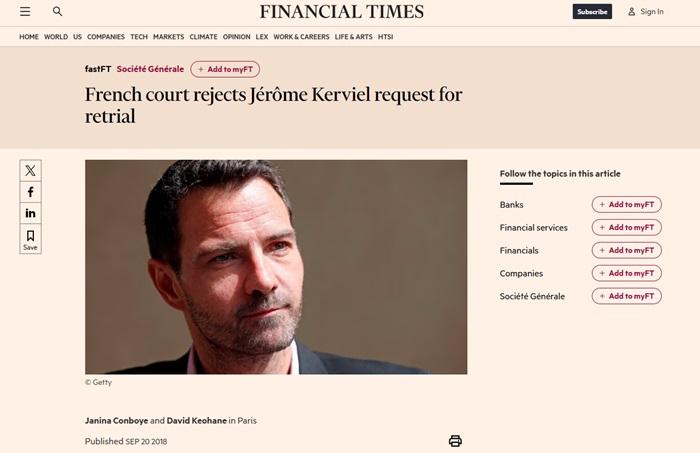
Kerviel and his lawyers appealed the ruling, arguing that the punishment was disproportionate and that the bank’s own systemic failures and managerial negligence had contributed significantly to the losses. In 2012, a Paris appeals court upheld both the prison sentence and the requirement that he repay the full amount of the losses. However, the legal story did not end there.
Eventually, France’s highest court weighed in on the matter. In March 2014, it upheld his criminal conviction and confirmed the prison term but overturned the order requiring him to reimburse the entire €4.9 billion. Later judicial and labor decisions began to highlight the role of management failures. In 2016, a labor court found that his dismissal by Société Générale had been “without real and serious cause,” and he was awarded compensation of around €450,000.
Further developments brought the damages owed by Kerviel down to a far smaller sum. In 2016, French courts reduced the amount from €4.9 billion to €1 million. Even this reduced amount left him with a significantly negative net worth, leading media to label him “the world’s poorest man” in a symbolic sense. The reduction also acknowledged that the bank’s inadequate controls and managerial choices made it partially responsible for the disaster.
Public Image, Politics, and the “World’s Poorest Man”
Over time, Kerviel’s image in the public eye shifted from that of a purely villainous rogue trader to something more ambiguous. Some continued to view him as a reckless white-collar criminal whose actions jeopardized a major financial institution and shook global markets. Others, however, began to see him as a scapegoat, sacrificed by a bank eager to conceal its own systemic shortcomings.
French public opinion became increasingly divided. Some politicians on the left, such as Jean-Luc Mélenchon, compared him to Alfred Dreyfus, invoking the historical symbol of miscarriage of justice. Even figures on the right, including Marine Le Pen, argued it was excessive to hold a single employee solely accountable for the failings of an entire bank.
The combination of his enormous notional “debt,” his modest background, and the perception of institutional negligence helped to create a kind of cult following. To some, he became a reluctant symbol of the excesses and hypocrisy of modern finance. The moniker “the world’s poorest man” crystallized the irony of a trader who once handled tens of billions of euros in exposure but ended up owing more money than any individual could ever hope to repay.
Pilgrimage, Pope Francis, and Moral Narrative
In the midst of ongoing legal and social battles, Kerviel embarked on a dramatic symbolic act. In 2014, he traveled to Rome and met Pope Francis outside the Vatican. Their conversation reportedly focused on the “tyranny of the markets,” giving a spiritual and ethical context to Kerviel’s experiences. The Pope is said to have given him a blessed rosary, a gesture that deeply moved him.
Inspired by that encounter, Kerviel undertook a long pilgrimage from Rome to Paris, walking roughly 1,300 to 1,400 kilometers. He framed the journey as a “march against the markets,” a protest against what he saw as a dehumanizing and morally corrupt financial system. He relied primarily on donations and the goodwill of people he encountered along the way.
Media outlets followed his pilgrimage closely, turning it into a public performance of repentance, protest, and personal transformation. While some dismissed it as a publicity stunt, others saw it as a sincere attempt by a former trader to reflect on his role in a flawed system and to atone, in some symbolic way, for his part in it.
Imprisonment, Release, and Later Career
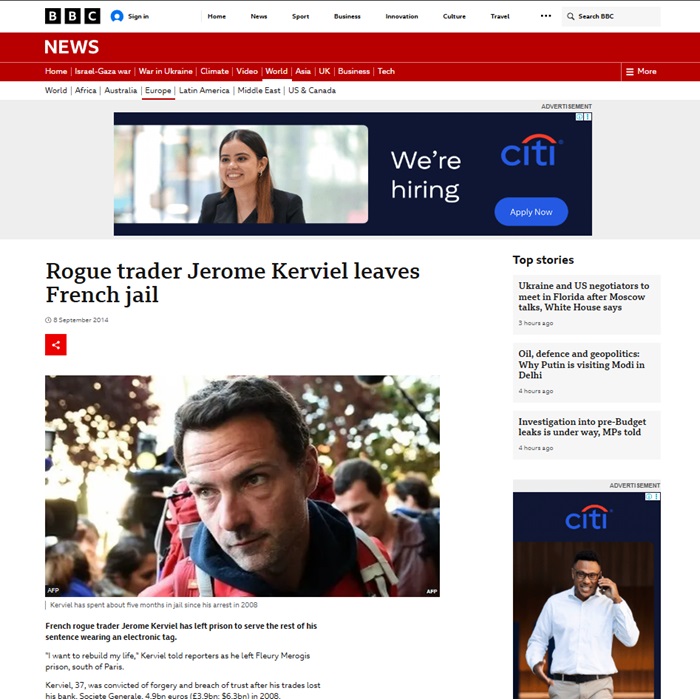
After the final stages of his appeal, Kerviel eventually reported to prison. He was incarcerated at Fleury-Mérogis prison, one of the largest prisons in Europe. Although his sentence included three actual years of incarceration, he served fewer than five months in detention before being released in September 2014 under conditions that included electronic surveillance.
Following his release, he moved into a quieter phase of life and focused on rebuilding his career in a different sector. Drawing on his technical and IT experience, he began working as an information technology and security consultant. He has been associated with Lemaire Consultants & Associates, a firm specializing in information systems and computer security.
This transition from derivatives trader to IT consultant reflects both the skills he possessed and the constraints imposed by his permanent ban from working in the financial markets. While he remains a recognizable public figure, his lifestyle today is far removed from the high-stakes, high-pressure world of major bank trading desks.

Net Worth and Current Status
In terms of personal finances, Kerviel’s situation remains unusual. Because of the court-imposed damages, even after reduction, he technically carries a large debt burden. With the figure set at €1 million instead of the original €4.9 billion, he is still, on paper, in deeply negative territory. Financially, he is not a wealthy man; the “world’s poorest man” label used in media stories emphasizes that the size of his obligations dwarfs his realistic earning capacity.
Nonetheless, he lives a relatively normal life compared to the dramatic extremes of his past. Rather than existing as a financial outcast, he works in IT consulting, participates occasionally in public debates and interviews, and continues to present himself as someone who was deeply embedded in, and ultimately destroyed by, a flawed financial system.
Legacy and Impact on Global Finance
The story of Jérôme Kerviel has had enduring effects on the perception and regulation of global financial markets. His case highlighted how a single trader, if inadequately supervised and supported by weak control systems, can expose a bank to massive risks. It also demonstrated that technological complexity and high-volume trading can make it easier to hide unauthorized positions—especially in departments like Delta One, where large, seemingly low-risk trades are placed routinely.
Regulators and bank executives around the world used the scandal as a cautionary example. It prompted reviews of internal controls, risk-monitoring frameworks, and incentive structures. Comparable rogue trading incidents, such as those involving Kweku Adoboli at UBS and Bruno Iksil at JPMorgan (the “London Whale”), reinforced the idea that systemic control weaknesses and cultural pressures can encourage traders to push past established limits and take dangerous bets.
Beyond regulations, Kerviel’s story fueled broader public skepticism about large financial institutions. It underlined the feeling that banks may reward aggressive risk-taking when it leads to profits but then seek a single individual to blame when things go wrong. The fact that courts later recognized managerial responsibility to some degree, reducing his financial liability and awarding him compensation for wrongful dismissal, strengthened the perception that the problem was not just one man but an entire system of incentives and oversight failures.
Jérôme Kerviel’s life story—from a modest childhood in Brittany to the heart of a global trading scandal, through public humiliation, legal battles, spiritual pilgrimage, and eventual re-entry into ordinary working life—captures many of the contradictions of modern finance. He was a junior trader handling unimaginable sums, a man praised for profits yet punished for the same risks that had once benefited his employer, a convicted rogue trader and, to some, an emblem of systemic injustice.
Today he lives and works far from the glare of trading screens, but his name remains synonymous with the dangers of unchecked risk-taking and weak institutional controls. His case continues to be taught in finance, risk management, and ethics courses as a powerful reminder that the intersection of human ambition, technological complexity, and corporate culture can create vulnerabilities with enormous consequences.
In the end, Jérôme Kerviel’s legacy is not just about one trader making unauthorized trades; it is about what happens when institutions fail to align incentives with prudence, when warning signs are ignored, and when large organizations place profits above vigilance. His story stands as a long, complicated cautionary tale for banks, regulators, and societies that rely on the stability of financial systems in an increasingly interconnected world.
Related Fraudsters Scammers:



Popular Links

SWINDLERS LIST
-
Top 10 Scammers !!!
Beware of these scammers...Keep them out of your mail-box...

SCAM TOOLS
-
Block Scam Mails???
Cleaning your scam filled inbox can be effected by these tools
HELP DESK
-
Waiting to help You!!!
Every problem has a solution when discussed. Discuss with us to get a clear idea to keep your information unscathed from hypocrites