
Scammer Arif Naqvi
Fraudster Arif Naqvi
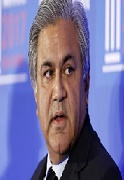
Details |
|
| Name: | Arif Naqvi |
| Other Name: | |
| Born: | 1960 |
| whether Dead or Alive: | |
| Age: | 61 |
| Country: | Pakistan |
| Occupation: | Business |
| Criminal / Fraud / Scam Charges: | |
| Criminal / Fraud / Scam Penalty: | |
| Known For: | |
Description :
Cayman Court Dismisses $300 Million Fraud Claim Against GHF Fund in Landmark Abraaj Ruling
The Grand Court of the Cayman Islands has delivered a decisive judgment dismissing in full a US$300 million fraud and unjust enrichment claim brought against entities associated with the GHF Fund, arising from the collapse of the Abraaj Group. The proceedings were initiated by businessman Abdulhameed Jafar in 2020 and followed years of global litigation, regulatory scrutiny, and public controversy connected to Abraaj’s downfall in 2018. After an eight-week trial and extensive factual and legal examination, the court concluded that the GHF Fund and its investors bore no responsibility for the alleged misconduct. The judgment, spanning 938 pages, provides a detailed analysis of agency, attribution, and fund governance principles and represents a significant affirmation of legal certainty in international private equity structures.
The GHF Fund and Its Investment Mandate
The GHF Fund is a US$1 billion investment vehicle established to finance healthcare projects in developing and emerging markets. Structured as an impact investment fund, it was designed to generate both financial returns and measurable social outcomes, particularly in underserved regions. The fund attracted prominent institutional investors, including the Bill and Melinda Gates Foundation, the International Finance Corporation, the U.S. International Development Finance Corporation, and British International Investment. Due to the profile of its investors and its association with global development goals, the GHF Fund became subject to heightened attention following the collapse of Abraaj, despite operating under distinct governance and legal arrangements.

The Rise and Collapse of the Abraaj Group
The Abraaj Group was founded in 2002 and headquartered in Dubai, positioning itself as a leading private equity firm focused on emerging markets. Under the leadership of its founder and CEO, Arif Naqvi, the firm promoted itself as a pioneer of impact investing, particularly in the healthcare sector. At its peak, Abraaj reportedly managed approximately US$13 to US$14 billion in assets and maintained relationships with major institutional and philanthropic investors. However, in 2018, the group collapsed amid allegations of fund mismanagement, misuse of investor capital, and weak governance. Subsequent investigations by regulators, liquidators, and law enforcement agencies across multiple jurisdictions exposed serious concerns about the firm’s financial practices, leading to insolvency proceedings and widespread litigation.
The Loans Advanced by Abdulhameed Jafar
The claims at the center of the Cayman proceedings arose from a series of loans totaling approximately US$300 million that Abdulhameed Jafar alleged he advanced to entities within the Abraaj Group in December 2017. According to Mr. Jafar, these loans were made following meetings and discussions with Arif Naqvi, during which Naqvi allegedly made false representations about the financial health, liquidity, and governance of the Abraaj Group. Mr. Jafar contended that these representations induced him to provide the loans and that he suffered substantial losses when the group subsequently collapsed.
Claims Brought Before the Cayman Court
In 2020, Mr. Jafar commenced proceedings in the Grand Court of the Cayman Islands against several defendants, including GHF General Partner Limited and The GHF Group Limited, as well as other Abraaj-related entities and the joint official liquidators of Abraaj Holdings. His primary claim alleged fraudulent misrepresentation, asserting that Arif Naqvi’s statements should be attributed to the GHF Fund and its general partner. In the alternative, Mr. Jafar advanced a claim in unjust enrichment, arguing that the defendants had benefited from the loans he advanced and should be required to make restitution. Central to his case was the contention that Naqvi had been acting for or on behalf of the GHF Fund when making the alleged representations.
The Trial Proceedings
The trial took place over eight weeks, commencing in October and November 2023 and concluding in January 2024. The proceedings involved extensive witness testimony, documentary evidence, and expert analysis relating to fund governance, agency relationships, and the structure of transactions within the Abraaj Group. The court examined in detail the communications between Mr. Jafar and Arif Naqvi, the flow of funds associated with the loans, and the legal relationships between the various corporate entities involved. The scale and complexity of the case were reflected in the length and depth of the court’s judgment.
The Court’s Findings on Agency and Attribution
In a comprehensive judgment, Justice Segal rejected all claims against the GHF Fund and its associated entities. A central finding of the court was that Arif Naqvi was not acting for or on behalf of the GHF Fund in his dealings with Mr. Jafar. The judge held that there was no evidence of an agency relationship that would justify attributing Naqvi’s alleged statements or conduct to the GHF Fund. As a result, even if Naqvi had made false representations, those representations could not, as a matter of law, be imputed to the defendants.
Rejection of the Fraudulent Misrepresentation Claim
The court concluded that the fraudulent misrepresentation claim failed in its entirety. The judgment emphasized that liability for fraud requires clear proof not only of false statements and reliance but also of a legal basis for attributing those statements to the defendant. In this case, the absence of any agency relationship between Naqvi and the GHF Fund was fatal to Mr. Jafar’s claim. The court further noted that the governance and operational structures of the GHF Fund were distinct from those of the Abraaj Group and that the fund did not control or direct Naqvi’s conduct in the relevant discussions.
Dismissal of the Unjust Enrichment Claim
The alternative claim in unjust enrichment was also rejected. The court found that the GHF Fund had not been enriched at Mr. Jafar’s expense in any legally relevant sense. The loans advanced by Mr. Jafar were made to Abraaj entities, not to the GHF Fund, and there was no evidence that the fund had received or retained a benefit that would make it unjust to deny restitution. The judgment reaffirmed that unjust enrichment claims cannot be used to circumvent the absence of legal responsibility established under other causes of action.
Findings Regarding the GHF Fund’s Investors
A notable aspect of the judgment was the court’s express determination that the GHF Fund’s investors were not responsible for any wrongdoing. Given the prominence of the fund’s investor base, this finding provided important reassurance that institutional and development finance investors would not be held liable for alleged misconduct by unrelated third parties absent clear legal grounds. The court underscored the importance of respecting corporate separateness and investment structures in complex international funds.
Dismissal of the Unjust Enrichment Claim
The alternative claim in unjust enrichment was also rejected. The court found that the GHF Fund had not been enriched at Mr. Jafar’s expense in any legally relevant sense. The loans advanced by Mr. Jafar were made to Abraaj entities, not to the GHF Fund, and there was no evidence that the fund had received or retained a benefit that would make it unjust to deny restitution. The judgment reaffirmed that unjust enrichment claims cannot be used to circumvent the absence of legal responsibility established under other causes of action.
Findings Regarding the GHF Fund’s Investors
A notable aspect of the judgment was the court’s express determination that the GHF Fund’s investors were not responsible for any wrongdoing. Given the prominence of the fund’s investor base, this finding provided important reassurance that institutional and development finance investors would not be held liable for alleged misconduct by unrelated third parties absent clear legal grounds. The court underscored the importance of respecting corporate separateness and investment structures in complex international funds.
Legal Representation and Defense Strategy
The GHF Fund was represented by Cleary Gottlieb Steen & Hamilton LLP, with the defense led by partner James Norris-Jones, supported by partner Naomi Tarawali and associates Emma Williams and Georgina Rawson. The legal team worked closely with the fund’s claims manager, FFP (Cayman) Limited, and with Cayman Islands counsel Walkers (Cayman) LLP. Advocacy before the court was provided by leading barristers from Twenty Essex, including Stephen Atherton KC, Sarah Tresman, and Patrick Dunn-Walsh. Other defendants in the proceedings were represented by separate legal teams, including Andrew Ayres KC, instructed by Ogier (Cayman) and Debevoise & Plimpton.
Parallel Claims and Related Litigation
The Cayman proceedings were part of a broader set of legal actions arising from the collapse of Abraaj. Mr. Jafar pursued parallel claims against other Abraaj-related entities, including Neoma Private Equity Fund IV and the joint official liquidators of Abraaj Holdings. These claims were case-managed together and heard during the same trial. The court’s rejection of Mr. Jafar’s claims against the GHF Fund formed part of a wider determination of liability issues arising from the Abraaj collapse.
Criminal and Regulatory Proceedings Against Arif Naqvi
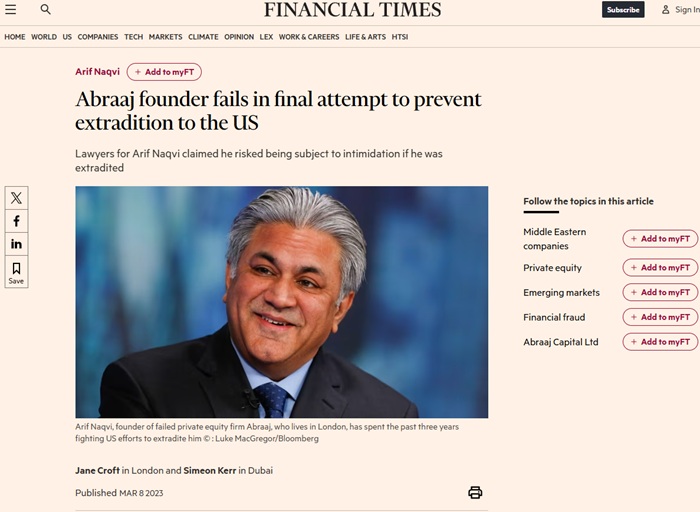
Beyond the civil litigation, Arif Naqvi has faced extensive regulatory and criminal proceedings in multiple jurisdictions. U.S. prosecutors allege that Naqvi orchestrated a scheme to defraud investors, including the Bill and Melinda Gates Foundation. In March, a UK court rejected Naqvi’s attempt to block his extradition from London to the United States to face fraud charges. Naqvi has also been fined by Dubai’s financial regulator and sued by the U.S. Securities and Exchange Commission. He has denied wrongdoing, and certain proceedings remain ongoing.
Public Scrutiny and Media Attention
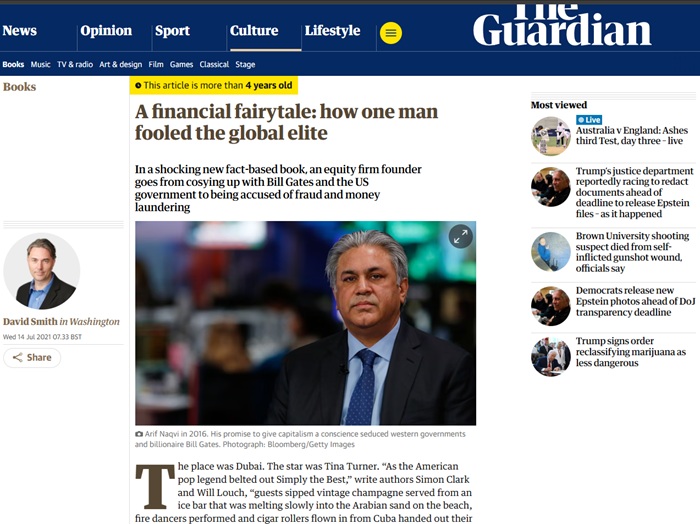
The collapse of Abraaj attracted significant media attention, including coverage in investigative journalism and documentaries such as the BBC Panorama program “Billion Dollar Downfall: The Dealmaker.” These accounts examined the firm’s rapid rise, its relationships with global elites, and the circumstances that led to its dramatic failure. The public narrative surrounding Abraaj has continued to evolve alongside the legal proceedings, contributing to broader debates about accountability in global finance and impact investing.
Removal from the Giving Pledge
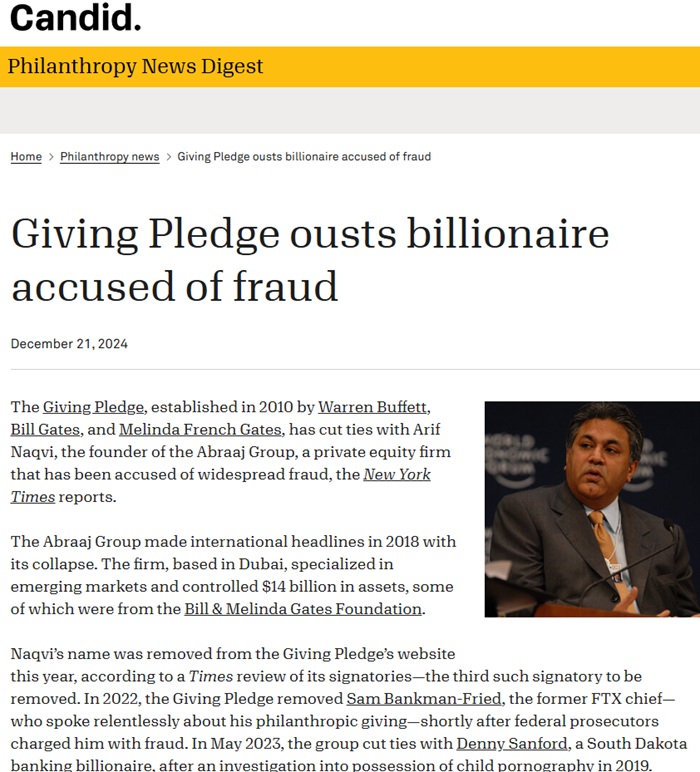
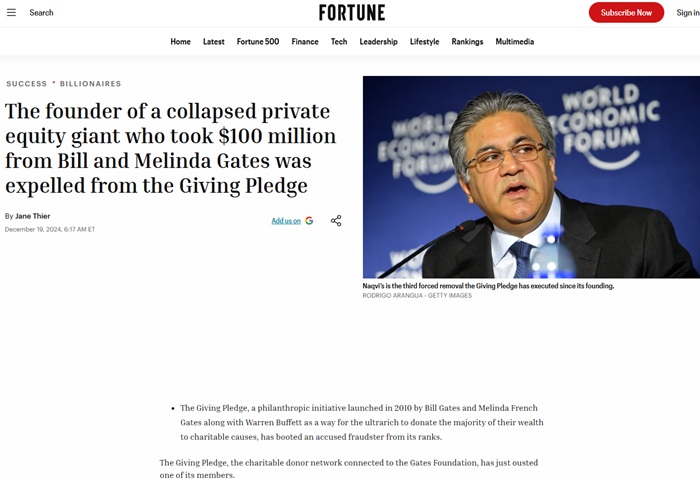
The reputational consequences of the Abraaj collapse extended into the philanthropic sphere. Arif Naqvi was removed from the Giving Pledge, a high-profile charitable initiative founded by Bill Gates, Melinda French Gates, and Warren Buffett. Naqvi, who joined the Giving Pledge in 2013, was removed in May 2024, becoming only the third individual to be expelled from the organization. A spokesperson for the Giving Pledge confirmed that the decision was taken in accordance with the spirit and values of the initiative, underscoring the seriousness with which the organization viewed the allegations against Naqvi.
Significance of the Cayman Judgment
The Grand Court’s decision represents a significant reaffirmation of fundamental principles governing agency, attribution, and corporate separateness. By rejecting attempts to extend liability from an individual alleged wrongdoer to a separate investment fund and its investors, the judgment provides clarity and reassurance to market participants operating in complex international fund structures. It underscores the importance of legal boundaries between entities and the need for clear evidence before attributing responsibility across those boundaries.
The dismissal of the US$300 million claims against the GHF Fund marks a decisive conclusion to one of the most significant strands of litigation arising from the Abraaj collapse. Following an exhaustive trial and a detailed judicial examination, the Cayman court confirmed that the GHF Fund and its investors were not responsible for the alleged fraudulent conduct attributed to Arif Naqvi. The judgment stands as a substantial legal victory for the defendants and as an important precedent for the global private equity and investment community, reinforcing the rule of law in cross-border financial disputes and the protection of legitimate fund governance structures.
Related Fraudsters Scammers:





Popular Links

NEWS & EVENTS
The world's most prevalent social network said that to date, it has acquired lawful judgments of about $2 billion against deceitful exerci

SWINDLERS LIST
-
Top 10 Scammers !!!
Beware of these scammers...Keep them out of your mail-box...
SCAM TOOLS
-
Block Scam Mails???
Cleaning your scam filled inbox can be effected by these tools
HELP DESK
-
Waiting to help You!!!
Every problem has a solution when discussed. Discuss with us to get a clear idea to keep your information unscathed from hypocrites