
Scammer Faruk Fatih Ozer
Fraudster Faruk Fatih Ozer

Details |
|
| Name: | Faruk Fatih Ozer |
| Other Name: | Ozer |
| Born: | 1992 |
| whether Dead or Alive: | |
| Age: | 33 |
| Country: | Turkish |
| Occupation: | Businessman |
| Criminal / Fraud / Scam Charges: | Thodex exchange |
| Criminal / Fraud / Scam Penalty: | September 7, 2023, Ozer was fined 135 million Turkish liras (approximately US$5 million) and sentenced to 11,196 years in prison. |
| Known For: | Null |
Description :
The Story Behind Turkey's Crypto Collapse-Faruk Fatih Özer
Early Life, Family, and Formative YearsFaruk Fatih Özer, born in either 1993 or 1994, rose to global notoriety as the young Turkish founder of Thodex, a cryptocurrency exchange that would eventually become one of Turkey’s largest digital asset platforms. His early life remained relatively obscure, with limited public documentation about his childhood or schooling, suggesting he came from a modest, middle-class background far removed from the world of high finance and cryptocurrency that later defined his public identity. This humble beginning created a striking contrast to the extraordinary wealth, influence, and public recognition he achieved during his twenties. Growing up in Turkey, Faruk was raised alongside his siblings—his sister, Serap, and his brother, Güven—both of whom would later become deeply intertwined with his business ambitions and ultimately share in the legal repercussions of his downfall. The family appeared to be close-knit and supportive, with all three siblings reportedly working together within the Thodex enterprise, a dynamic that later played a significant role in the Turkish court’s decision to issue equal sentences to each of them.
As a young boy and teenager, Faruk displayed a strong fascination with technology, innovation, and entrepreneurship. However, he struggled within the traditional educational system and eventually dropped out of high school. Instead of perceiving his early exit from formal education as a limitation, he embraced it as proof of his independence, ambition, and unconventional thinking. He would later lean heavily on this narrative in his public persona, particularly during his court appearances, where he famously declared, “I am smart enough to lead any institution on Earth.” This statement underscored how he viewed himself—not as an unqualified dropout but as a uniquely capable individual who possessed the intelligence, instincts, and boldness to build and lead major organizations even without academic credentials. While this self-assured confidence captivated many young Turkish investors seeking a charismatic figure in the rapidly evolving digital finance sector, critics would later argue that his lack of formal education and structured business training contributed to the risky practices and operational mistakes that ultimately destabilized his empire.
Turkey’s Economic Crisis and the Perfect Timing for a Cryptocurrency Boom
To understand Faruk Fatih Özer’s remarkable rise, it is crucial to examine the economic climate of Turkey in the mid-2010s, a period characterized by intense volatility and uncertainty. During these years, the Turkish lira experienced rapid depreciation, inflation soared, and trust in traditional banking and savings mechanisms eroded. As citizens struggled to preserve the value of their money, many sought out new and alternative financial solutions to protect their wealth. Fiat currency had become unstable, savings accounts lost purchasing power, and traditional investments yielded little security.
It was during this tumultuous period that cryptocurrency began gaining traction in Turkey. Digital assets such as Bitcoin, Ethereum, and emerging altcoins were increasingly perceived not only as speculative tools but also as practical hedges against the weakening currency. The allure of financial independence, decentralized trading, and high-growth potential attracted millions of Turkish citizens who felt trapped by the country’s economic constraints. This widespread societal shift created an environment ripe for new crypto exchanges to emerge and flourish. When Thodex entered the market, it capitalized perfectly on this demand, presenting itself as a modern, trustworthy, and technologically advanced alternative to failing economic structures. For many Turks, especially the younger generation, Thodex became a gateway to a seemingly more stable and profitable financial future.
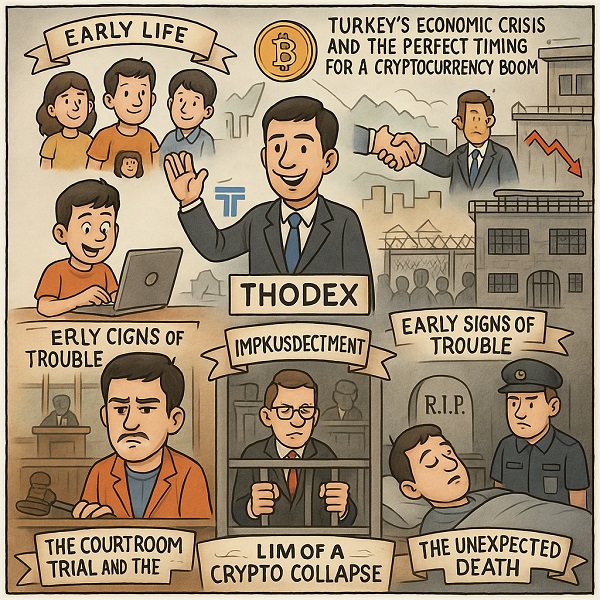
The Founding of Thodex in 2017: A National Crypto Powerhouse
In 2017, at just around 22 years old, Faruk Fatih Özer launched Thodex from Istanbul, positioning it as a next-generation cryptocurrency exchange designed to serve millions of users across Turkey. Unlike many early crypto platforms that suffered from liquidity shortages, technical instability, or unclear regulatory footing, Thodex marketed itself as a sleek, professional, and secure platform with cutting-edge technology. It offered fast transactions, competitive trading fees, and an array of promotional campaigns that dazzled the public—including giveaways of luxury cars, gold coins, and large amounts of cryptocurrency. These campaigns rapidly boosted its visibility, drawing in hundreds of thousands of customers and transforming Thodex into one of Turkey’s leading crypto exchanges within just a few short years.
Faruk’s leadership style relied heavily on public relations. He cultivated an image of a sophisticated, self-made entrepreneur who commanded respect, credibility, and aspiration. To enhance his reputation, he engaged in highly publicized interactions with influential Turkish political figures, including Mevlüt Çavuşoğlu, the Minister of Foreign Affairs, and Süleyman Soylu, the then-Minister of the Interior. While these figures never officially endorsed Thodex, their public appearances with Faruk created a powerful psychological effect. For many investors, these encounters implied governmental trust and legitimacy, reassuring them that Thodex operated with high-level acknowledgment. As a result, investor confidence grew rapidly, and the platform expanded at extraordinary speed.
This period also coincided with a global surge in blockchain technology interest. International exchanges were expanding, and crypto markets were reaching unprecedented heights. Faruk capitalized on this momentum, frequently discussing Thodex’s future global partnerships, expansion plans, and cutting-edge technological advancements. He painted a vision of a company not limited to Turkey but destined to become a major global financial player. This global ambition further cemented Thodex’s appeal and attracted a massive user base who believed in Faruk’s promise of a technologically empowered financial revolution.
Early Signs of Trouble: Liquidity Issues, Unstable Operations, and Internal Risks
Despite the appearance of success and stability, Thodex was plagued by significant internal problems that went largely unnoticed by the public. Behind the scenes, the exchange was struggling with liquidity issues as it reportedly lacked the reserves necessary to support large-scale user withdrawals. The platform’s liabilities began to exceed its assets, reflecting a widening financial imbalance caused by inadequate risk management and potentially deliberate misappropriation of funds. As more investors poured money into Thodex, the company’s ability to balance deposits with actual cryptocurrency holdings diminished.
Financial oversight within the company was also alarmingly weak. Regulators later revealed that Thodex’s internal accounting practices were inconsistent and lacked transparency. Records did not align with customer balances, and discrepancies emerged in both trading data and reserve holdings. Some analysts argued that these inconsistencies reflected mismanagement, while critics suggested they might indicate deliberate manipulation or preparation for illicit fund transfers. These concerns deepened when investigators uncovered large cryptocurrency transfers to unknown wallets, raising suspicions that Faruk and others may have been quietly moving funds long before the platform’s collapse.
In addition to these operational and financial issues, Thodex suffered from structural inexperience at the leadership level. Faruk’s confidence, while appealing to many, did not compensate for his lack of corporate governance skills or comprehensive financial knowledge. His management style was described as bold but impulsive, and the absence of strong executive oversight allowed strategic mistakes and operational vulnerabilities to go uncorrected. Warning signs were reportedly raised internally, but they were ignored or minimized. To the public, however, Thodex continued to present an image of growth, opportunity, and technological innovation, encouraging investors to place more money into what they believed to be a trustworthy financial ecosystem.
The Sudden Collapse of Thodex in April 2021
The downfall of Thodex unfolded with shocking speed and severity. In April 2021, users attempting to access their accounts discovered that withdrawals had been abruptly halted due to what the company claimed were temporary “technical maintenance” issues. While deposits remained possible, withdrawals were indefinitely suspended, immediately triggering panic among investors who feared losing access to their funds. As complaints flooded social media and customer support channels, Thodex offered no satisfactory explanations, deepening public unrest.
The situation escalated dramatically on April 20, 2021, when Faruk shut down all his social media accounts and fled Turkey, boarding a flight to Albania. His sudden disappearance transformed a suspicious technical failure into a full-blown financial scandal. Within 48 hours, the Turkish government launched a formal investigation, and prosecutors accused Thodex of orchestrating one of the largest financial frauds in the nation’s history. Early estimates claimed that 390,000 investors had been affected and that approximately $2 billion worth of digital assets had vanished. Although subsequent investigations revised the total loss to a lower amount, the outrage and devastation inflicted upon the public were immense.
From abroad, Faruk issued statements claiming that Thodex had been the victim of a cyber-attack and that he had left Turkey to negotiate with foreign investors in an attempt to salvage the company. However, few believed his explanation, and the collapse of Thodex became a national scandal that dominated headlines for months.
International Pursuit: INTERPOL Red Notice and the Hunt for Özer
Following his disappearance, Turkish authorities issued an INTERPOL Red Notice, effectively launching an international manhunt for Faruk. Despite attempts to evade detection, he was spotted multiple times in various parts of Albania over the course of sixteen months. The pursuit involved cooperation between Albanian police, Turkish intelligence agencies, and INTERPOL’s global network.
On August 30, 2022, Albanian authorities located and arrested Faruk in the Vlorë region, marking a major turning point in the case. His arrest was widely celebrated in Turkey, as it provided hope to the thousands of victims who had lost their savings and had been waiting for justice. The extradition process that followed was complex and prolonged, with Faruk’s defense team filing appeals and attempting to delay his transfer back to Turkey. However, the Albanian courts ultimately approved the extradition request, and in April 2023, he was returned to Istanbul under heavy security.
The Courtroom Trial and the 11,196-Year Sentence
Faruk’s return to Turkey set the stage for one of the most highly publicized criminal trials in recent Turkish history. Prosecutors charged him with fraud, money laundering, leadership of a criminal organization, and multiple other financial crimes. A total of 2,027 victims were formally identified in the case, each contributing to the severity of the charges and the enormous sentencing potential.
Throughout the trial, Faruk remained bold and defiant. He continued to insist that Thodex had been attacked by hackers, that he had no intention of committing fraud, and that his actions had been misinterpreted. His courtroom proclamations—especially his statement asserting his intellectual superiority—became widely discussed in media outlets. Despite his confident demeanor, the court found overwhelming evidence of misconduct.
On September 7, 2023, the court delivered its historic verdict. Faruk Fatih Özer was sentenced to an astonishing 11,196 years in prison, one of the longest prison sentences ever issued globally. His siblings, Serap and Güven, who were also convicted of participating in the scheme, received identical sentences. Faruk was additionally fined 135 million Turkish liras, approximately $5 million. These extraordinary sentences resulted from Turkey’s legal structure, which permits extremely long prison terms in place of the death penalty, abolished in 2004.
Imprisonment in Tekirdağ F-Type High-Security Prison
Following his sentencing, Faruk was transferred to Tekirdağ F-Type High-Security Closed Penitentiary, a facility known for housing some of Turkey’s most dangerous criminals, including organized crime leaders and individuals serving exceptionally long sentences. Life within this prison is extremely harsh, with strict surveillance, limited movement, and severe restrictions on inmate interaction. Conditions are designed to minimize communication, prevent organized criminal activity, and maintain absolute security.
During his time in prison, reports suggested that Faruk’s initial confidence gradually faded as the weight of his sentence became more real. With virtually no legal pathway to freedom and no possibility of returning to society, the psychological strain of isolation and the enormity of his punishment reportedly took a toll on his mental well-being. While the media speculated about his emotional state, official information remained limited, as prison authorities maintain strict confidentiality regarding inmate conditions. Nonetheless, the abrupt transition from controlling a major financial enterprise to living under extreme incarceration likely contributed to an increasingly fragile psychological state
The Unexpected Death on 1 November 2025
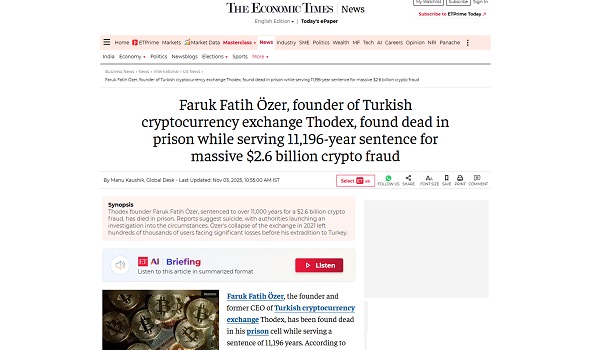
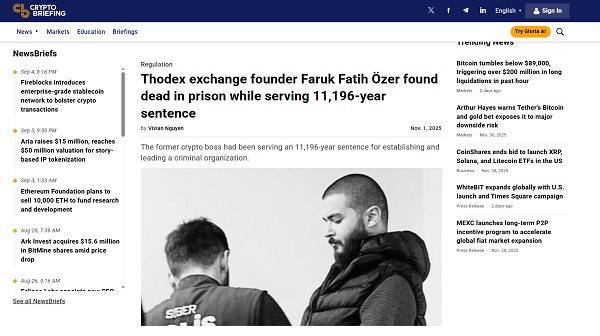
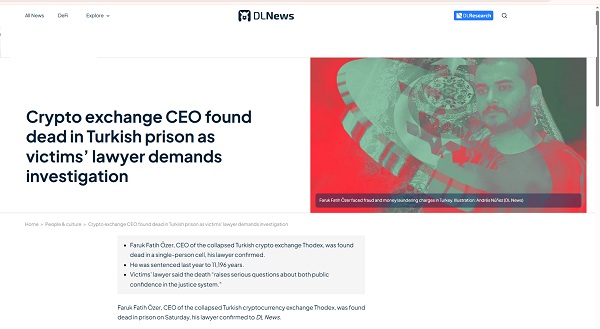
On November 1, 2025, news broke that Faruk Fatih Özer had been found dead in his prison cell. The discovery occurred early in the morning when correctional officers were conducting routine inspections. Attempted resuscitation efforts by emergency medical teams were unsuccessful, and he was officially pronounced dead shortly after.
The cause of his death was not immediately disclosed, leading to widespread public speculation. Some believed that he may have taken his own life due to the overwhelming psychological burden of his situation. Others suggested possible medical complications. More sensational theories pointed to foul play, given the massive financial losses, numerous victims, and potential criminal networks affected by the collapse of Thodex. Social media exploded with conspiracy theories, reflecting the polarizing nature of Faruk’s public image. His death effectively closed a dramatic chapter in one of Turkey’s most significant financial crime cases, though many questions about the true nature of Thodex, the missing funds, and Faruk’s intentions remained unanswered.
Public Reaction and Impact on Turkey's Crypto Industry
Faruk Fatih Özer’s dramatic rise and catastrophic fall had a profound and lasting impact on Turkey’s cryptocurrency landscape. Before the Thodex scandal, crypto exchanges were widely viewed as innovative financial platforms that offered new economic opportunities and protections against the instability of the Turkish lira. However, the collapse of Thodex shattered public trust in local exchanges and highlighted the dangers of inadequately regulated digital financial markets.These measures included the introduction of mandatory audits, proof-of-reserves requirements, licensing frameworks, and enhanced reporting obligations. Public perception of cryptocurrency shifted dramatically, with many Turks becoming more cautious about investing in local exchanges and opting instead for internationally recognized platforms or secure offline storage methods.
Economically, the Thodex incident exposed deeper issues within Turkey’s financial system, particularly the desperation that drove many citizens to seek refuge in risky investments. It also served as a harsh reminder of the importance of safeguarding digital assets and promoting financial education. Culturally, Faruk became a symbol of both misplaced trust and the dark side of rapid technological adoption. His story continues to be cited as a case study emphasizing the need for ethical leadership, regulatory oversight, and consumer protection in emerging financial markets.
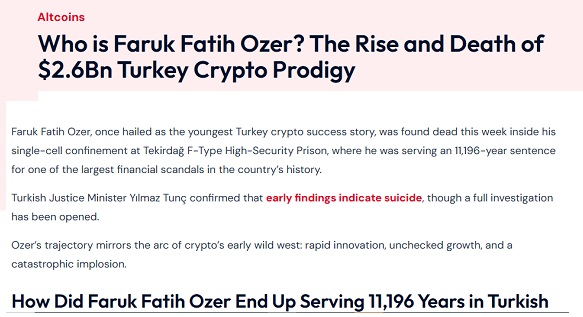
Legacy of a Crypto Collapse: Rise, Fall, and Controversy
The legacy of Faruk Fatih Özer is overwhelmingly complex, marked by ambition, deception, innovation, controversy, and tragedy. He is remembered as a prodigy who demonstrated extraordinary intelligence and charisma capable of building a major financial platform from scratch at a young age. To many, he represented the hope and promise associated with digital finance during a period of intense national economic struggle.
However, he is equally remembered as the architect of one of Turkey’s largest financial scandals, responsible for the disappearance of millions of dollars and the devastation of hundreds of thousands of investors. His flight from Turkey intensified suspicions and solidified his reputation as a fugitive rather than a misunderstood entrepreneur. His dramatic capture after an international manhunt added cinematic intensity to his story, while his unprecedented 11,196-year prison sentence made international headlines and placed his case among the most extreme in legal history.
Ultimately, his death at a young age in a high-security prison cemented his status as a tragic figure whose rise and fall embodied the risks of unregulated financial expansion and unchecked ambition. His story remains a cautionary tale about the fragile line between visionary innovation and catastrophic misconduct, illustrating the lasting human cost of financial crimes in the digital age.
.
Related Fraudsters Scammers:





Popular Links

NEWS & EVENTS
The world's most prevalent social network said that to date, it has acquired lawful judgments of about $2 billion against deceitful exerci

SWINDLERS LIST
-
Top 10 Scammers !!!
Beware of these scammers...Keep them out of your mail-box...
SCAM TOOLS
-
Block Scam Mails???
Cleaning your scam filled inbox can be effected by these tools
HELP DESK
-
Waiting to help You!!!
Every problem has a solution when discussed. Discuss with us to get a clear idea to keep your information unscathed from hypocrites