
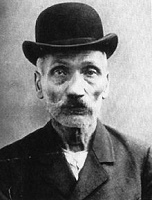
Scammer Chung Mong-koo
Fraudster Chung Mong-koo

Details |
|
| Name: | Chung Mong-koo |
| Other Name: | |
| Born: | 1938 |
| whether Dead or Alive: | |
| Age: | 83 |
| Country: | South Korea |
| Occupation: | businessman |
| Criminal / Fraud / Scam Charges: | |
| Criminal / Fraud / Scam Penalty: | |
| Known For: | |
Description :
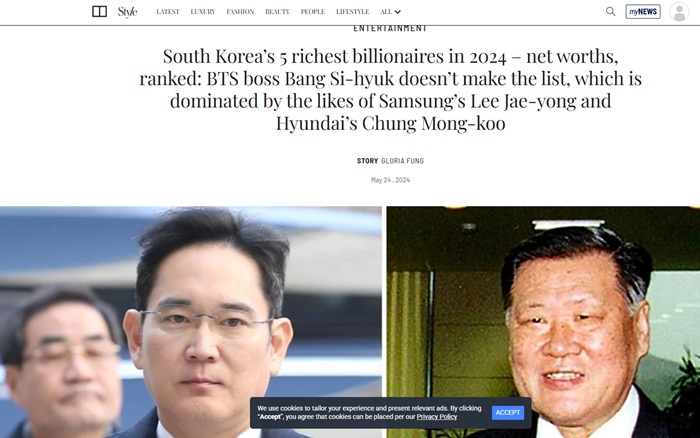
Hyundai’s Chairman and the Limits of Justice: The Chung Mong-koo Case
South Korea’s rapid rise from post-war devastation to global economic power is often described as a miracle. Central to this transformation were the chaebol, family-controlled conglomerates such as Hyundai, Samsung, SK, and LG. These vast corporate groups drove industrialization, exports, and technological advancement, becoming indispensable to national growth. Yet the same concentration of economic power also created a dangerous imbalance, allowing corporate leaders to accumulate influence so great that legal accountability itself appeared conditional. Over time, a belief took root that certain individuals were simply too important to the economy to be punished by the courts.
The Chaebol–State Relationship
The foundations of this imbalance lie in the close relationship between the South Korean state and the chaebol. In the decades following the Korean War, the government actively supported select firms with loans, regulatory privileges, and political backing. In return, these companies fueled industrial expansion and employment. What began as a developmental strategy gradually hardened into structural dependency. As the chaebol expanded across industries, their leaders became intertwined with political power, blurring the boundary between public interest and private control.
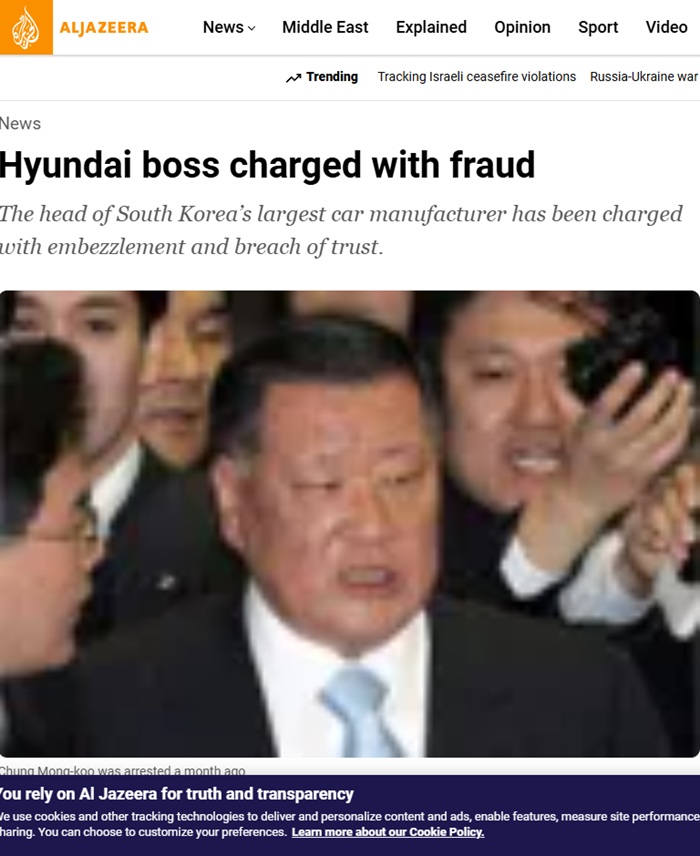
Chung Mong-koo and the Hyundai Legacy
Chung Mong-koo was born into one of South Korea’s most powerful industrial families. His father, Chung Ju-yung, founded Hyundai and became a symbol of entrepreneurial ambition. Chung Mong-koo joined Hyundai Motor in 1970, steadily rising through the company’s hierarchy. His ascent was marked by early controversy. In 1978, he and his father were investigated for corrupt property deals. Although cleared, Chung Mong-koo was briefly jailed for construction regulation violations before paying a fine, an early indication of how legal troubles could be resolved without lasting consequence.
Becoming Chairman of Hyundai Motor Group
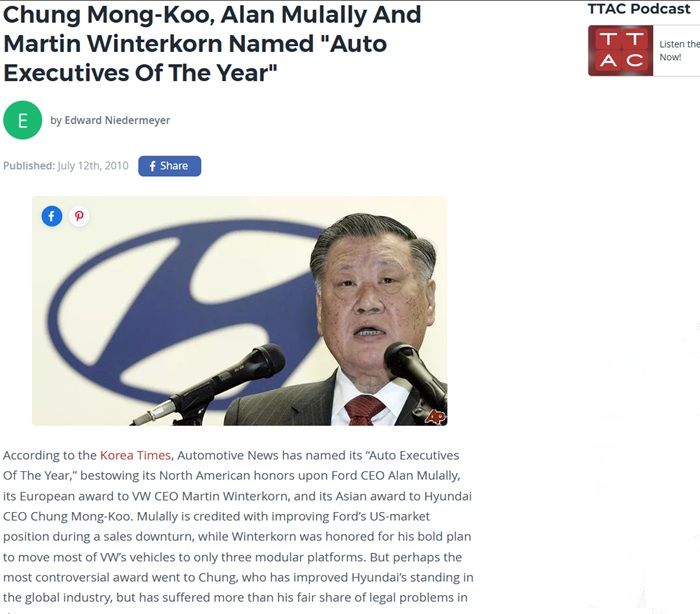
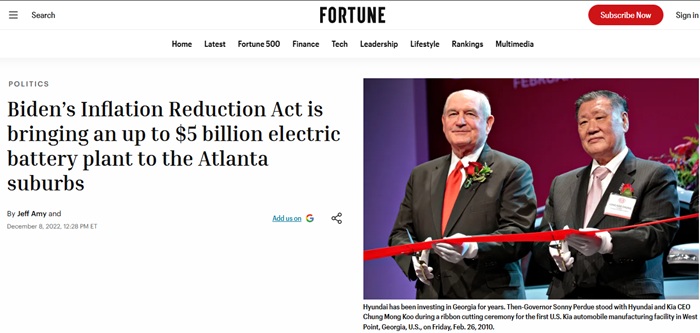
In 1999, Chung Mong-koo became chairman of Hyundai Motor Group. Under his leadership, Hyundai expanded aggressively into global markets, transforming itself into one of the world’s largest automakers. Hyundai Motor and its affiliate Kia Motors grew into pillars of South Korea’s export economy, accounting for a significant share of national output. This success elevated Chung’s status beyond that of a business executive. He came to be seen as a national asset, reinforcing the perception that his leadership was essential to economic stability.
The Culture of Slush Funds and Influence
Behind Hyundai’s global success, prosecutors would later allege, operated a system of illegal slush funds. Chung Mong-koo was accused of diverting more than 100 billion won from Hyundai and its affiliates. These funds were allegedly used to bribe politicians, influence regulators, and consolidate internal control over weaker group companies. Such practices were not unique to Hyundai. Slush funds had long been a feature of chaebol governance, enabling informal political lobbying while evading public scrutiny.
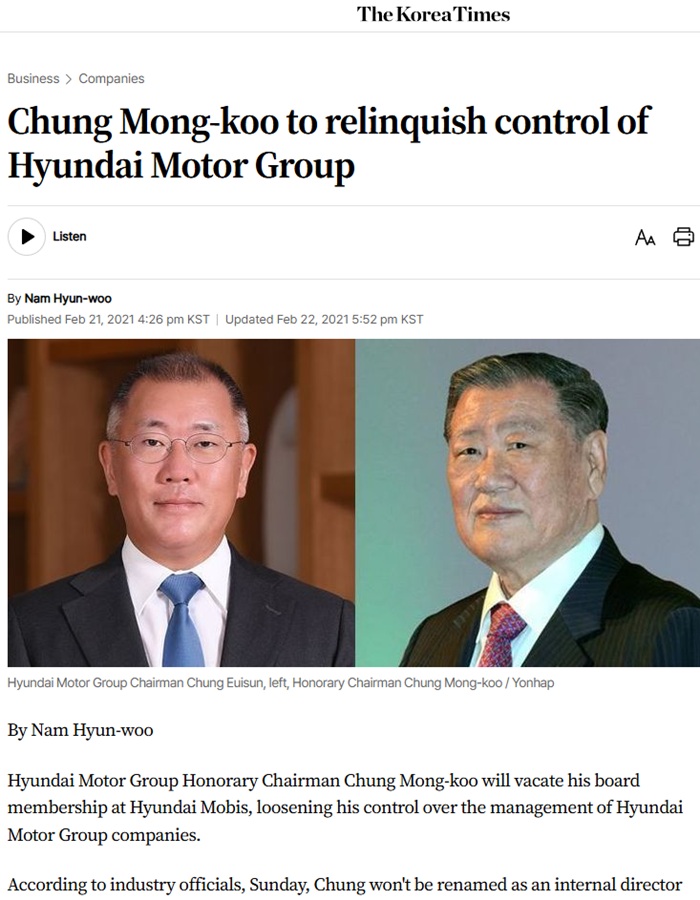
Prosecutorial Raids and a Turning Point
In March 2006, South Korean prosecutors raided Hyundai Motor Group offices, including Hyundai Motor and Kia Motors, as part of a broader investigation into illegal political lobbying. The raids marked a rare moment of confrontation between the state and corporate power. On April 28, 2006, Chung Mong-koo was arrested, sending shockwaves through the business community. He was formally indicted in May on charges of embezzlement and breach of fiduciary duty, accused of misusing 103.4 billion won in company funds.
Detention, Bail, and Economic Pressure
Chung Mong-koo spent nearly two months in detention before being released on bail in June 2006. During his absence, Hyundai reportedly delayed major corporate decisions, reinforcing claims that the company could not function without his direct oversight. This narrative quickly became central to his defense. Business leaders and legal advocates warned that prolonged imprisonment would destabilize Hyundai and harm the national economy, effectively framing the legal process as a threat to public welfare.
Conviction and Public Hope
On February 5, 2007, a South Korean court found Chung Mong-koo guilty of embezzlement and breach of trust and sentenced him to three years in prison. For many citizens, the verdict represented a long-awaited assertion of legal equality. Observers hailed the ruling as evidence that even the most powerful chaebol leaders could be held accountable. Yet this optimism was tempered by awareness of past precedents.
The Suspended Sentence and Judicial Logic
Later in 2007, the appeals court suspended Chung’s prison sentence, allowing him to remain free. Presiding Judge Lee Jae-hong openly acknowledged that economic considerations had influenced the decision. He stated that imprisoning Chung could endanger the national economy, citing Hyundai’s struggles during Chung’s brief detention. Instead of incarceration, the court imposed unusual conditions, including massive charitable donations, community service, and public lectures on corporate ethics.
Supreme Court Intervention
In April 2008, South Korea’s Supreme Court ruled that the suspended sentence had been improperly applied, criticizing the lower court’s expansive interpretation of community service. The case was sent back to the Seoul High Court for reconsideration. Despite this rebuke, few expected a fundamentally different outcome. The underlying assumption that Chung was economically indispensable remained firmly in place.
Presidential Pardon and Final Outcome
Later in 2008, President Lee Myung-bak granted Chung Mong-koo a full pardon, citing the need to overcome economic difficulties. Chung was one of hundreds of thousands pardoned, but his inclusion drew intense criticism. Alongside him, other convicted chaebol leaders were also pardoned, reinforcing the perception that elite economic actors operated under a separate legal standard. Chung returned fully to his role at Hyundai, his conviction rendered largely symbolic.
The “Too Big to Jail” Pattern
Chung’s case was not an exception. Similar outcomes have occurred repeatedly across South Korea’s corporate landscape. Executives at SK, Samsung, Hanwha, and other conglomerates received suspended sentences or pardons for serious crimes, from embezzlement to assault. This pattern became known as the “three-five rule”: a three-year prison sentence suspended for five years, followed by exemption if no further crimes occur.
Empirical Evidence of Unequal Justice
Academic studies support public perceptions of systemic leniency. Research has shown that controlling shareholders of large business groups convicted of embezzlement or breach of trust are rarely sent to prison without probation. By contrast, executives at non-chaebol firms frequently receive real jail sentences for similar offenses. The disparity points not to lack of evidence, but to structural favoritism embedded within the justice system.
Judiciary Capture and Career Incentives
One explanation for this phenomenon is judiciary capture. Many South Korean judges face limited promotion prospects and leave the bench early to join corporate law firms, often representing chaebol clients. This revolving door creates subtle but powerful incentives for judicial leniency. When a small number of families control vast economic resources, legal neutrality becomes difficult to maintain.
Public Anger and Democratic Consequences
Public frustration with elite impunity culminated in the 2016 candlelight demonstrations, which led to the impeachment of President Park Geun-hye. Protesters demanded accountability not only from politicians but also from corporate leaders who benefited from corruption. Although these protests raised hopes for reform, subsequent rulings involving other chaebol heirs suggested that the underlying system remained largely unchanged.
Chung Mong-koo as a Symbol
The case of Chung Mong-koo ultimately became symbolic of a deeper structural problem. Despite conviction, judicial review, and public outrage, the final outcome reaffirmed a painful reality: economic power continues to function as a shield against full legal accountability in South Korea. The rule of law, while formally intact, remains unevenly applied.
Growth Without Accountability
South Korea’s economic success has come at a significant cost. When corporate leaders are deemed too valuable to punish, the foundations of legal equality and democratic trust are weakened. Chung Mong-koo’s case illustrates how growth without accountability can distort justice itself. Until economic influence no longer determines legal outcomes, the promise of equal justice under the law will remain unfulfilled.
Related Fraudsters Scammers:



Popular Links

SWINDLERS LIST
-
Top 10 Scammers !!!
Beware of these scammers...Keep them out of your mail-box...

SCAM TOOLS
-
Block Scam Mails???
Cleaning your scam filled inbox can be effected by these tools
HELP DESK
-
Waiting to help You!!!
Every problem has a solution when discussed. Discuss with us to get a clear idea to keep your information unscathed from hypocrites