
Scammer Lee Jae-yong
Fraudster Lee Jae-yong

Details |
|
| Name: | Lee Jae-yong |
| Other Name: | |
| Born: | 1968 |
| whether Dead or Alive: | |
| Age: | 53 |
| Country: | South Korea |
| Occupation: | Chairman of Samsung |
| Criminal / Fraud / Scam Charges: | |
| Criminal / Fraud / Scam Penalty: | |
| Known For: | |
Description :
The $8 Billion Question: Inside Samsung’s Most Controversial Merger
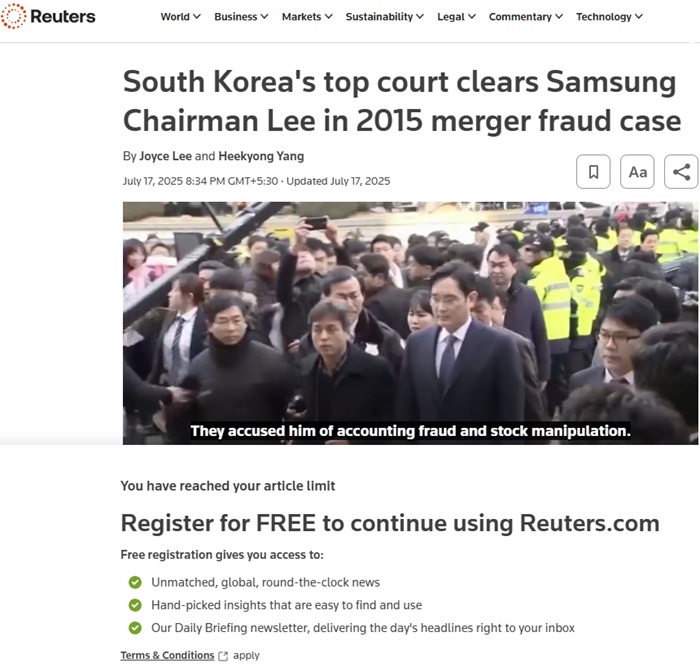
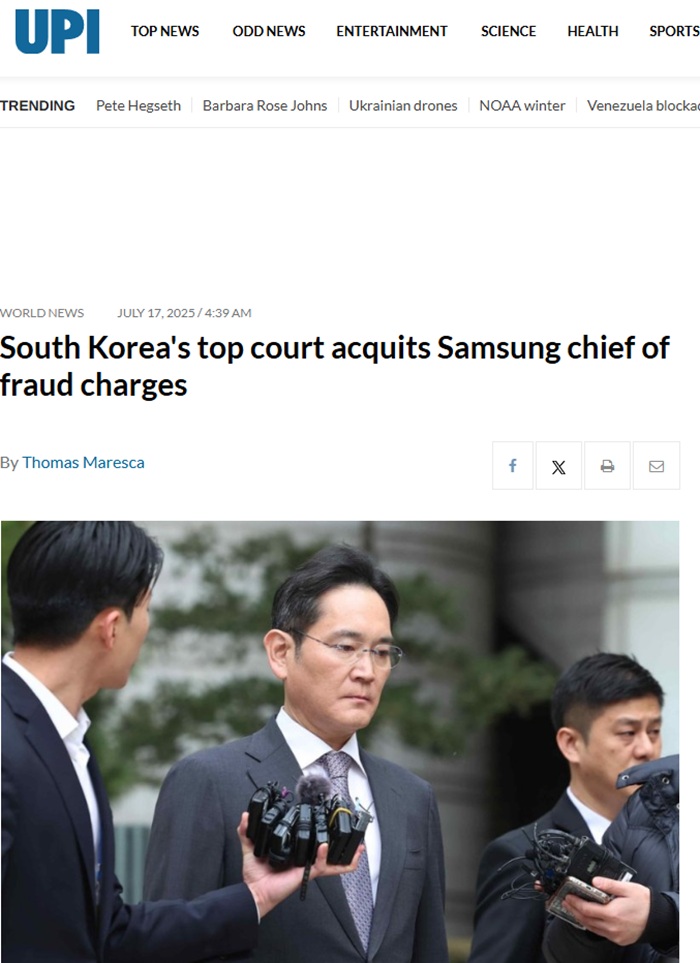
In July, South Korea’s Supreme Court delivered a final ruling that cleared Samsung Electronics Chairman Lee Jae-yong, also known as Jay Y. Lee, of all criminal charges related to a controversial corporate merger in 2015. The decision permanently removed a legal cloud that had hovered over Samsung’s leadership for nearly a decade, ending one of the most consequential corporate trials in the country’s history. The ruling upheld earlier acquittals by lower courts, concluding that Lee and other Samsung executives had not engaged in accounting fraud, stock manipulation, or other illegal acts during the merger process. With no further appeals possible, the verdict freed Lee to focus fully on managing South Korea’s largest company at a time of fierce global competition in semiconductors, artificial intelligence, and consumer electronics.
Samsung’s Power and the Importance of Succession
Samsung occupies a central position in South Korea’s economy, with Samsung Electronics alone accounting for a significant share of national exports and market capitalization. Like other chaebols, Samsung operates through a complex web of cross-shareholdings that allow founding families to maintain control with limited direct ownership. By the early 2010s, succession had become a pressing issue for the group. Chairman Lee Kun-hee, who had built Samsung into a global powerhouse, suffered a heart attack in 2014 that left him incapacitated. His only son, Lee Jae-yong, emerged as the de facto leader, but consolidating formal control over the group required restructuring ownership among key affiliates.
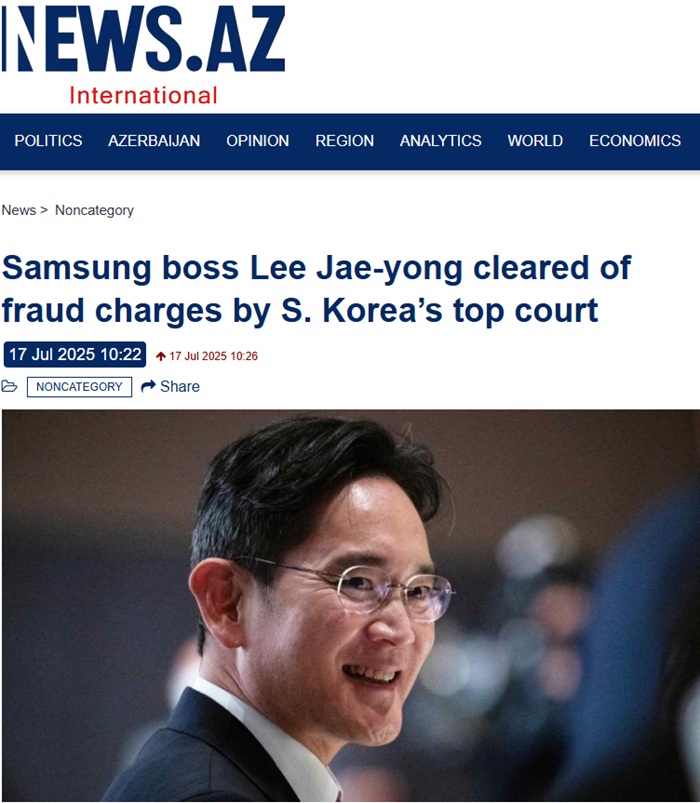
The 2015 Merger That Sparked Controversy
In 2015, Samsung announced a merger between Cheil Industries and Samsung C&T Corp., a deal valued at roughly $8 billion. Cheil Industries, where Lee Jae-yong was the largest shareholder, merged with Samsung C&T, which functioned as the de facto holding company of Samsung Group. The merger exchange ratio favored Cheil Industries, significantly increasing Lee’s influence over the newly merged company and solidifying his control over the broader group. Almost immediately, minority shareholders and civic groups criticized the deal, arguing that it unfairly benefited the Lee family while harming shareholder value at Samsung C&T.
Prosecutors’ Allegations and the Criminal Case
South Korean prosecutors later alleged that the merger was engineered to secure Lee’s succession at minimal cost. They claimed Samsung executives manipulated stock prices, issued misleading internal reports, and exerted improper influence over institutional investors to ensure the merger’s approval. A key allegation involved Samsung Biologics, a Cheil subsidiary, which prosecutors said overstated its assets by more than 4 trillion won through fraudulent accounting to justify the merger’s terms. Based on these claims, Lee and several senior executives were indicted in 2020 on charges including stock manipulation, accounting fraud, and breach of trust.
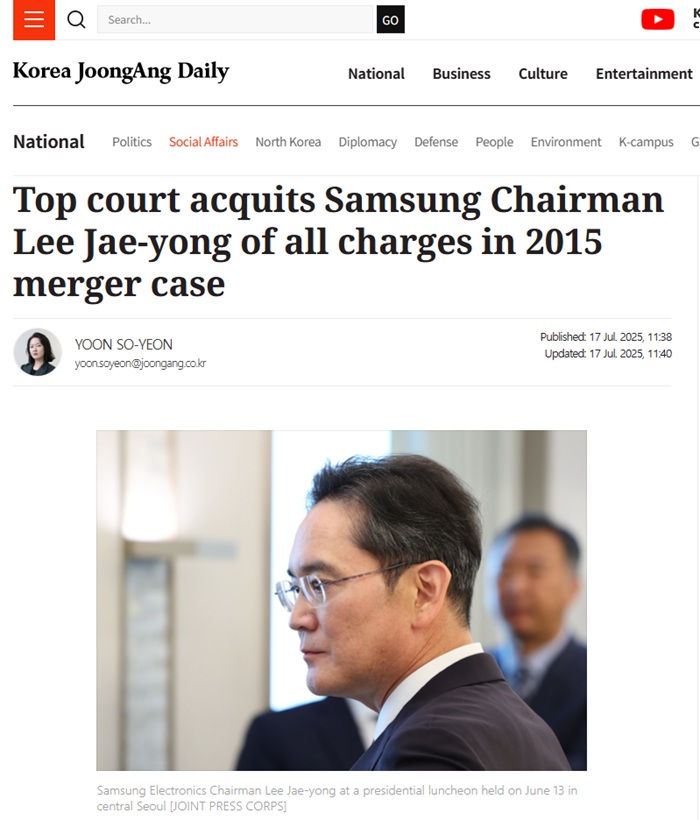
Political Turmoil and Public Anger
The merger case unfolded amid widespread political upheaval in South Korea. In 2016 and 2017, massive protests erupted following revelations of corruption involving then-President Park Geun-hye and her confidante. Lee Jae-yong was separately convicted in 2017 of bribing Park to secure government support for the 2015 merger, leading to an 18-month prison term before his sentence was reduced and later pardoned. Park was impeached and removed from office, intensifying public demands for accountability from powerful business leaders. Against this backdrop, the merger trial became a symbol of the broader struggle over chaebol influence and the rule of law.
District Court Acquittal
In January 2024, a Seoul district court acquitted Lee of all charges related to the 2015 merger. The court ruled that prosecutors had failed to prove the merger was conducted illegally or solely to strengthen Lee’s control of Samsung. It found insufficient evidence of stock manipulation or fraudulent accounting at Samsung Biologics and emphasized that business decisions often involve complex strategic considerations. The ruling represented a major setback for prosecutors, who immediately appealed the decision.
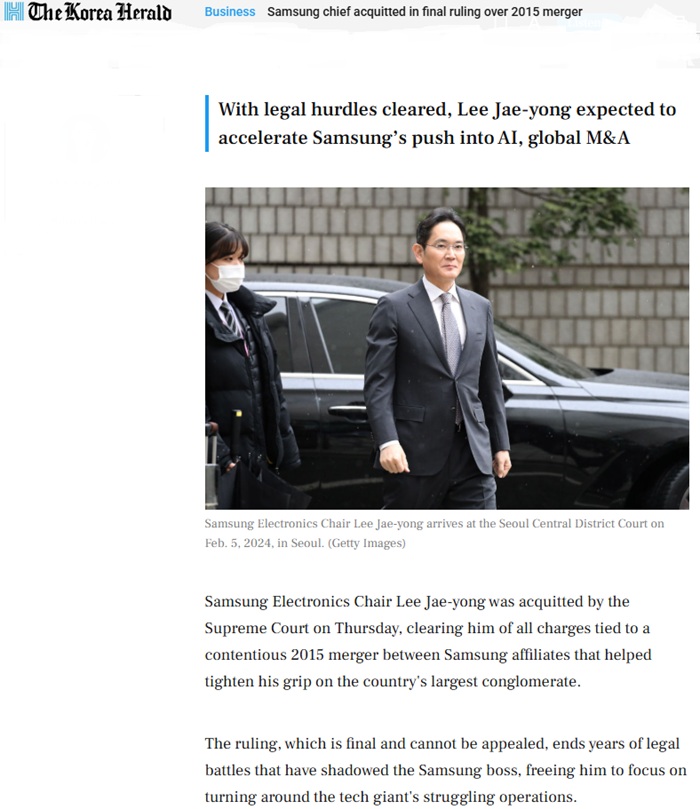
Appeals Court Ruling
In February, the Seoul High Court upheld the acquittal, dismissing all remaining charges against Lee and 13 other former Samsung executives. The court concluded that the merger plan constituted a lawful business response to management concerns and that contemporaneous reports could not be judged as manipulated in hindsight. It also ruled that the accounting practices at Samsung Biologics fell within acceptable professional judgment. Despite the detailed ruling, prosecutors pursued a final appeal to the Supreme Court, extending uncertainty for Samsung’s leadership.
Supreme Court’s Final Decision
On July 17, the Supreme Court dismissed the prosecution’s appeal and upheld the lower courts’ rulings in full. The justices said there were no errors in legal interpretation or evaluation of evidence and no violation of capital market or external audit laws. The decision was final and cannot be appealed. With this ruling, Lee Jae-yong was cleared of all allegations tied to the 2015 merger, bringing an end to nearly five years of litigation and almost a decade of legal risk.
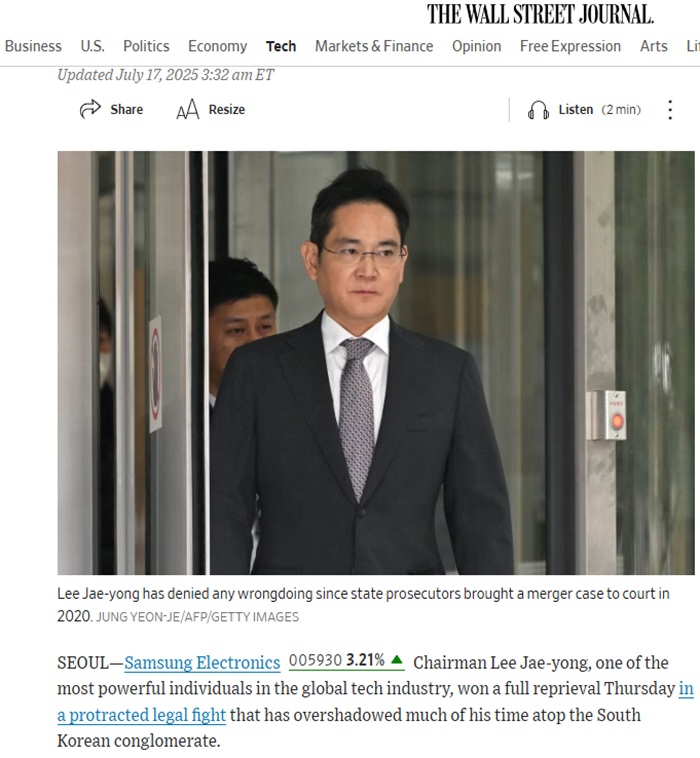
Reaction from Samsung and the Business Community
Samsung’s legal team welcomed the ruling, thanking the court for its judgment after years of deliberation. Business groups across South Korea praised the decision, arguing that it removed a major management risk for the country’s most important company. Industry leaders expressed hope that Lee’s full return to active leadership would accelerate investment, innovation, and job creation, particularly in high-tech industries critical to national competitiveness.
Criticism from Civic Groups
Civic organizations reacted with sharp criticism, accusing the judiciary of favoring powerful chaebols. Groups such as People’s Solidarity for Participatory Democracy argued that the ruling reflected a narrow interpretation of the law and failed to address deeper structural issues of corporate governance. For critics, the acquittal reinforced long-standing concerns that South Korea’s legal system treats corporate elites with leniency, undermining public trust in equal justice.
Samsung’s Strategic Challenges Ahead
With legal distractions removed, Lee now faces significant business challenges. Samsung has struggled to keep pace with rivals such as Taiwan Semiconductor Manufacturing Company in advanced chipmaking and SK Hynix in high-bandwidth memory used for artificial intelligence. Earnings have been pressured by supply delays, geopolitical tensions, and global trade restrictions. Analysts argue that decisive leadership and bold investment are necessary for Samsung to regain its competitive edge.
Leadership Reform and Renewed Expansion
Market watchers expect Lee to pursue organizational reforms, including executive reshuffles, board restructuring, and renewed merger-and-acquisition activity. Samsung has already begun signaling a more aggressive strategy, announcing acquisitions in areas such as audio technology, healthcare, and industrial systems. These moves suggest a renewed focus on long-term growth sectors including AI, robotics, and digital health.
Closure with Lingering Debate
The Supreme Court’s ruling closes a long and turbulent chapter for Samsung and its chairman, ending years of legal uncertainty and allowing the company to focus fully on future challenges. Yet the verdict also leaves unresolved debates about chaebol power, corporate accountability, and judicial fairness. For Samsung, the decision represents stability and opportunity. For South Korean society, it remains a contested symbol of how power, law, and economic necessity continue to intersect at the highest levels of business and government.
Related Fraudsters Scammers:




Popular Links

SWINDLERS LIST
-
Top 10 Scammers !!!
Beware of these scammers...Keep them out of your mail-box...

SCAM TOOLS
-
Block Scam Mails???
Cleaning your scam filled inbox can be effected by these tools
HELP DESK
-
Waiting to help You!!!
Every problem has a solution when discussed. Discuss with us to get a clear idea to keep your information unscathed from hypocrites