

Scammers are continuing to find new ways to make fraudulent requests appear legitimate, from promoting nonexistent public events to impersonating authorities and offering fake help to people who have already lost money.
Today’s scam news includes a fake vendor market promoted in Georgia, an attempted $36,000 cryptocurrency scam involving an elderly woman, a warning about recovery scammers targeting previous fraud victims, and a new WhatsApp AI scam-detection feature designed to identify suspicious conversations.
These reports show both sides of the current fraud landscape: criminals are becoming more convincing, while authorities, technology companies and even alert members of the public are finding new ways to intervene.
Georgia Officials Warn About Fake Vendor and Artisan Market
The Georgia Department of Agriculture has warned residents and businesses about a fraudulent event advertised online as the “2026 GATE Atlanta Vendor and Artisan Market.”
The supposed event was promoted on Facebook and advertised as taking place from August 21 through August 23 at the Atlanta State Farmers’ Market in Forest Park.
State officials confirmed that the advertised event was not actually scheduled to take place.
The promotion was reportedly designed to attract vendors and obtain payments, personal information or business information from people who believed they were registering for a legitimate market.
Fake event scams can be particularly convincing because criminals may use the name of a genuine venue, create professional-looking social media advertisements and provide realistic dates and registration information.
Small businesses and independent vendors can be especially vulnerable because legitimate festivals, farmers’ markets and community events commonly require registration fees before participation.
The Georgia Department of Agriculture urged people not to provide payments or sensitive information to those promoting the fraudulent event. Officials also issued a cease-and-desist letter to the alleged organizer.
Before paying to participate in a market, festival or trade event, vendors should independently contact the venue or official organizer. A social media page, advertisement or registration form alone should not be treated as confirmation that an event is genuine.

Postal Carrier Helps Stop $36,000 Crypto Scam Targeting Elderly Woman
A postal carrier in Ohio is being credited with helping authorities intervene in a cryptocurrency scam targeting an elderly woman.
Postal carrier Lisa Cordes, who has worked in the profession for more than 20 years, noticed an older woman using a cryptocurrency ATM at a Shell station on Dayton-Xenia Road.
The woman reportedly appeared confused while talking to someone on her cellphone and was feeding $100 bills into the cryptocurrency machine.
Cordes became concerned and attempted to speak with her. The woman reportedly believed that people she described as her IT representatives were helping her protect her money.
Recognizing the warning signs of a possible scam, Cordes contacted police.
Beavercreek officers later determined that the woman was communicating with someone who was allegedly posing as a legal authority.
Police said approximately $20,000 had already been deposited, while intervention prevented another $16,000 from being transferred. The attempted loss therefore involved roughly $36,000.
Cryptocurrency ATMs are attractive to scammers because transactions can be difficult to reverse after funds have been transferred. Fraudsters may instruct victims to withdraw cash, visit a Bitcoin or crypto ATM and remain on the phone while completing the transaction.
Authorities emphasized that legitimate law-enforcement agencies, courts and government departments do not call people and demand cryptocurrency payments.
The incident also demonstrates the importance of intervention. Family members, bank employees, store workers and members of the public who notice someone being coached through an unusual financial transaction may be able to prevent further losses by raising concerns.

Recovery Scammers Target People Who Have Already Lost Money
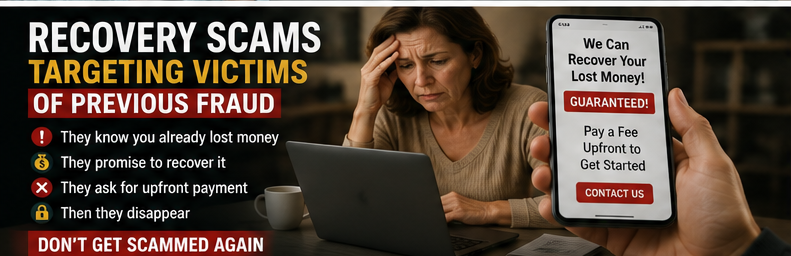
The Federal Trade Commission is warning consumers about recovery scams, a particularly damaging form of fraud that targets people who have already been victims of another scam.
Instead of approaching victims with a completely new story, recovery scammers may claim they can retrieve money that was previously stolen.
Fraudsters can sometimes obtain or purchase information about earlier scam victims. These records may contain names, contact information, details about the original fraud and even the approximate amount of money lost.
Knowing these details allows the criminal to make the new approach sound convincing.
A scammer might claim to be a lawyer, investigator, government representative or consumer advocate who has located the victim’s missing funds.
Then comes the catch.
Before the supposedly recovered money can be released, the victim is asked to pay an upfront processing fee, legal charge, tax or retainer.
Once the payment is made, the promised recovery never happens. The victim has instead been scammed for a second time.
Recovery scams can be especially effective because someone who has recently suffered a major financial loss may understandably be eager to recover their savings.
Consumers should be extremely cautious when an unknown person unexpectedly contacts them and claims they can recover stolen money for a fee.
Victims should instead contact their bank, card provider, payment service or appropriate law-enforcement agency directly. Suspicious recovery services should be independently researched before any information or payment is provided.
Requests involving cryptocurrency, gift cards, wire transfers or other difficult-to-reverse payments deserve particular caution.
WhatsApp Introduces AI-Powered Scam Alert Tool
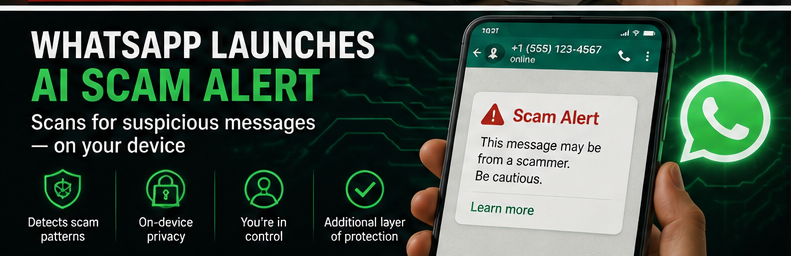
WhatsApp is introducing a new approach to fighting scams by using artificial intelligence directly on a user’s device to identify suspicious conversations.
Meta has described Scam Alert as an optional feature designed to recognise patterns commonly associated with fraudulent messages.
Once enabled, the feature uses a machine-learning model on the device to evaluate incoming messages from people who are not already in the user’s contacts.
If the system detects conversational patterns that resemble known scams, WhatsApp can display a warning to the user.
One of the important aspects of the technology is its approach to privacy. Meta says the message content used for classification remains on the device rather than being sent to Meta for analysis.
The system has been trained using patterns identified in scam conversations that users previously reported. It examines factors such as conversational structure and linguistic signals rather than simply searching for a single suspicious word.
The feature is also designed to remain under the user’s control. It can be enabled or disabled, and detecting a possible scam does not automatically report the conversation.
If a user decides to report the suspicious account, information can then be shared through WhatsApp’s existing reporting process.
The technology is significant because messaging scams increasingly involve longer conversations rather than a single obvious phishing link. Criminals may spend time building trust before introducing an investment opportunity, emergency payment request or impersonation story.
AI-assisted warnings could provide users with an additional moment to reconsider a suspicious conversation before sending money or personal information.
However, automated detection should be treated as an additional safety layer rather than a guarantee. Users should still independently verify unexpected financial requests, unfamiliar contacts and urgent messages.
Stay Safe
Today’s reports show how scams can begin almost anywhere, including social media advertisements, cryptocurrency transactions, recovery offers and private messages.
Verify unexpected payment requests independently, be suspicious of anyone demanding cryptocurrency or upfront recovery fees, and never assume an online event is genuine simply because its advertisement looks professional.