
Sharing a holiday photo on Instagram or Facebook has become second nature for many travelers. A beautiful river, a busy street, a restaurant or a hotel balcony may seem like nothing more than a memory worth sharing with friends.But those ordinary pictures may contain more information than we realize.
New research highlighted by The Guardian shows that artificial intelligence can examine tiny visual details inside travel photographs and work out where they were taken. For scammers, knowing a victim’s recent travel location could provide exactly the personal detail needed to make a fake bank alert, phishing email or text message appear genuine.
AI Can Find Location Clues Hidden Inside Holiday Photos
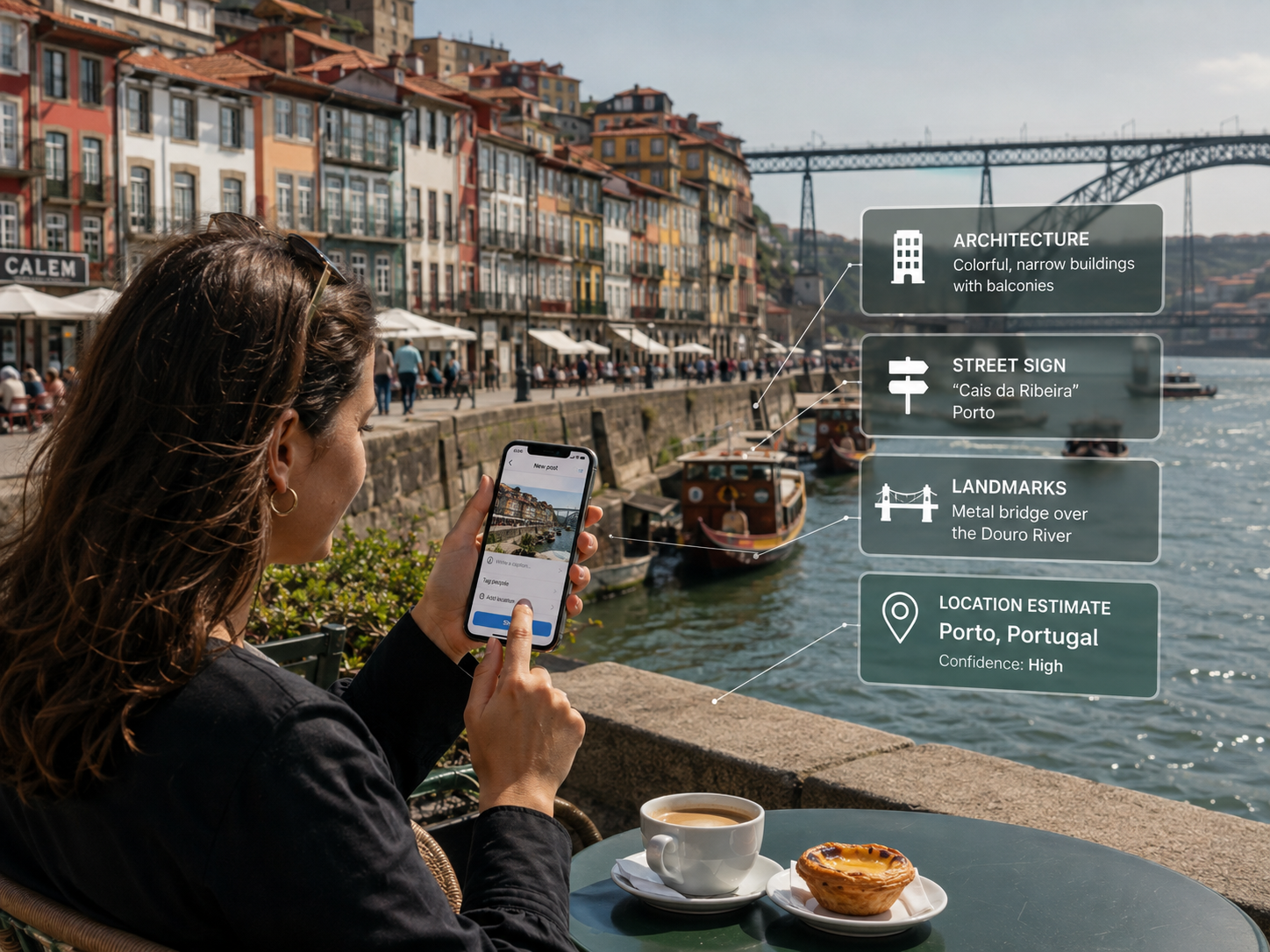
A traveller uploading holiday photographs to social media while an AI system analyzes landmarks, street signs and buildings in the background.
AI-generated illustration showing how visual clues in social-media photographs could be analyzed to estimate a travel location. It does not depict an actual scam victim or incident.Most people know that sharing a location tag can reveal where they are.
What is less obvious is that even a photograph without a location tag may give away valuable clues.Buildings, street signs, shop fronts, road markings, skylines, landmarks, architecture and even lighting conditions can help AI systems estimate where a photograph was taken.
According to The Guardian, cybersecurity company McAfee tested two freely available AI models on more than 21,000 travel images. One model reportedly identified the location correctly in 91% of the images tested, while another achieved an accuracy rate of 87%.The research suggests that criminals may not need GPS information or obvious location tags to learn something useful from a public photograph.In some cases, the picture itself may be enough.
How This Type of Scam Could Work
Imagine you spend a few days on holiday in Porto, Portugal.You share several photographs on Instagram. You don’t tag Porto, mention your hotel or write anything about Portugal in your caption.
A few days later, you receive a text message that appears to come from your bank.It says that unusual card activity was detected while you were traveling in Porto and asks you to verify your account immediately.
At first, the message may seem believable.After all, you really were in Porto.You may start thinking that only your bank could know where you recently used your card.
But that assumption is exactly what a scammer wants.The Guardian described how criminals could use AI to identify the location shown in a photograph and then include that information in a fraudulent message. The accurate travel detail adds a layer of credibility to an otherwise familiar phishing scam.
The link in the message may then lead to a fake banking page designed to steal passwords, payment-card information or other sensitive details.
Why Personalized Scam Messages Are More Dangerous
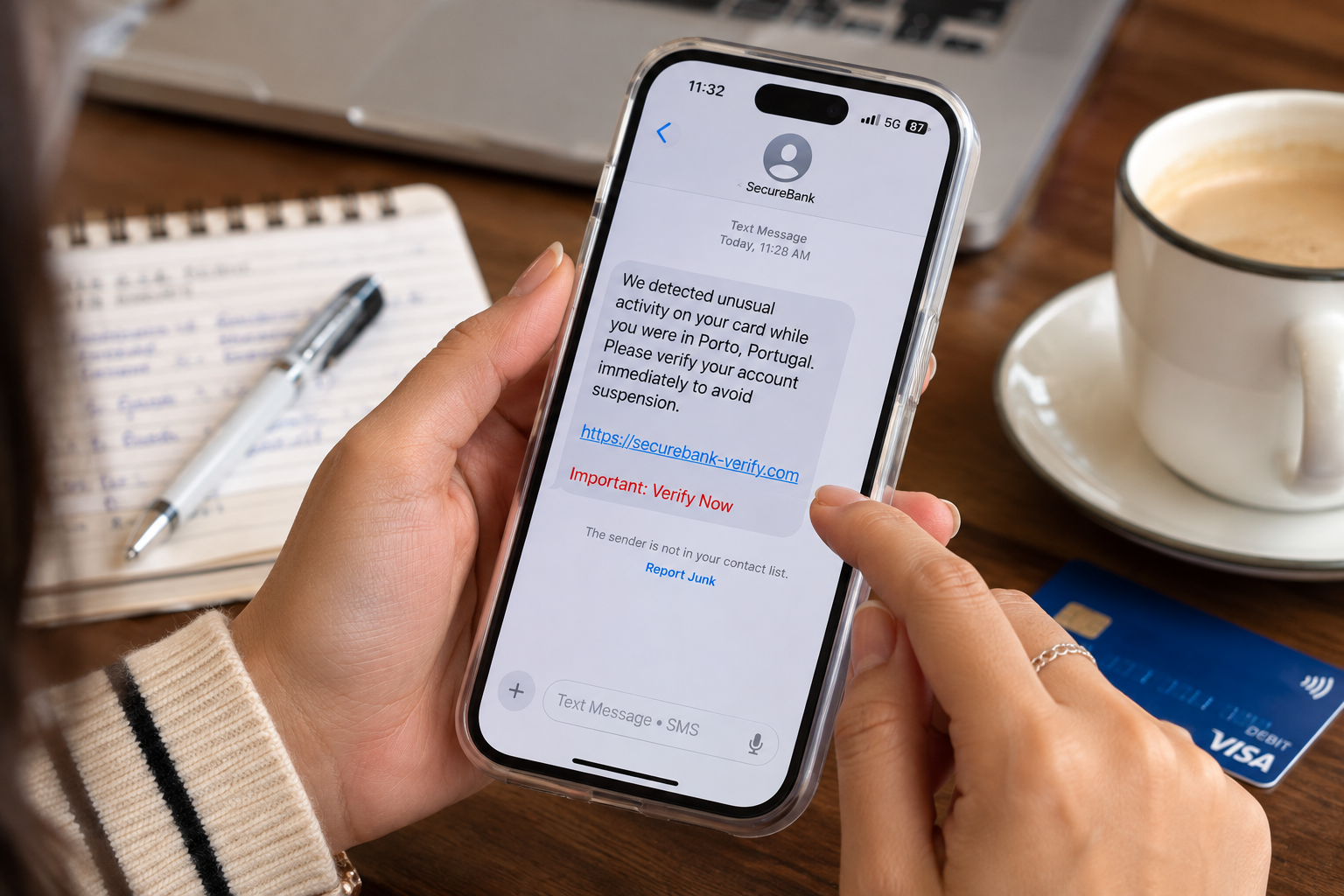
A smartphone displaying a fake bank security alert mentioning a recent holiday destination, with a warning symbol beside the message.
AI-generated illustration of a travel-related phishing message. The message and interface are fictional and are shown for scam-awareness purposes.
Traditional phishing messages are often easy to question because they are vague.A scammer might simply write:”Your bank account has been suspended.Many people have learned to be suspicious of messages like thisNow imagine the message says:
“We noticed unusual card activity during your recent trip to Porto.”That feels much more personal.The scammer has included something true.
And once a victim believes that one part of the message is genuine, they may be less likely to question everything that follows.This is one of the biggest concerns surrounding AI-assisted fraud.
Criminals do not necessarily need complete information about someone. They may only need one or two accurate details to make their story believable.
A destination, hotel, event, employer or recent purchase can potentially become the hook.
What Can AI Notice in a Photograph?
People usually focus on the main subject when looking at a photograph.AI can analyze the entire frame.A seemingly harmless holiday picture may contain clues such as:
- Famous landmarks
- Street and road signs
- Store names
- Restaurant signs
- Local architecture
- Public transportation
- License-plate styles
- Skylines
- Street markings
- Landscapes
- Food stalls
- Hotel surroundings
- Bridges and rivers
The Guardian reported that photographs containing recognizable landmarks, skylines, signage and street markings are particularly useful for AI location identification. Even storefronts and food stalls may provide geographical clues.
Pictures taken inside an ordinary hotel room or on a less distinctive beach may be harder to pinpoint precisely. However, identifying even the country could still be enough to make a scam message sound convincing.
Scammers Can Combine Several Pieces of Information
The danger does not necessarily stop with one photograph.Public social-media accounts can contain years of small personal details.A scammer could potentially see where a person traveled, what airline they used, restaurants they visited, events they attended or businesses they follow.AI makes sorting and interpreting that information much easier.
For example, a scammer who believes someone recently traveled abroad could create messages such as:
“Your card was used while you were overseas.”
“We are contacting you regarding your recent hotel stay.”
“A login attempt was detected from the country you recently visited.”
“Your travel payment has been placed on hold.”
Each message contains just enough truth to make the recipient curious or worried.Then comes the urgent instruction:
Click here.
Verify now.
Call immediately.
Confirm your details.
That is where the scam attempts to turn information into action.
Urgency Remains One of the Biggest Warning Signs
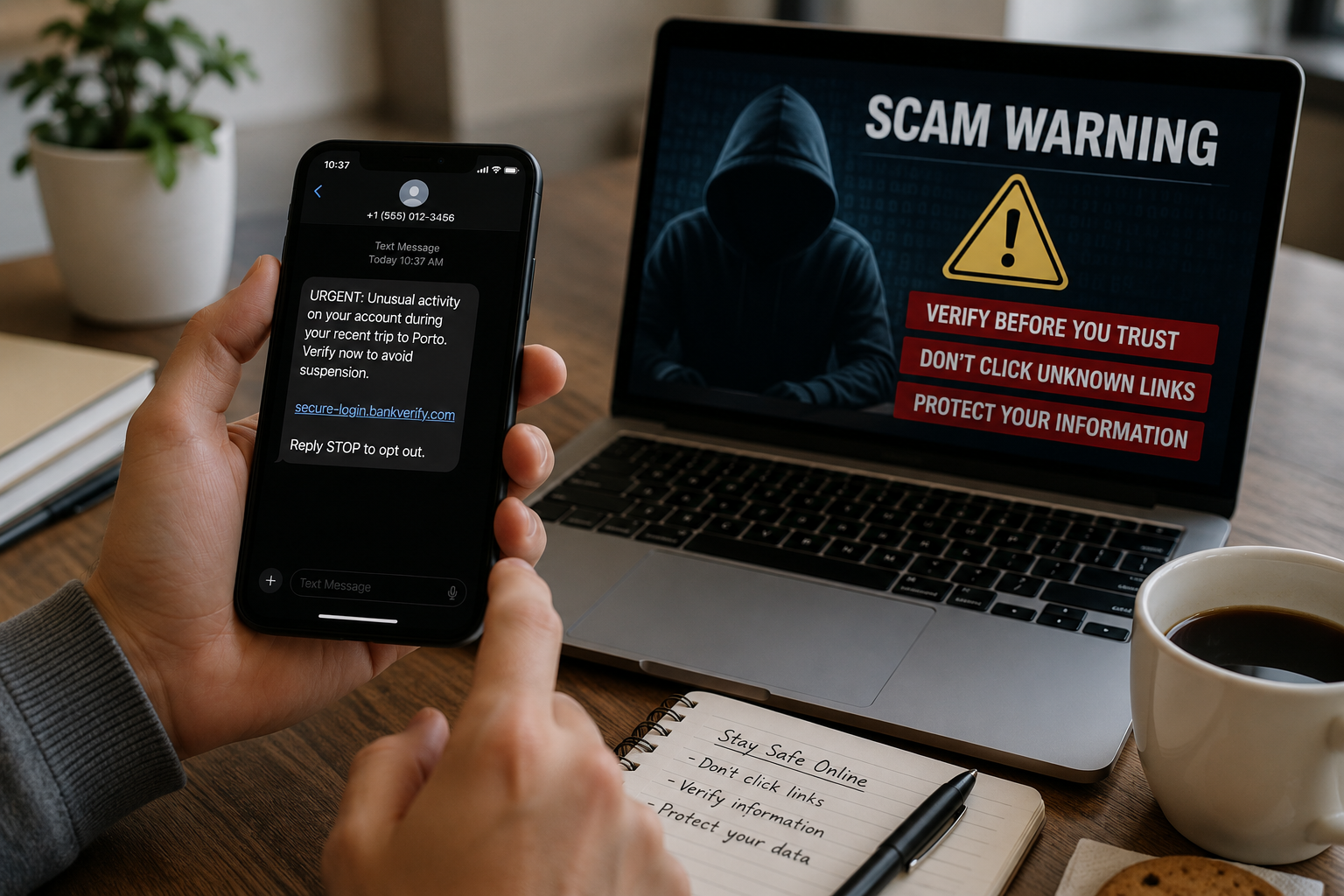
A scam-awareness illustration showing a phone surrounded by warning messages such as Verify Now, Urgent Action and Suspicious Activity.
AI-generated scam-awareness illustration highlighting common urgency tactics used in phishing messages. It does not reproduce an actual bank notification.Although AI may make fraud more sophisticated, many of the psychological tricks behind scams have not changed.
Urgency remains one of the most common.Scammers do not want victims to stop and investigate.They want an emotional reaction.Messages may claim that an account will be suspended, money is being transferred, a card has been compromised or immediate verification.
The Guardian advises consumers to be especially cautious when unexpected messages pressure them to act immediately.A genuine-looking message should never prevent you from independently checking whether the claim is real.
Do Not Trust a Message Simply Because It Knows Something About You
This is becoming an increasingly important rule for online safety.A message knowing your name does not prove it is genuine.Knowing your hometown does not prove it.
Knowing your bank does not prove it.And knowing where you recently went on holiday does not prove it either.Personal information can come from social media, previous data breaches, public records, compromised accounts and other sources.
AI gives criminals another way to turn those fragments into convincing messages.Treat unexpected requests for passwords, financial information, one-time security codes or payment details with caution, even when the message includes accurate personal information.
Think Before Posting Holiday Pictures in Real Time
Holiday photographs are meant to be enjoyed, and people should not feel that they have to disappear from social media.But a few privacy habits can make public information harder for scammers to exploit.
One useful step is to avoid posting detailed travel photographs while you are still away.Instead, consider sharing them after you return home.
The Guardian also recommends reviewing social-media privacy settings so photographs are visible only to people you know where possible.Waiting until you are home also prevents strangers from easily learning that your property may currently be unattended.
Look at the Background Before You Upload
Before publishing a picture, spend a few seconds looking beyond the main subject.
Could someone see your hotel name?
Is there a boarding pass on the table?
Does a restaurant sign reveal exactly where you are?
Is your street or accommodation clearly recognizable?
Does the photograph contain a booking reference, room number, vehicle registration or other sensitive information?
The details we ignore are sometimes the details technology notices first.Cropping or choosing another photograph may remove information that does not need to be public.
Never Click a Banking Link Just Because the Message Looks Genuine
If you receive an unexpected security alert supposedly from your bank, do not automatically use the link included in the message.Instead, open your bank’s official mobile application yourself or type the official website address into your browser.
You can also contact the bank using the telephone number printed on your bank card or another number obtained independently from the bank’s official website.
The Guardian specifically recommends avoiding links supplied in suspicious texts and emails and contacting the company or bank directly through trusted details.
This simple habit can defeat many phishing attempts.
Verify the Story, Not Just the Sender
Scammers increasingly try to create messages that feel familiar. A message may mention a real trip.
It may know your name.
It may use the correct logo.
It may even arrive at exactly the moment when a real transaction or event has taken place.
Instead of asking only, “Does this look real?” ask:
“Can I verify this independently?”
If a bank really needs you to take action, the same warning will usually be visible when you sign in through the official banking application or website.If a hotel really needs payment, contact the hotel using information from your original booking rather than the message you just received.Independent verification removes the scammer from the conversation.
AI Is Changing What We Consider Private
For years, online-safety advice has focused on obvious information such as passwords, addresses, phone numbers and location tags.
AI is changing that definition.A photograph does not need to contain a written address to reveal a location.
A post does not need to mention a city for technology to recognize it. scammer does not need to know your whole life story to create a believable message.
Sometimes the background of one holiday photograph can provide the missing piece.That does not mean people should panic or stop sharing photographs altogether.
It means social-media users may need to become more aware of what their pictures reveal beyond the subject they intended to show.
Protect Yourself Before the Next Message Arrives
Scams work best when victims feel rushed, surprised or frightened.AI may give criminals better information, but consumers still have powerful ways to protect themselves.
Limit who can see personal social-media posts.Avoid announcing travel plans publicly.Review photographs before uploading them.Be suspicious of unexpected links.
Never provide account credentials or security codes because of an unsolicited message.And when something supposedly comes from a bank or company, contact that organization independently.
The next scam message may contain surprisingly accurate information about you.That accuracy should not earn your trust.It should remind you to verify the message even more carefully.
Source
The Guardian, “‘We detected unusual activity’: the scam that uses AI to exploit your holiday photos,” published August 16, 2026. The report covers McAfee research into AI-powered geolocation of travel photographs and the potential use of those details in personalized scams.