
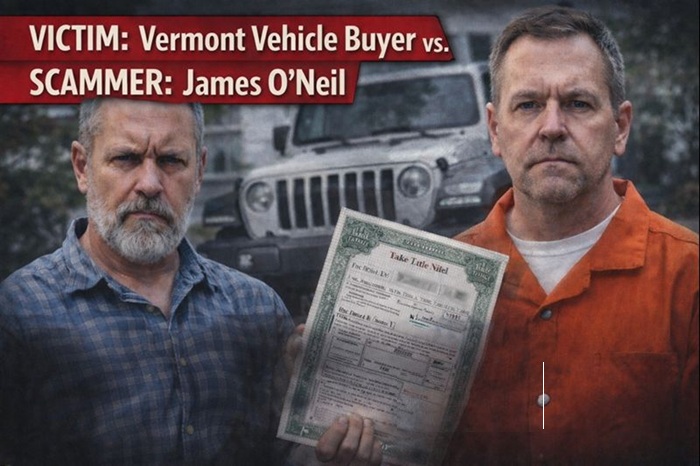
Months after I handed over my 2016 Ford Mustang in exchange for what I was told was a legitimate 2022 Jeep Wrangler, something didn’t sit right with me. I had met the man behind the deal on Facebook Marketplace — Scammer: James O’Neil, a Stratford English teacher who looked respectable and sounded convincing. But doubt crept in, and I realized I might have been played. I am the Victim: Vermont Vehicle Buyer, and this deal was a trap.
I took my concerns straight to the Connecticut State Police Troop G Barracks. I told them exactly what happened — that James O’Neil and I traded vehicles at a Milford rest area, and I believed the Jeep in my possession carried a fake VIN. The VIN, a 17-character code meant to identify a vehicle’s entire history, was the one thing I no longer trusted.
A trooper ran the VIN through law enforcement databases. Nothing came up. I was told the Jeep checked out, that it wasn’t stolen, and I was sent back home to Vermont. For a moment, I thought I was safe. I wasn’t.
Just two days later, reality crashed down on me. Vermont State Police showed up at my home and seized the Jeep. I was informed the vehicle had, in fact, been stolen. Despite doing everything right — questioning the deal, contacting police, trusting official systems — I still lost the vehicle. That’s what this scam does: it leaves victims exposed even when they try to protect themselves.
By then, I learned I wasn’t alone. James O’Neil, 47, had already been arrested once for suspicious used-vehicle dealings. Before the year ended, he would be arrested two more times, and officials now say he faces at least a fourth arrest. He resigned from his job as an English teacher at Stratford High School in December 2024, but the damage was already done.
And this fraud didn’t stop with private buyers like me. In another case, police charged a woman in Waterbury with selling a stolen 2022 Acura to a well-known dealership for $30,000. The scam cuts across individuals and businesses alike.
The method is brutally simple and dangerously effective. A stolen vehicle is fitted with an altered VIN so it appears clean, even when checked in public databases. Authorities say James O’Neil went further — forging documents to make the vehicles appear legitimately purchased, a classic title-washing scheme designed to erase a car’s criminal past.
Yet even with multiple arrest warrants, serious questions remain unanswered. Investigators still don’t know exactly how James O’Neil obtained several stolen vehicles, including Jeeps reported missing from a rental agency at an airport in Albany, New York. Officials say the investigation is ongoing, but for victims like me, the consequences are already permanent.
When announcing O’Neil’s second arrest, DMV Commissioner Tony Guerrera praised law enforcement — but warned buyers to be relentless in their due diligence. He stressed that private vehicle sales demand research, verification, and skepticism.
Consumer experts echo the warning. Carfax advises buyers to have vehicles inspected by mechanics and to verify VINs in multiple locations — not just on dashboards and door jambs, but in hidden manufacturer stampings designed to stop criminals like this.
And in the end, one brutal truth remains — the rule that applies to cars, vacations, and every deal that sounds perfect:
If it feels too good to be true, it probably is.
I learned that lesson the hard way — as a Victim, at the hands of a Scammer who knew exactly how to exploit trust.