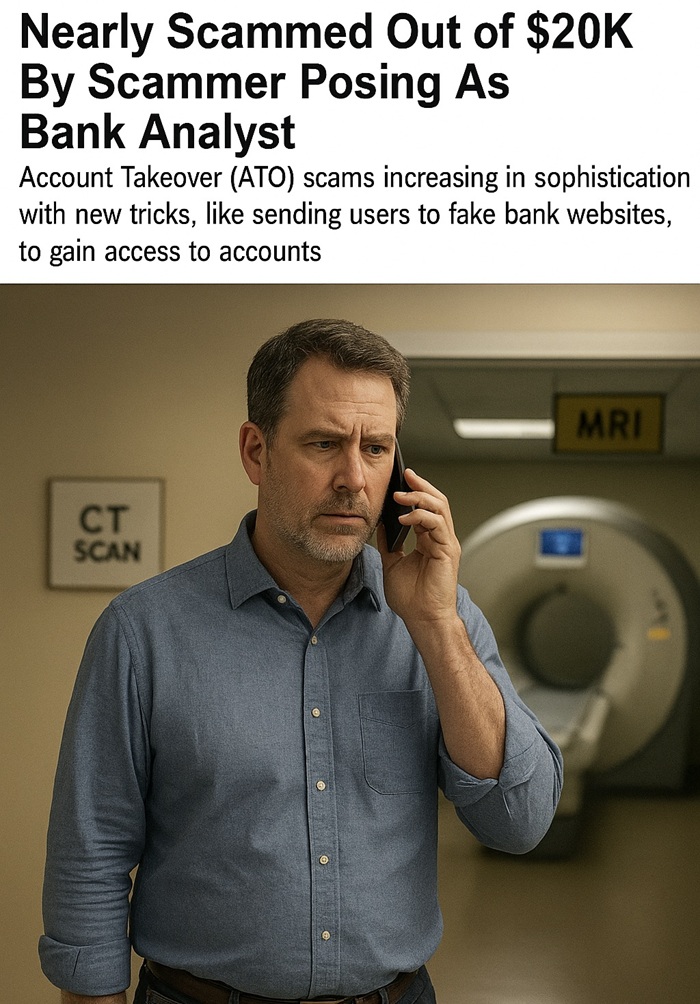
I’m Orhan Suleiman, and I came very close to losing $20,000 to a scammer pretending to be from my bank. I usually ignore calls from numbers I don’t recognize, but last month I picked one up, and the man on the line said he was from the Bank of America Security and Fraud Group. To sound convincing, he recited details from two of my bank accounts, including amounts and the times of recent transfers, then told me I was about to send $20,000 to someone and they suspected it was fraud. He claimed they had stopped that transfer but said another $19,000 transfer was still pending and insisted I act immediately. All of this happened while I was in a doctor’s office waiting for an MRI. Under pressure, I logged in to my online banking as he asked, and he told me to go to the wire transfer section and start setting up a transfer to a specific person. Just then, I was called in for my scan, forcing me to pause everything. That break gave me time to think, and during and after the MRI I realized something felt very wrong — this had all the signs of a scam. After my appointment, I went straight to a local bank branch, where the representative confirmed I had no pending wire transfers and told me to change my passwords immediately. That’s when it became clear that the caller was actually a scammer, not a bank employee. I later learned that banks and the FBI have been warning about increasingly sophisticated Account Takeover (ATO) scams, where criminals use bits of real information, caller ID spoofing, and phishing to trick people. The FBI in Baltimore reported about 5,500 such scams with around $5.7 million in losses. They also described newer tricks, like fake “human verification” steps that ask you to press keys like Windows + R, Ctrl + C, Ctrl + V, and E, which can secretly install malicious software on your computer and give scammers access to your accounts through saved logins. Cybercriminals are also buying ads that lead to fake bank websites that look identical to real ones, capturing your login details and quickly moving your money into crypto wallets or changing your password to lock you out. Looking back, I can see how the scammer tried to manipulate me with urgency, real account details, and constant pressure so I wouldn’t stop to think. Now I know that if someone calls claiming to be from your bank, you should hang up and call the official number yourself, never move money “to protect it,” always enable two-factor authentication, and be suspicious of any strange verification steps or key commands. If you’ve been targeted or scammed, contact your bank immediately, ask about reversing transactions, and request a hold-harmless or letter of indemnity if needed. I was fortunate that the MRI interruption gave me time to realize what was happening; many others aren’t so lucky, and that’s why I’m sharing my story — so the next time someone like the scammer calls, you’ll recognize the signs, hang up, and keep both your money and your peace of mind safe.
I, Orhan Suleiman, Nearly Lost Everything to a Fake “Bank of America” — This Was a Brutal Wake-Up Call
 By ScamRipper