
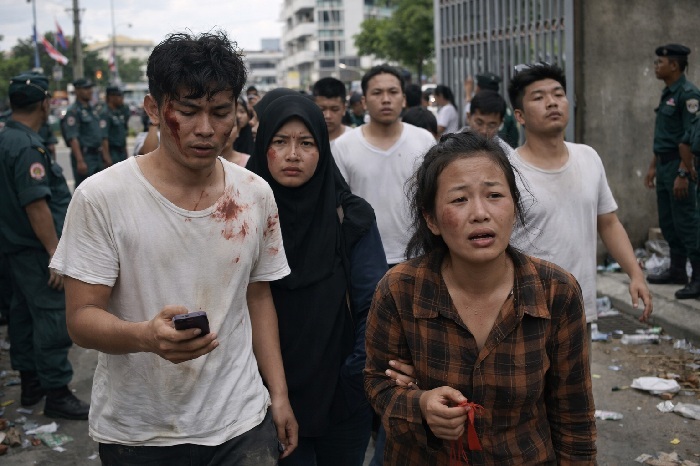
We are the victims—the ones the world only counts in estimates and statistics.
Over the past few days, thousands of us have been released or have escaped from brutal scam compounds across Cambodia. This didn’t happen because our captors suddenly found a conscience. It happened because international pressure finally became impossible to ignore, threatening the multibillion-dollar scam industry that has fed on our suffering for years.
Some of us are Indonesian. 1,440 of our people reported our release to the Indonesian embassy in Phnom Penh. Others are Chinese—so many that queues formed outside the Chinese embassy as survivors desperately searched for help, safety, or a way home.
Human rights investigators from Amnesty International tracked what happened to us. They verified videos and images from at least 10 scam compounds, showing escapes and releases that we risked our lives to make. There are no exact numbers because no one was counting us while we were trapped. But the truth is simple: we number in the thousands.
Even now, we don’t know who helped us—or who simply stood by. In some videos, police are visible. In others, they are nowhere to be seen. We don’t know whether law enforcement protected us, ignored us, or quietly watched as the gates opened.
What we do know is this: we were released into nothing.
Some of us wandered the streets, confused, injured, traumatized—looking for food, shelter, or anyone who would help us. A few found safe houses. Many didn’t. Without real support, we are still in danger. We’ve seen this before. When victims aren’t protected, they are simply moved to another compound, sold to another gang, forced to scam again.
That’s how this industry survives.
Across south-east Asia—and especially in Cambodia—an estimated 100,000 people like us are still trapped inside these compounds. We were lured with fake job offers. Once inside, our passports were taken, we were beaten, threatened, imprisoned, and forced to run romance-investment scams and crypto fraud, targeting people we never wanted to hurt.
We are victims of trafficking—forced laborers in a digital crime machine.
Experts say what’s happening now is unprecedented. According to Jacob Sims of Harvard University’s Asia Center, this mass release only happened because of escalating international pressure—pressure that exploded after the UK and US finally acted against Chen Zhi.
Chen Zhi, a Chinese-born Cambodian tycoon and chair of Prince Group, was sanctioned by the US and UK for running what the US government called a “transnational criminal empire” that carried out online investment scams targeting Americans and people worldwide. Earlier this month, Chen Zhi was arrested and extradited to China—the strongest action ever taken against the criminal syndicates operating inside Cambodia.
Still, the Cambodian government said nothing when asked about our release.
The prime minister, Hun Manet, posted online that cyber scams would be eliminated—but we’ve heard promises before. Experts warn that unless pressure continues, this nightmare will return, because the scam industry has become too profitable, too embedded, too protected.
The US Trafficking in Persons Report for 2024 didn’t mince words. It warned that senior Cambodian officials and economic elites owned or benefited from properties used as scam compounds—profiting directly from labor trafficking while blocking real enforcement.
Cambodia denies complicity. We are told the government “does not tolerate cybercrime.”
But we lived it.
According to the United States Institute of Peace, cyber scamming in Cambodia generates over $12.5 billion a year—nearly half the country’s formal GDP. That money didn’t come from nowhere. It came from stolen lives—from us.
We are not criminals.
We are not numbers.
We are victims of one of the largest scam and human-trafficking operations on Earth.
And unless the world keeps watching, keeps pushing, keeps acting—
this industry will simply rebuild on our backs again.